
Agencies | Washington :
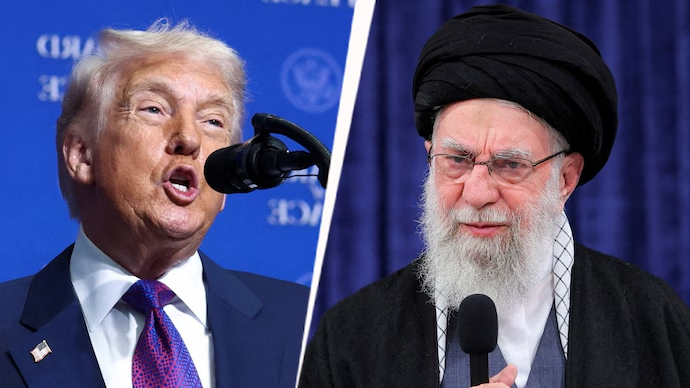
US President Donald Trump on Thursday intensified pressure on Iran, warning that Tehran must agree to a “meaningful” nuclear agreement or face serious consequences, even as indirect negotiations continue in Switzerland against a backdrop of rising military tensions in the Middle East.
Speaking at the inaugural meeting of his Board of Peace in Washington, Trump underscored that while diplomacy remains open, it will not remain so indefinitely. “We have to make a meaningful deal with Iran,” he said, acknowledging the difficulty of past negotiations. “Iran must make a deal or bad things will happen,” he added, urging Tehran to “join us on a path to peace.”
His remarks come as US and Iranian officials pursue indirect talks in Geneva aimed at defusing a deepening nuclear standoff. American envoys Steve Witkoff and Jared Kushner are engaging, through mediators, with Iranian Foreign Minister Abbas Araqchi in an effort to prevent escalation into open confrontation.
Washington is pressing Iran to significantly curb or dismantle its nuclear programme, arguing that Tehran’s uranium enrichment activities and stockpiles pose a serious proliferation risk. Iran, however, has consistently denied seeking nuclear weapons, maintaining that its programme is intended solely for civilian energy and research purposes. Tehran has also rejected calls to fully abandon enrichment, describing it as a sovereign right.
Despite hardened rhetoric on both sides, officials indicate that discussions remain active. A senior US official said Iran is expected to submit a written proposal outlining how it plans to address American concerns — a document that could determine whether negotiations advance toward a framework agreement or stall entirely.
However, diplomacy is unfolding alongside a substantial US military build-up in the region. Washington has deployed more than 50 advanced fighter aircraft — including F-22s, F-35s, and F-16s — in addition to naval assets and air defence systems. US officials describe the mobilisation as a deterrent posture designed to protect American forces and reassure regional allies.
Iran has responded with military drills and stern warnings against any potential strike on its nuclear facilities. Iranian leaders have cautioned that any attack would trigger retaliation and further destabilise the already volatile Gulf region.
Analysts describe the current moment as particularly fragile. While neither side appears eager for full-scale war, the combination of heightened military deployments and uncompromising public messaging has significantly narrowed the margin for error. Any miscalculation — whether at sea, in the air, or through regional proxies — could escalate rapidly.
Trump’s latest remarks underscore a dual-track strategy: pursue negotiations while maintaining visible military pressure. US officials argue that past diplomatic efforts faltered due to weak enforcement mechanisms and insist that the current approach is designed to ensure tangible consequences for non-compliance.
Meanwhile, Iranian officials maintain that sanctions relief and security guarantees must form part of any durable agreement. Without reciprocal steps from Washington, Tehran has signalled it will not scale back its nuclear activities.
With talks ongoing and an Iranian proposal expected soon, the coming days could prove pivotal in determining whether diplomacy prevails — or tensions edge closer to confrontation.