
Agencies | Abu Dhabi:
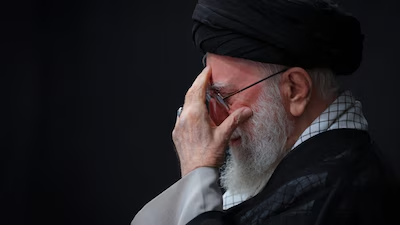
Iran’s Supreme Leader, Ali Khamenei, has died following a large-scale joint military strike by the United States and Israel, Iranian state media confirmed early Sunday. The announcement came hours after US President Donald Trump declared on social media that Khamenei was dead, calling it Iran’s “greatest chance” to “take back” the country. Iranian state television and the official news agency IRNA did not immediately specify the cause of death of the 86-year-old leader.
The assassination of Khamenei — Iran’s most powerful political and religious authority for over three decades — has thrown the future of the Islamic Republic into uncertainty, raising fears of regional instability and the prospect of a wider war. As Supreme Leader, Khamenei held final authority over all major state policies and commanded both the clerical establishment and the powerful Islamic Revolutionary Guard Corps.
Trump described the operation as a decisive blow, warning that “heavy and pinpoint bombing” would continue if necessary. He framed the strike as part of a broader effort to permanently dismantle Iran’s nuclear capabilities, despite having earlier claimed that previous US operations had crippled Tehran’s nuclear programme. The latest offensive marks a dramatic escalation in US involvement in the region and signals a sharp turn in Trump’s “America First” doctrine, which had promised to avoid prolonged foreign conflicts.
Iran swiftly vowed retaliation. Ali Larijani, Secretary of Iran’s National Security Council, warned that Israel and the United States would “regret their actions,” promising an “unforgettable lesson” in response. Tehran launched waves of missiles and drones toward Israel and targeted US military installations in Bahrain, Kuwait and Qatar. The US military reported no American casualties and minimal damage to its regional bases despite what it described as “hundreds of Iranian missile and drone attacks.”
Israeli officials said the coordinated strikes targeted Revolutionary Guard command centres, missile and drone launch sites, air defence systems and military airfields. Israel also claimed it had killed senior Iranian military leaders, including the commander of the Revolutionary Guard Corps and the country’s defence minister.
An Iranian diplomat told the United Nations Security Council that hundreds of civilians were killed or wounded in the attacks. Reports from southern Iran indicated significant civilian casualties, including at least 115 deaths after a girls’ school was allegedly struck — claims US officials said they were investigating. Additional fatalities were reported in residential areas and public facilities.
The strikes came after months of rising tensions and stalled nuclear negotiations. The Trump administration had built up one of the largest US military deployments in the Middle East in decades, citing intelligence that Iran was rebuilding critical nuclear infrastructure and had developed the capability to produce advanced centrifuges necessary for highly enriched uranium.
Democrats in Washington criticised the President for acting without formal congressional authorization, though the White House said key Republican and Democratic leaders had been briefed in advance.
Khamenei’s death creates a significant leadership vacuum in Tehran, with no publicly designated successor. As the second Supreme Leader of the Islamic Republic — succeeding Ayatollah Ruhollah Khomeini after the 1979 Revolution — Khamenei shaped Iran’s domestic and foreign policies for more than 35 years. His absence now leaves the Islamic Republic at a critical crossroads, with the potential for internal power struggles and intensified geopolitical confrontation.
Meanwhile, regional tensions have disrupted air travel across the Middle East, and air defence systems were activated in multiple cities, including Tehran and Dubai. With missile exchanges continuing into the night and civilian casualties mounting, global leaders are urging restraint to prevent a broader regional conflict.