
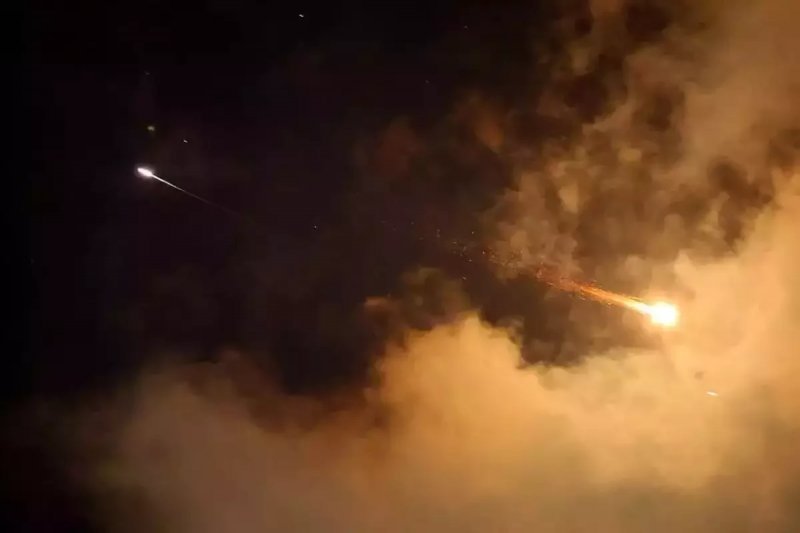
A critical United States early warning radar installation in Qatar has sustained significant damage following an Iranian strike, in what analysts describe as a serious setback to Washington’s missile defence architecture in the Gulf.
Satellite imagery obtained from Planet Labs indicates visible structural damage and firefighting activity around the site housing the US Space Force’s AN/FPS-132 (Block 5) Ballistic Missile Early Warning Radar System — one of the most powerful American-operated radar systems in the Middle East.
The installation, reportedly valued at approximately $1.1 billion, forms part of the Upgraded Early Warning Radar (UEWR) programme built by Raytheon. Designed to detect and track ballistic missiles and other aerial threats at distances of up to 5,000 kilometres, the radar provides crucial early-warning data across the Middle East, including coverage over Iran, Iraq, Syria, Turkey, parts of Central Asia, and the Indian Ocean.
Iran’s Islamic Revolutionary Guard Corps (IRGC) described the strike as a “precision missile attack.” However, other assessments suggest that a low-cost, one-way attack drone — possibly of the Shahed type — may have penetrated defences during a saturated barrage involving both missiles and drones.
The radar’s strategic importance lies in its integration within a broader US missile defence network, linking systems such as THAAD batteries, Patriot missile defences, and Aegis-equipped naval warships. By detecting launches in their earliest stages, the system provides vital minutes for interception — often the difference between a successful defence and catastrophic impact.
Military analysts caution that damage to such a high-value fixed radar could create temporary gaps in regional missile-tracking coverage. Although the United States operates a global network of satellites and supplementary radar systems, the AN/FPS-132 serves as a central node for Gulf-based operations. Large, fixed installations of this scale are complex and time-consuming to repair or replace.
Retired US Army Colonel Douglas Macgregor described the strike starkly, saying, “They took out the eyes,” underscoring the radar’s role as a surveillance cornerstone. Geopolitical analyst Brian Allen warned that parts of the US defensive grid in the Gulf may now be “operating blind,” calling the installation the “backbone” of regional missile defence.
Beyond the tactical damage, the incident carries wider strategic implications in the context of the ongoing Iran–US–Israel confrontation.
Impact on the Iran–US–Israel Conflict
The strike marks a significant escalation in the shadow war between Iran and the US-Israel alliance. By targeting a core element of American missile defence infrastructure rather than forward-operating bases or naval vessels, Tehran has signalled its capability — and willingness — to hit high-value strategic assets.
For Iran, the attack serves multiple objectives:
- Demonstrating its ability to penetrate layered air defences.
- Signalling deterrence against further US or Israeli strikes.
- Raising the operational costs of sustained American military presence in the Gulf.
For the United States and Israel, the damage could complicate short-term defensive coordination in a region already on edge. Missile defence systems such as THAAD and Patriot rely heavily on accurate early-warning inputs. Any degradation in radar data may reduce reaction time in the event of additional missile launches, particularly amid heightened hostilities.
Strategic security experts also point to the asymmetric cost dynamic underscored by the incident. While the radar system represents a billion-dollar asset, the attacking weapon — if indeed a low-cost drone was used — may have cost only a fraction of that amount. The strike highlights a defining feature of modern warfare: defenders must intercept every incoming threat, while attackers need only one successful breach to inflict substantial damage.
As tensions between Iran, the United States, and Israel continue to rise, the incident may prompt a reassessment of American force posture and surveillance deployment across the Gulf. It could also accelerate moves toward further militarisation of the Strait of Hormuz and surrounding strategic corridors critical to global energy supplies.
With regional deterrence dynamics shifting rapidly, the strike on the Qatar radar installation may mark a turning point in the evolving conflict — one that reshapes both defensive strategy and escalation thresholds in West Asia.