
Agencies | New Delhi:
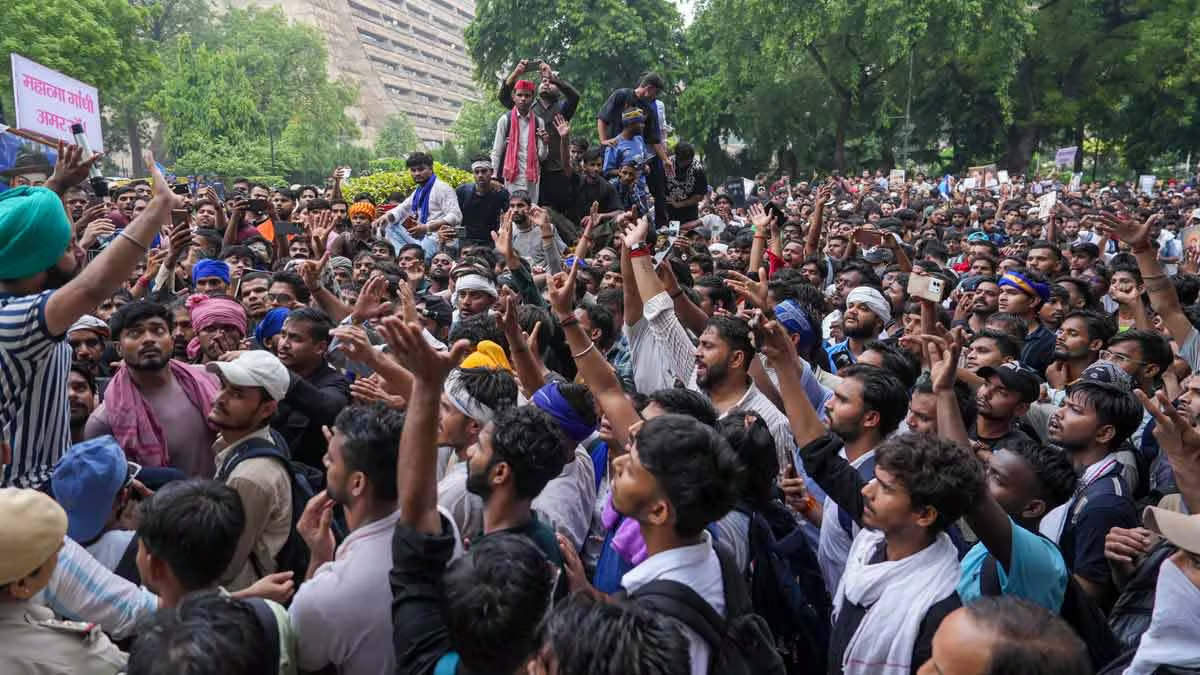
Central Delhi witnessed widespread clashes on Monday after security forces fired tear gas shells, carried out lathi charges and deployed anti-riot vehicles to disperse protesters participating in the Cockroach Janta Party’s (CJP) ‘Chalo Sansad’ march, who attempted to breach security barricades around Parliament.
The protest, held on the opening day of the Monsoon Session of Parliament, led to repeated confrontations between demonstrators and police as authorities enforced one of the largest security deployments in the national capital in recent months.
The first confrontation broke out near Jantar Mantar, where protesters breached police barricades and attempted to march towards Parliament. As the agitation intensified, demonstrators repeatedly tried to push through multiple security layers in the high-security zone, resulting in scuffles in which several protesters and police personnel sustained minor injuries.
Amid the police action, the CJP claimed that its founder, Abhijeet Dipke, was detained from Jantar Mantar.
Tear gas and baton charge
Clashes spread across several parts of central Delhi, including Jantar Mantar, Constitution Club, Rail Bhawan, Shastri Bhawan, Janpath, Connaught Place and the area near the Reserve Bank of India, as thousands of protesters converged despite elaborate security arrangements.
Near Shastri Bhawan, security personnel fired tear gas shells after protesters attempted to break through barricades to continue their march towards Parliament.
With Parliament in session, security around the Parliament complex was significantly intensified. Rail Bhawan, located adjacent to Parliament, witnessed a massive deployment of Delhi Police and paramilitary personnel as demonstrators attempted to enter the high-security zone.
Visuals from the area showed police repeatedly asking protesters to disperse before resorting to tear gas and later a lathi charge after sections of the crowd attempted to force their way past barricades.
Similar scenes unfolded near the Constitution Club, where police baton-charged protesters and used tear gas to disperse demonstrators attempting to advance towards Parliament.
Another group of protesters reached the vicinity of the Reserve Bank of India, close to Parliament, where they raised slogans before security personnel used mild force to disperse them and prevent entry into the restricted area.
Heavy security across Central Vista
As the protest spread beyond Jantar Mantar, large groups of demonstrators also gathered in Connaught Place, prompting authorities to tighten security in the commercial district. Traffic along the Outer Circle came to a standstill after police halted buses and other vehicles to prevent protesters from moving further.
Authorities deployed Vajra anti-riot vehicles, water cannons and rapid response teams at key locations, including Rail Bhawan, Shastri Bhawan, Constitution Club, Janpath and Connaught Place, to contain the march.
Several commuters were stranded after access to nearby Delhi Metro stations was restricted and some station gates were temporarily closed as a precautionary measure. Security was also stepped up at Metro stations across the New Delhi district.
The Parliament complex and the Central Vista corridor were effectively sealed off, with public movement restricted and traffic suspended across the stretch leading to Parliament.
Protesters also alleged that internet and mobile connectivity around the protest sites had been disrupted due to the use of signal jammers, although there was no official confirmation of the claim.
Protest over NEET row
The CJP organised the ‘Chalo Sansad’ march from Jantar Mantar to Parliament to demand education reforms and seek the resignation of Union Education Minister Dharmendra Pradhan over alleged irregularities in the NEET examination. The protest coincided with the opening day of the Monsoon Session.
Ahead of the march, Delhi Police had implemented an extensive security plan, deploying more than 5,000 Delhi Police and paramilitary personnel across the New Delhi district. More than 25 battalions of the Central Armed Police Forces (CAPF), including women personnel, were stationed at strategic locations.
According to sources, the New Delhi district was divided into 15 security sectors, each supervised by senior officers, while intelligence agencies and the Delhi Police Special Branch monitored crowd movement through hourly updates to facilitate real-time deployment.
Meanwhile, the CJP claimed that the Centre had agreed to hold talks with the protesters and that it had sought a meeting with the government to discuss its demands. However, there was no official confirmation from the Centre regarding any such engagement. (Inputs from different agencies)