
Examiner Bureau | Wishangton :
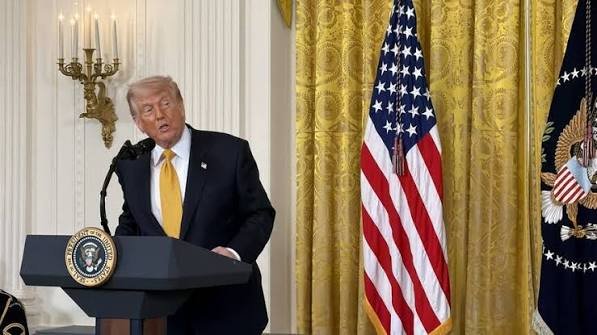
US President Donald Trump on Wednesday claimed that the United States has “total control” over the strategically vital Strait of Hormuz, signalling that Washington intends to maintain its grip over the key waterway amid escalating tensions with Iran.
In a statement, Trump said, “The U.S.A. has total control over the Strait of Hormuz. I THINK WE WILL KEEP IT!”
Trump also praised the US naval blockade, describing it as a “WALL OF STEEL” and asserting that Iran had little ability to challenge American control of the maritime passage.
The US president launched a broad attack on Iran’s military and economic condition, accusing Tehran of being “devious negotiators” and portraying the country as increasingly weakened.
Trump claimed that Iran no longer had an effective navy or air force and alleged that some of its remaining military personnel were unpaid. He further claimed that the Islamic Revolutionary Guard Corps (IRGC) had been “decimated and fleeing”.
He also questioned the stability of Iran’s leadership and its financial position, saying the country had no money.
Trump described Iran as “shot” and criticised what he portrayed as the country’s economic crisis, referring to what he called “300% inflation”. He declared that Iran was no longer “the Bully of the Middle East” and ended his statement with the words, “Praise be to Allah!”
Iran Rejects Ceasefire Extension Talks
Trump’s remarks came as diplomatic efforts to ease tensions between Washington and Tehran appeared to face another setback.
A senior Iranian source told Reuters on Wednesday that Iran and the United States had held no discussions over extending a ceasefire.
The source said Tehran did not recognise any period that could be extended, arguing that the interim arrangement had never properly come into effect.
The comments followed a report by Turkey’s Anadolu news agency, citing Pakistani government sources, that Iran and the United States had agreed to extend a 60-day ceasefire under an interim agreement reached in June.
Iran rejected that account.
“There is no talk of an extension because, from Iran’s perspective, there is no period that began and therefore nothing to extend,” the Iranian source told Reuters.
Tehran Accuses Washington of Violating Agreement
The Iranian source also accused the United States of violating the interim agreement shortly after it was reached.
“The United States violated the interim agreement 48 hours after it was reached and withdrew from it a few days later,” the source alleged.
The claim directly contradicts reports suggesting that Washington and Tehran had agreed to prolong the ceasefire, underscoring the deep disagreement between the two sides over the status of the arrangement.
Strait of Hormuz at Centre of Tensions
The Strait of Hormuz remains at the centre of the confrontation because of its strategic importance to global energy and maritime trade. Any prolonged disruption in the waterway could have significant consequences for international shipping and energy markets.
Trump’s assertion that the US has “total control” of the strait, coupled with his praise for the naval blockade, signals a hardening US position as diplomatic efforts continue.
For its part, Tehran has rejected claims that a ceasefire extension has been agreed and maintains that Washington violated the interim arrangement.
The conflicting positions highlight the difficulties facing mediators seeking to reduce tensions between the two countries. With Washington insisting on its military leverage and Tehran rejecting the reported ceasefire extension, efforts to establish a durable framework for de-escalation remain uncertain.