
Agencies | Washington:
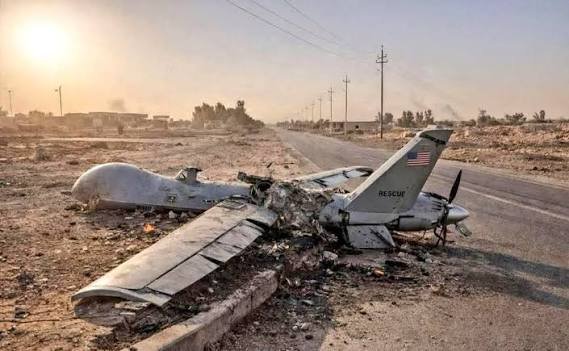
The United States has lost at least 45 MQ-9 Reaper surveillance and strike drones during its war with Iran, potentially costing taxpayers more than $1.3 billion, according to a report by The Washington Post citing US officials.
The losses represent roughly a quarter of the US Reaper fleet and highlight the growing cost of sustained drone and precision-strike operations during the conflict. The reported losses also come at a time when Washington is facing wider concerns over depleted stocks of precision weapons and the lengthy process required to replenish them.
Not all of the Reapers were destroyed by enemy action. According to the newspaper, a US official said some drones crashed after losing communications links with their operators, while several others were reportedly shot down.
The United States had approximately 185 MQ-9 Reapers when the conflict began on February 28, including around 165 operated by the US Air Force and 20 by the Marine Corps, the report said. None of the Marine Corps-operated Reapers, which are generally deployed in the Asia-Pacific region, were reported lost.
Manufactured by General Atomics, the MQ-9 Reaper is one of the US military’s most widely used remotely piloted aircraft. It combines long-endurance surveillance capabilities with the ability to conduct precision strikes.
The aircraft entered US service in 2007 and has subsequently played a major role in American military operations in Afghanistan, Iraq and the broader Middle East, as well as counterterrorism campaigns.
A Reaper is estimated to cost approximately $30 million to $50 million, depending on its configuration, sensors and weapons. The overall cost can be considerably higher when associated ground-control stations, satellite communications systems, weapons and other support equipment are included.
The reported losses therefore extend beyond the price of the aircraft themselves. Replacing a significant number of sophisticated unmanned systems also involves production capacity, trained personnel, communications infrastructure and the time required to integrate new platforms into operational units.
According to The Washington Post, several of the Reapers were shot down while operating primarily over the Strait of Hormuz, a strategically important waterway connecting the Persian Gulf with the Gulf of Oman.
US officials were reportedly surprised by the precision of some of the attacks, raising questions about the effectiveness of Iranian air-defence capabilities against relatively expensive unmanned aircraft.
The losses could have implications beyond the immediate conflict. Reapers are used not only for strike missions but also for intelligence, surveillance and reconnaissance. Sustained losses can therefore reduce the number of platforms available to monitor large areas and support other military operations.
The episode also illustrates a broader challenge facing modern militaries: highly capable unmanned aircraft can provide persistent surveillance and precision-strike capabilities, but they remain vulnerable when operating in heavily defended airspace.
The Reaper losses have emerged alongside growing reports about pressure on American stocks of precision-guided weapons.
Several US media reports have suggested that Washington has used substantial quantities of expensive long-range munitions during the conflict with Iran. Reuters reported earlier this month that virtually all of some high-cost weapons, each potentially valued at more than $1 million, had been depleted during the nearly six-month conflict.
The reports have intensified debate over the United States’ ability to sustain prolonged high-intensity warfare while simultaneously maintaining readiness for other potential conflicts.
Unlike relatively simple conventional weapons, sophisticated missiles, interceptors and unmanned aircraft often require complex supply chains and specialised manufacturing facilities. Expanding production capacity can take years, particularly when demand rises sharply during wartime.
The Trump administration is seeking congressional support for a $67 billion war funding package, with officials warning that rebuilding stocks of munitions, missile interceptors and drones could take years.
The reported Reaper losses could add to that financial burden. Even if the aircraft themselves are replaced relatively quickly, the broader process of restoring the operational capacity lost during the conflict would involve replacing sensors, weapons, communications equipment and other associated systems.
The issue also raises questions about the economics of drone warfare. Reapers are significantly cheaper than many manned combat aircraft, while allowing operators to conduct long-duration surveillance and strike missions without putting a pilot physically inside the aircraft.
However, the loss of dozens of platforms in a relatively short period demonstrates that unmanned systems are not necessarily inexpensive or expendable when equipped for sophisticated military operations.
The reported losses could prompt the Pentagon to reassess how it employs large unmanned aircraft in contested airspace.
For years, platforms such as the MQ-9 have been particularly effective in environments where adversaries lacked sophisticated air-defence systems. The experience in Iran, however, points to the limitations of such aircraft against opponents capable of detecting, tracking and engaging them.
Future operations could place greater emphasis on electronic warfare, stealthier unmanned systems, stand-off weapons and networks of smaller drones operating alongside traditional aircraft.
The conflict may also accelerate investment in more survivable unmanned platforms designed specifically for contested environments.
For Washington, the immediate challenge is to balance operational requirements in the current conflict with the need to preserve military readiness elsewhere. Replacing 45 Reapers is only one part of that equation. Rebuilding missile inventories, air-defence interceptors and other critical weapons could prove far more difficult and expensive.
The Pentagon has declined to comment on the reported Reaper losses, according to The Washington Post. Consequently, the precise number of drones lost, the circumstances of individual incidents and the total financial impact remain subject to further confirmation.
Nevertheless, the reported figures underscore a significant reality of modern warfare: even technologically advanced militaries can face substantial financial and operational costs when high-value systems are deployed repeatedly against a capable and well-defended adversary.