
By | Syed Salman:
Jammu and Kashmir is witnessing a rapid expansion of infrastructure and economic activity, with roads, highways, hydropower projects, mining, tourism infrastructure and urban development reshaping landscapes across the Union Territory. While these projects are important for connectivity, energy security, employment and economic growth, they are also raising a critical question: how much pressure can the region’s fragile mountain ecosystems absorb?
The issue becomes particularly significant in the Himalayan context, where steep slopes, young geological formations, fragile soils, rich biodiversity and climate-sensitive ecosystems make the region naturally vulnerable to landslides, floods, erosion and habitat fragmentation.
The concern is not that development itself is undesirable. Rather, the challenge is to ensure that development does not progressively weaken the ecological systems on which communities, agriculture, tourism and even infrastructure ultimately depend.
Increasing mining and extraction of construction materials have emerged as an important environmental concern. Stone quarrying, sand and mineral extraction can alter riverbeds, destabilise slopes, remove vegetation and increase soil erosion when undertaken without adequate safeguards.
Riverine mining is particularly sensitive because rivers in the Himalayan region are not merely channels carrying water. Their banks and adjoining ecosystems support vegetation, aquatic life and wildlife while also helping regulate sediment movement.
Unregulated or poorly managed extraction can disturb these natural processes and potentially increase the vulnerability of downstream areas to erosion and flooding.
Jammu and Kashmir has significant hydropower potential, and a number of power projects have been planned, constructed or expanded to meet growing energy requirements.
Hydropower can provide renewable electricity and contribute to economic development. However, large infrastructure projects in mountainous terrain involve tunnelling, excavation, blasting, construction of roads and transmission infrastructure and the movement of heavy machinery.
These activities can disturb slopes and forests, particularly when construction takes place in ecologically sensitive areas.
The cumulative impact of several projects within the same river basin also deserves greater attention. A project-by-project assessment may not always capture the combined effect of roads, tunnels, dams, transmission lines, quarrying and construction activity on an entire ecosystem.
Road development is another major driver of change.
The expansion and widening of highways and rural roads has transformed connectivity across Jammu, Kashmir and the higher mountain regions. Better roads are essential for economic development, tourism, emergency services and access to markets and healthcare.
But road construction in mountainous areas frequently involves cutting hillsides, removing vegetation and disturbing natural drainage channels.
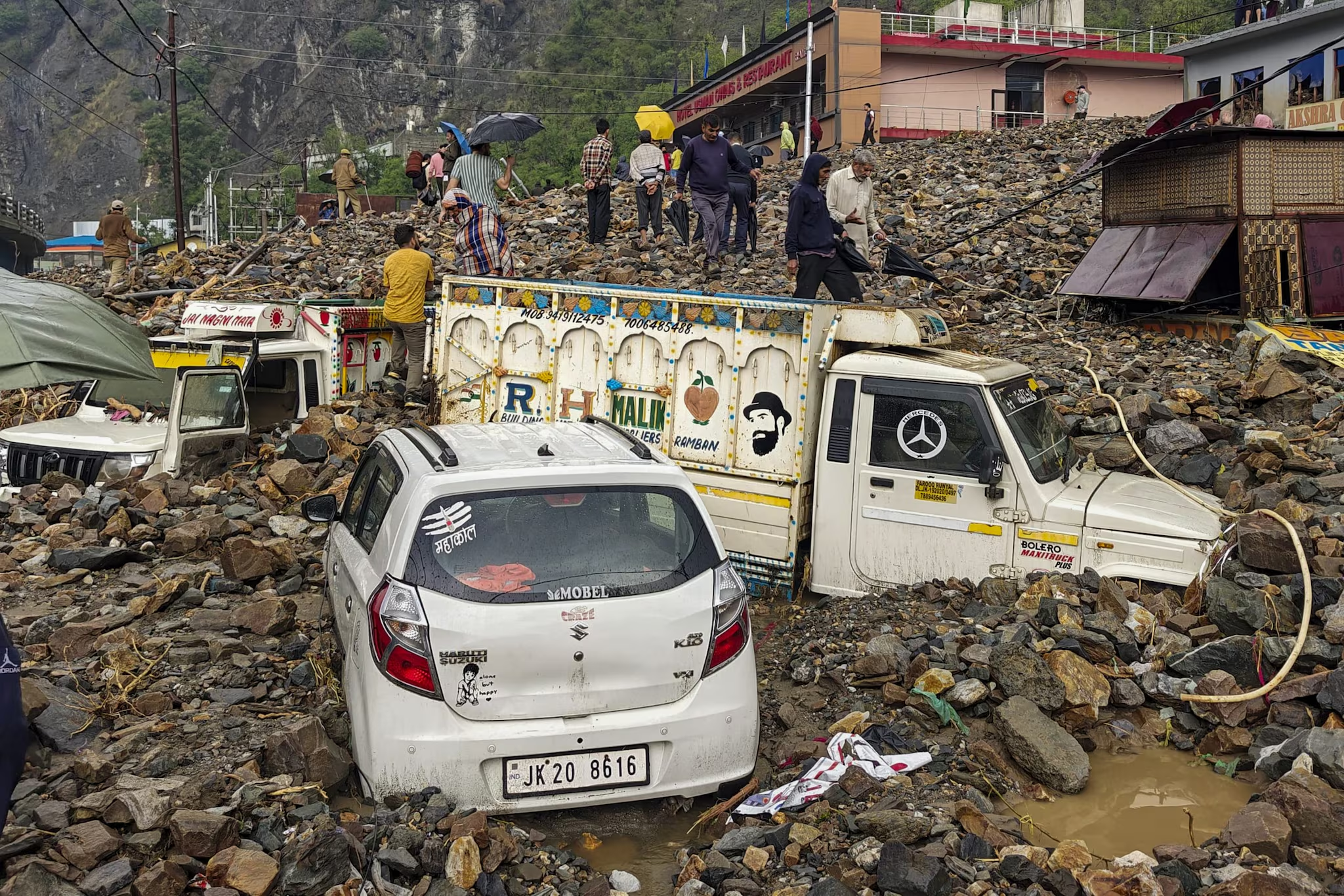
The consequences can become particularly visible during intense rainfall, when weakened slopes are more susceptible to landslides, rockfalls and erosion. Repeated road damage caused by extreme weather can, in turn, require further excavation and reconstruction, creating a cycle of environmental disturbance.
Jammu and Kashmir is home to diverse wildlife, including Himalayan species that depend on relatively undisturbed forests and mountain habitats.
As roads, buildings, power infrastructure, tourism facilities and other human activities expand, previously connected habitats can become fragmented.
For wildlife, a forest is not simply a collection of trees. Animals require movement corridors to find food, water, shelter and breeding grounds. Roads and other infrastructure can interrupt these routes, increasing the possibility of human-wildlife conflict and restricting animal movement.
The impact may be gradual and therefore difficult to detect immediately. A forest can remain visually intact while its ecological connectivity is slowly weakened.
Tourism is one of Jammu and Kashmir’s most important economic sectors, but rapid and concentrated tourism can also create environmental pressures.
The expansion of hotels, homestays, parking areas, roads, commercial establishments and other facilities increases demand for land, water, electricity and waste-management systems.
Popular destinations can face pressure from traffic congestion, solid waste, sewage generation and unplanned construction.
The challenge is particularly acute in areas where the local infrastructure was originally designed for much smaller populations.
Environmental pressure cannot be viewed separately from climate change.
Jammu and Kashmir has experienced episodes of intense rainfall, cloudbursts, flash floods, landslides and other extreme weather events. When natural hazards interact with disturbed slopes, deforestation, construction and inadequate drainage, the consequences can become more severe.
This means environmental protection is not merely about conserving forests and wildlife. It is increasingly becoming a question of protecting infrastructure and human settlements themselves.
A road built without adequate slope protection may become vulnerable to landslides. A settlement developed too close to a river may face flooding. A project constructed without sufficient drainage may experience serious damage during extreme rainfall.
One of the biggest questions for policymakers is whether individual environmental clearances are sufficient for a region experiencing multiple simultaneous development pressures.
A road project may appear manageable by itself. A hydropower project may also meet its individual requirements. Mining activity may be assessed separately. Tourism expansion may be treated as another issue.
But what happens when all of these activities take place within the same landscape?
This is where cumulative environmental assessment becomes important.
Instead of examining projects only individually, authorities need to evaluate their combined impact on river systems, forests, wildlife corridors, groundwater, slopes and local communities.
Jammu and Kashmir cannot—and should not—remain isolated from economic development.
Modern roads, reliable electricity, telecommunications, tourism facilities, healthcare infrastructure and employment opportunities are necessary for improving people’s quality of life.
The real challenge is therefore not development versus environment, but responsible development versus unsustainable development.
Stronger environmental monitoring, scientific zoning, protection of wildlife corridors, responsible mining practices, slope stabilisation, improved drainage systems, proper waste management and stricter enforcement of construction norms can help reduce ecological risks.
Local communities also need a greater role in environmental decision-making because they are often the first to experience the consequences of landslides, flooding, water shortages, wildlife conflict or degradation of natural resources.
The question confronting Jammu and Kashmir is no longer whether development should take place. It is how development should take place in one of the most ecologically sensitive mountain regions of the country.
Mining, hydropower projects, highway expansion, tourism, urbanisation and other human activities will continue to grow as the region’s economy expands. But every new project also adds another layer of pressure to an ecosystem already exposed to climate variability and natural hazards.
The future therefore demands a more integrated approach—one in which economic growth, infrastructure development and ecological protection are planned together rather than treated as competing objectives.
For Jammu and Kashmir, the warning is clear: the mountains can support development, but only if development respects the limits of the mountains.