Examiner News Desk | Srinagar:
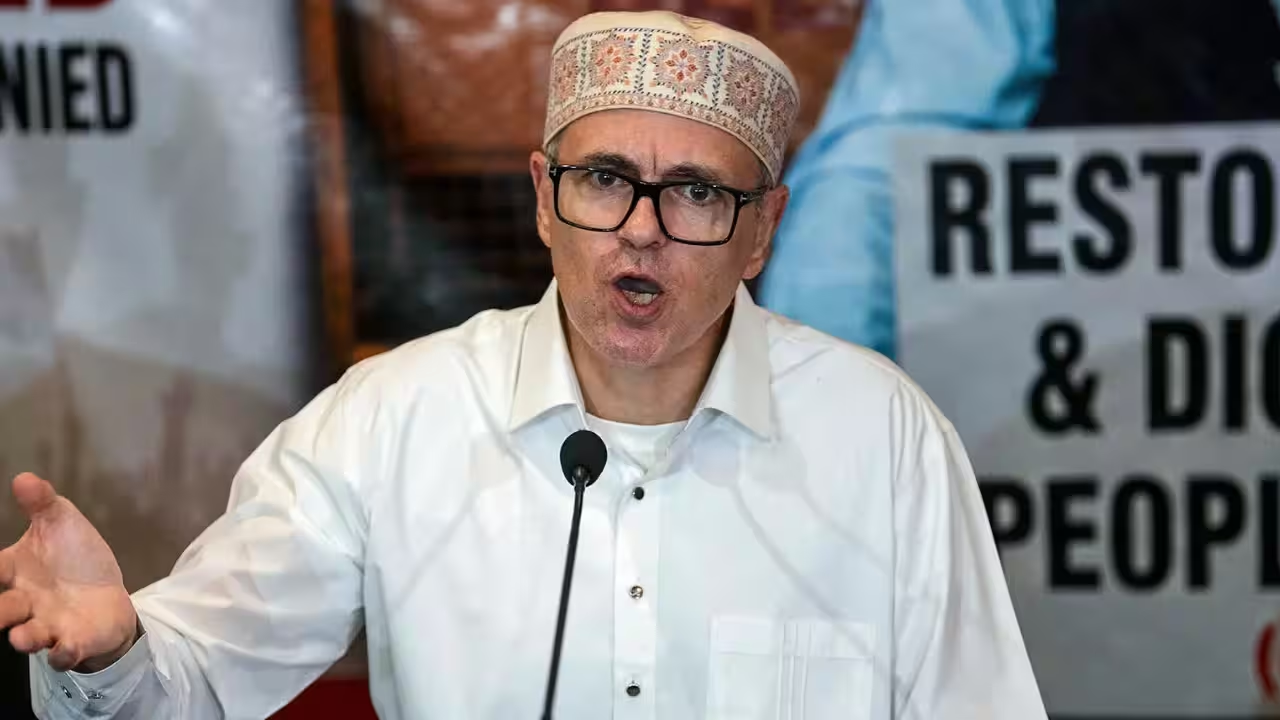
Power corridors in Srinagar and Jammu are buzzing with anticipation as Chief Minister Omar Abdullah confirmed that the long-awaited expansion and portfolio reshuffle of the Jammu and Kashmir Council of Ministers is a “work in progress.” However, putting an end to immediate speculation, the Chief Minister signaled that no new inductions will take place before Independence Day.
The upcoming expansion is seen as a crucial balancing act for the ruling National Conference (NC)-led government, which must weigh regional representation, factional expectations, and strategic alliance dynamics.
The Numbers Game: 3 Vacancies, Heavy Portfolios
Under the provisions of the Jammu & Kashmir Reorganisation Act, 2019, the Council of Ministers is capped at 10 percent of the 90-member Legislative Assembly, allowing for a maximum of nine ministers, including the Chief Minister.
Currently, the government functions with just six cabinet members, leaving three crucial berths vacant. As a result, several ministers are handling exceptionally heavy portfolio loads:
Existing Council of Ministers & Portfolios
- Omar Abdullah (Chief Minister): Holds all unallocated departments, including General Administration, Home, Planning, Finance, and Information.
- Surinder Kumar Choudhary (Deputy CM – JKNC): Public Works (R&B), Industries & Commerce, Mining, Labour & Employment, Skill Development.
- Sakina Itoo (JKNC): Health & Medical Education, School Education, Higher Education, Social Welfare.
- Javid Ahmad Dar (JKNC): Agriculture Production, Rural Development & Panchayati Raj, Cooperatives, Election.
- Javed Ahmed Rana (JKNC): Jal Shakti, Forest, Ecology & Environment, Tribal Affairs.
- Satish Sharma (Independent): Food, Civil Supplies & Consumer Affairs, Transport, Science & Technology, IT, Youth Services & Sports.
Insiders note that Chief Minister Abdullah, who currently holds major portfolios like Home, Finance, and General Administration, is looking to lighten his administrative burden and streamline governance across key infrastructure and social sector departments.
The Contenders: Who Will Secure a Cabinet Seat?
With three slots up for grabs, intense lobbying has intensified across party lines and regional divisions.
The Congress Dilemma
The Indian National Congress (INC), which won six assembly seats and supports the coalition, had initially decided to stay out of the ministry as a protest over the delay in restoring statehood to J&K.
However, political observers suggest that if the Congress leadership alters its stance to strengthen governance participation, top leaders such as J&K Congress chief Tariq Hameed Karra or veteran leader Ghulam Ahmad Mir (Dooru MLA) could be inducted into high-profile portfolios. Should Congress maintain its boycott of cabinet positions, the NC leadership will absorb all remaining seats.
National Conference Front-Runners
Within the ruling NC, senior party veterans and influential regional leaders are vying for inclusion to ensure geographical parity between the Jammu region and the Kashmir Valley:
- Srinagar & Central Kashmir: Senior parliamentarian and NC stalwart Ali Mohammad Sagar (Khanyar) remains a top contender to ensure strong representation for the summer capital. Additionally, key figures linked to prominent religious-political families, including representatives supported by MP Mian Altaf Ahmad, are in active discussion.
- North Kashmir Representation: Veteran leaders like Saifullah Mir (Trehgam) and former minister Chowdhury Mohammad Ramzan are seen as strong claimants to give North Kashmir a prominent voice in the executive cabinet.
- South Kashmir & Allies: Senior NC figures alongside party advisor Nasir Aslam Wani—should an appropriate legislative route open—remain central to the political math.
Independent MLAs Push for Inclusion
Independent legislators who extended crucial post-election support to the NC coalition—including Inderwal MLA Pyare Lal Sharma and Chhamb MLA Satish Sharma (already inducted)—are pressing for direct executive oversight. Independent MLAs argue that cabinet representation is essential to fast-track development work in overlooked border and hilly constituencies.
Political analysts view the impending reshuffle as more than an administrative routine. With public expectations high following the return of an elected assembly, the expansion after August 15 will test Omar Abdullah’s ability to maintain party unity, satisfy regional ambitions, and deliver efficient governance.
All eyes now remain on Lok Bhavan and the Chief Minister’s Secretariat as the countdown to the cabinet expansion begins.