
Examiner News Desk | Srinagar:
Jammu and Kashmir Chief Minister Omar Abdullah on Friday raised concerns over reported threats to Kashmiri Pandit employees working in the Valley, while reiterating that the campaign for restoration of statehood would continue until the Centre fulfils its commitment.
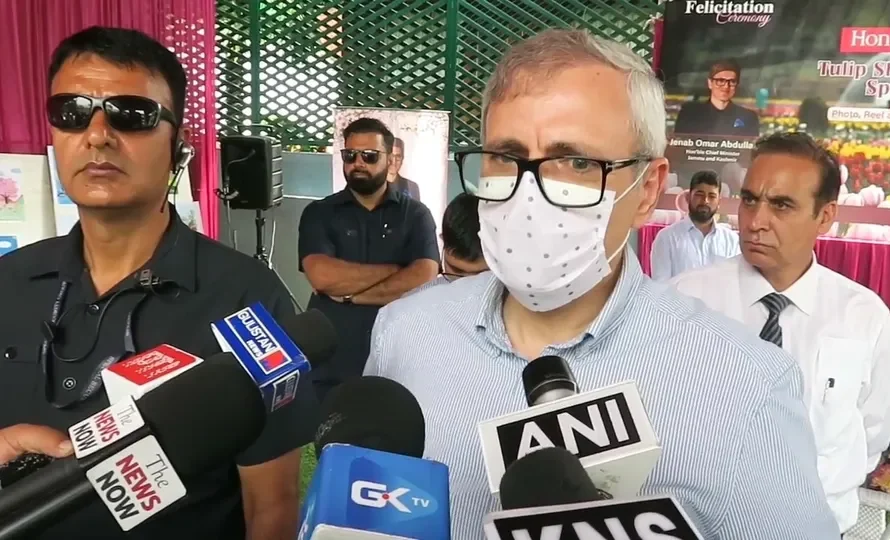
Speaking to reporters, Abdullah said security agencies must not underestimate threats against Kashmiri Pandit workers, particularly in view of targeted killings witnessed in Jammu and Kashmir in the past.
“We have been hearing time and again that militancy has ended in J-K, that now no one is left. But then this threat comes, so where is this threat from?” Abdullah said, urging those responsible for security arrangements to take the matter seriously.
The Chief Minister called for action against those behind the reported threats and stressed the need for adequate security arrangements for Kashmiri Pandit employees posted in the Valley.
He recalled the targeted killings of members of the minority community in previous years, saying the incidents had created fear among employees and prompted many to consider leaving Kashmir.
“One or two years ago, targeted killings happened, particularly against the minority community. How many names should I take of those who were targeted?” Abdullah said.
He said the government and security agencies should ensure that employees are not again placed in a situation of fear and insecurity.
“So, this threat should not be taken lightly. Action should be taken against the people behind this. And full security arrangements should be kept for these people,” he said.
On the demand for restoration of statehood, Abdullah said the Jantar Mantar protest was only the beginning and not the conclusion of the campaign.
“This is not the end. This is just the start of the restoration,” he said.
Asked about reports that the National Conference may organise a long march over the issue, the Chief Minister said several options were being considered.
“There are many options. Now, apparently, I hear my party is planning a long march. That’s a good thing. It’s not a wrong thing,” he said.
Abdullah said the Centre must be reminded of the commitment made by Prime Minister Narendra Modi regarding restoration of statehood to Jammu and Kashmir.
“The country needs to remember that we were promised. And it wasn’t a normal promise. It was a promise of Modi,” he said.
Describing the commitment as a “super promise”, Abdullah questioned why it had not yet been implemented.
“Why hasn’t this super promise been fulfilled yet? We are not getting an answer to this,” he said.
The Chief Minister maintained that he would continue to raise the issue politically and would not remain silent until statehood is restored.
“We will keep discussing this topic again and again. Neither will I remain silent on this topic. We will keep talking,” he said.
Abdullah also spoke strongly about Jammu and Kashmir’s water resources while commenting on the Indus Waters Treaty, arguing that the region should have greater rights over the rivers flowing through its territory.
“This is our blood that has been sucked. These are our rivers. We had the first right to this,” he said.
Referring to Pakistan’s claims of sympathy for Kashmiris, Abdullah said such sentiments were absent when it came to the region’s water resources.
“Pakistanis say that they are very sympathetic to Kashmiris. But when it comes to water, their sympathy disappears,” he said.
He pointed to restrictions that, according to him, had affected Jammu and Kashmir’s ability to fully utilise rivers such as the Chenab for drinking water, power generation and navigation.
“We could not get drinking water from Chenab. We could not make a dam on Tulbul and use it for navigation. We could not make a big dam on any of our rivers and stop the water,” Abdullah said.
He said the suspension of the Indus Waters Treaty should provide Jammu and Kashmir with an opportunity to make greater use of its water resources, particularly for development and power generation.
Abdullah also condemned the reported attack on Shiromani Akali Dal leader Sukhbir Singh Badal, stressing that political disagreements should never be settled through violence.
“There is no need for such things in a democracy. If you are angry with someone, you can express your anger in an election. Attacking is very dangerous for a democracy,” he said.
Questioning the security arrangements around Badal, who is accorded Z-plus security, Abdullah asked, “But where is the Z-plus?”
He said Badal was injured in the attack and had to be taken to hospital for treatment.
The Chief Minister’s remarks touched upon three issues with direct implications for Jammu and Kashmir—security of vulnerable communities, restoration of statehood and greater utilisation of the region’s natural resources—while his condemnation of the attack on Badal underscored his broader call for political disagreements to remain within democratic institutions.