Examiner Bureau | Srinagar:
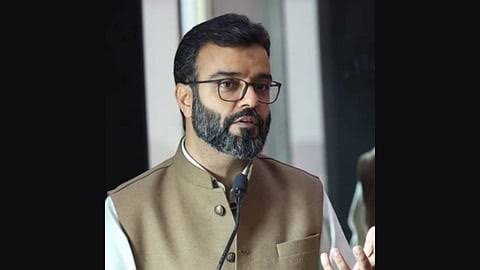
National Conference (NC) MP from Srinagar, Aga Ruhullah Mehdi, on Sunday said Jammu and Kashmir had continued to lose political powers over the years, while its political leadership had failed to reclaim them.
Speaking to reporters during an interaction in Baramulla, Ruhullah said his remarks were not aimed at any particular individual or political party, but reflected his assessment of the broader political situation in Jammu and Kashmir.
“J&K has always lost things and not gained, from statehood to Article 370. Politically, J&K has not gained anything right from the outset,” he said.
Ruhullah also questioned the National Conference’s approach after the party came to power, alleging that its position on the rights lost after 2019 had changed.
He said people had voted for the NC in the 2024 Assembly elections on the basis of commitments made regarding the restoration of Jammu and Kashmir’s political rights.
“I ask only for the rights which we told people during election campaigning. It is the party’s words too and not mine alone. Kashmiris put trust in NC on the rights lost after 2019,” he said.
The Srinagar MP stressed that raising such concerns should not be viewed as an act of opposition to the party. He argued that elected representatives must have the freedom to question decisions and policies if they believe political commitments are not being pursued.
“Why can’t I raise issues against the party? We are not slaves of the party. We can raise genuine questions if the party is not on the track,” he said.
Ruhullah maintained that political parties ultimately remain accountable to the electorate and cannot place themselves beyond public scrutiny.
“Parties are accountable to people, not above questions,” he said.
His comments underline an ongoing debate within Jammu and Kashmir’s political discourse over the balance between party discipline, electoral commitments and the restoration of rights that were altered or withdrawn after 2019.
The NC MP also questioned the increasing focus on restoration of statehood, arguing that it should not be treated as the sole political issue concerning Jammu and Kashmir.
He recalled that NC vice president and Chief Minister Omar Abdullah had previously criticised an approach that focused exclusively on statehood, maintaining that the party’s political agenda extended beyond that demand.
Ruhullah said the commitments made to voters during the 2024 Assembly election campaign should continue to remain central to the political conversation.
Ruhullah’s remarks are likely to add to the wider debate over Jammu and Kashmir’s political future, particularly the questions surrounding statehood, the restoration of political powers and the commitments made by parties during elections.
While the restoration of statehood remains a major demand among mainstream political parties in J&K, Ruhullah’s comments suggest that sections within the political establishment believe the discussion must encompass a broader set of political rights and commitments.
For the Srinagar MP, questioning the party leadership is part of the democratic process rather than an act of disloyalty.
His intervention also highlights the expectations placed on elected representatives by voters who, he said, supported the National Conference on the basis of specific promises.
Ruhullah maintained that those commitments should not disappear from the political agenda and that political leadership must remain answerable to the people of Jammu and Kashmir.