
Agencies | NewDelhi:
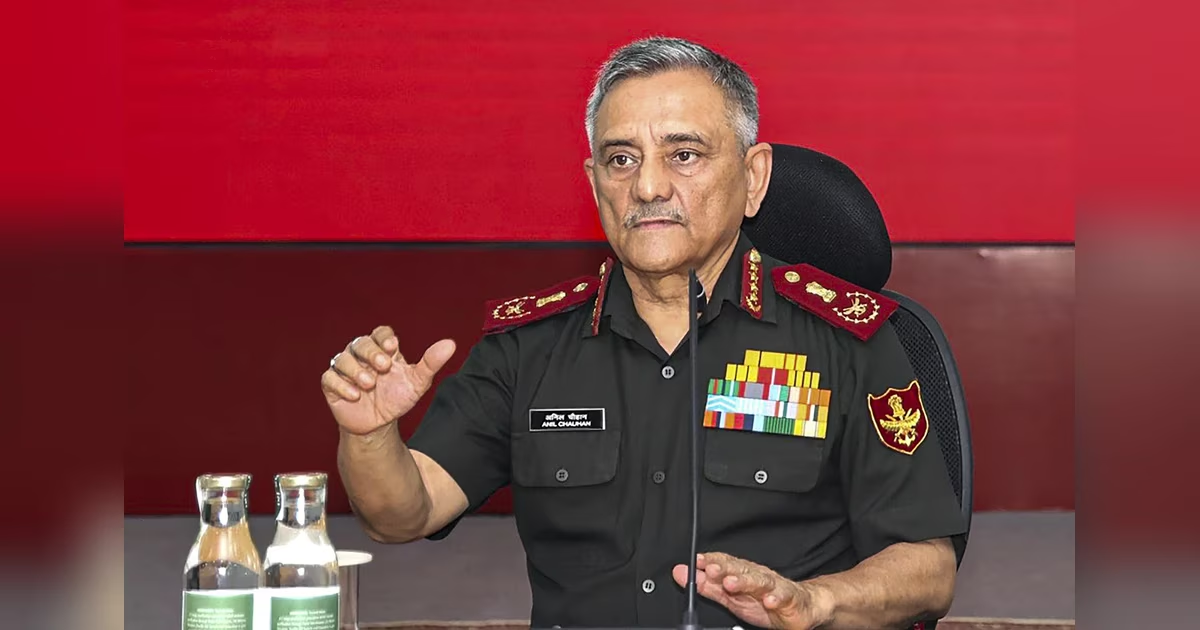
Former Chief of Defence Staff (CDS) General Anil Chauhan has disclosed that the Skardu airbase in Pakistan-occupied Kashmir (PoK) was identified as a potential target during Operation Sindoor, but adverse weather conditions prevented Indian forces from carrying out the planned strike.
Speaking at an event organised by the Vivekananda International Foundation, General Chauhan provided fresh insights into the strategic planning and decision-making process behind the operation, including target selection and subsequent modifications based on operational conditions.
According to Chauhan, the development came after Pakistan reportedly initiated contact with India seeking talks during the operation.
Recalling the sequence of events, he said that around 10 a.m., Pakistan reached out expressing a desire for dialogue. At approximately the same time, the Indian Air Force sought approval to conduct a strike on Sargodha, one of Pakistan’s key military airbases.
“Once the Pakistanis had picked up the phone and said they wanted to talk at about 10 AM, the Air Chief asked me whether he should strike Sargodha. I said, ‘Go ahead.’ I also asked him to identify two more targets, and one of the targets identified was Skardu,” Chauhan said.
The former CDS stated that Skardu airbase, located in the strategically significant Gilgit-Baltistan region of Pakistan-occupied Kashmir, was subsequently approved as a potential target. However, deteriorating weather conditions over the area compelled planners to revise the operational plan.
“We gave a yes, but after some time, the weather was bad over it and they had to change over to Bholari,” he said.
The revelation sheds new light on the scale and scope of planning undertaken during Operation Sindoor and highlights the role of real-time operational factors in military decision-making.
General Chauhan also addressed recurring speculation regarding Kirana Hills, an area often associated with Pakistan’s strategic and nuclear infrastructure.
Reiterating India’s earlier position, he said Indian forces did not target Kirana Hills during Operation Sindoor.
Backing statements previously made by then Director General of Air Operations, Air Marshal A.K. Bharti, Chauhan said the issue had resurfaced repeatedly despite official clarification.
“We have not hit Kirana Hills, whatever is there,” Chauhan said, reaffirming that the location was not among the targets selected during the operation.
He suggested that speculation may have arisen due to India’s strikes in and around Sargodha, which prompted widespread discussion regarding the extent of the operation and the nature of the targets involved.
The remarks provide one of the clearest accounts yet of the operational considerations behind Operation Sindoor, indicating that Indian military planners had evaluated multiple strategic targets before making final decisions based on evolving battlefield and weather conditions.
Chauhan’s disclosures underscore the complexity of modern military operations, where intelligence assessments, strategic objectives, diplomatic developments and environmental factors collectively influence the execution of high-stakes missions.