
Agencies | Kathmandu:
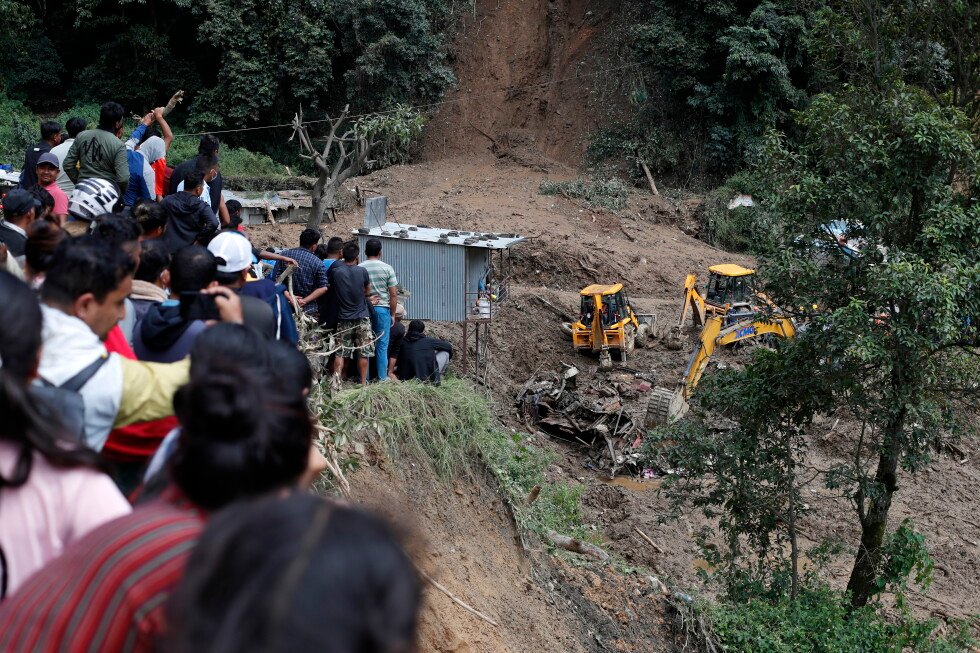
A devastating flash flood swept through Nepal’s Himalayan border region, leaving at least 165 people dead and hundreds more missing as rescue teams battled destroyed roads, bridges, communication networks and other infrastructure to reach isolated communities.
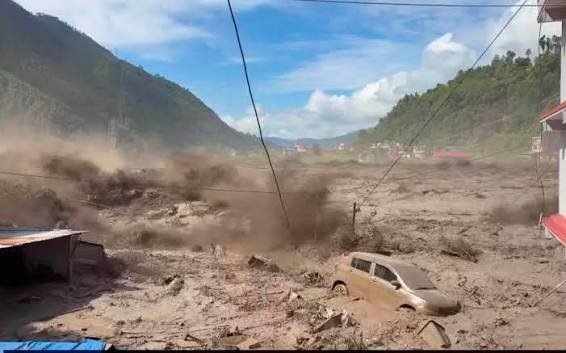
The disaster began near the Nepal-China border and sent a massive surge of mud, rocks and water downstream, causing widespread destruction across several districts. Villages were inundated, vehicles were swept away and multiple hydropower projects suffered extensive damage.
The full scale of the tragedy remains unclear as authorities continue to verify casualty figures and search for people missing on both sides of the border.
According to preliminary assessments by Nepal’s National Disaster Risk Reduction and Management Authority (NDRRMA), the disaster originated around the Lhende River along the Nepal-Tibet border.
Officials said a landslide involving ice and rock caused a sudden surge of debris-laden water. Nepal’s Foreign Minister Shisir Khanal told Parliament that a seismic event was recorded in the Tibet region at around 8:37 am local time, followed by reports of the flash flood just three minutes later.
The timing initially raised concerns that an earthquake may have triggered a glacial collapse.
However, the United States Geological Survey later indicated that the seismic signal was associated with the collapse of glacial rock and ice rather than a conventional earthquake triggering the disaster.
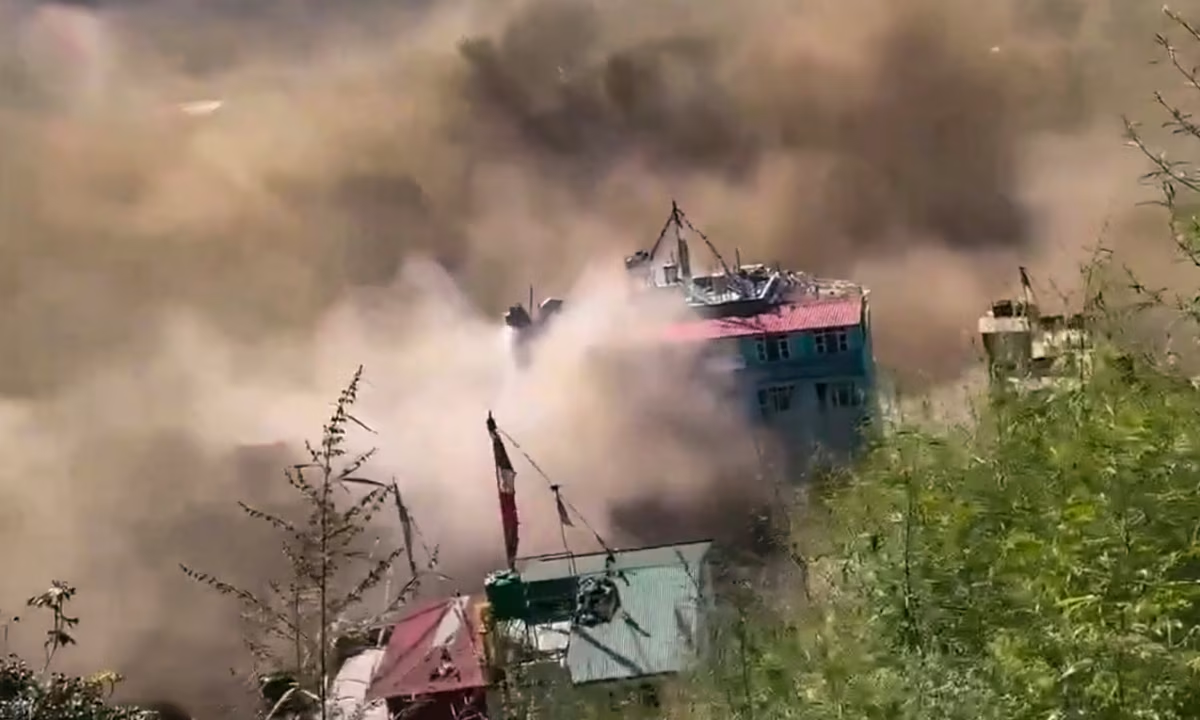
The resulting torrent of mud, rocks and water entered the Bhote Koshi River before flowing into the Trishuli River near Timure in Rasuwa district.
The devastation was particularly severe in Rasuwa and Dhading, before floodwaters travelled downstream into Nuwakot, Chitawan, Gorkha, Tanahu and Nawalparasi East.
The affected areas extend across a large stretch of central Nepal, roughly 70 to nearly 200 kilometres from Kathmandu.
The force of the flood destroyed homes, vehicles, roads and bridges. Officials said 19 motorable bridges were swept away, while the 42-kilometre road linking Betrawati in Nuwakot with the Rasuwagadhi border crossing was also damaged.
Dramatic footage from the disaster zone showed torrents of muddy water carrying huge quantities of rocks and debris through populated areas. Buildings and vehicles were swept away, while bridges collapsed under the force of the floodwaters.
“There is devastation everywhere we look,” health worker Tula Bahadur BK told Reuters, describing how settlements along the river had been swept away. He said five of his relatives remained missing.
Nepal Police has put the death toll at 162, while other official assessments have placed the overall toll at around 165. The number of missing people remains in the hundreds.
Authorities have cautioned that the figures could change as rescue teams reach remote areas and communication is restored.
On the Chinese side of the border, state media reported three deaths and 265 people missing, although those figures were still being verified.
The disaster has also raised serious concerns about Indian nationals caught in the affected region.
Officials have reported that at least 133 Indian nationals and 37 non-resident Indians are among those missing in Nepal.
The affected region is also an important route for the Kailash Manasarovar pilgrimage, which attracts Indian pilgrims during this period.
The Isha Foundation said 77 of its members who were present at an immigration centre were missing. Its founder Sadhguru said there had been no official information about their whereabouts, while 495 members had returned safely.
Several Indian states, including Tamil Nadu, Uttar Pradesh and Kerala, have activated helplines amid concerns over residents who may have been caught in the disaster.
Foreign nationals are also believed to be among those missing, including tourists and workers from countries such as the United States, United Kingdom, Malaysia, South Africa, Australia and the Netherlands.
South Korea separately reported that eight of its nationals working at a hydropower project were missing.
Nepal has mobilised the Nepal Army, Armed Police Force and Nepal Police for large-scale search-and-rescue operations.
The Nepal Army deployed 12 helicopters to affected areas. Six people were evacuated from Syaphrubesi, two from Mailung and four from Dhunche, all in Rasuwa district.
However, rescue operations have been severely hampered by destroyed roads, damaged bridges, disrupted electricity supplies and communication failures.
In some of the worst-hit areas, helicopters have also faced difficulties landing because of continuing floodwaters, unstable terrain and debris.
The Nepal Army has established an emergency treatment facility at its Military Training Centre No. 1 in Trishuli. An MI-17 helicopter carrying an Emergency Medical Rescue Team was also deployed towards the district hospital in Trishuli.
Authorities said around 100 people had been rescued from different locations, while dozens of injured survivors were receiving treatment in hospitals in Kathmandu and other areas.
Despite the ongoing rescue operations, authorities have warned that the threat has not completely subsided.
Nepal’s Flood Forecasting Division said a lake formed behind a blockage in the river had not yet completely drained, raising the possibility of further surges in the Bhote Koshi and Trishuli river systems.
The NDRRMA similarly warned residents to stay away from rivers and remain in safe locations until further updates.
People living in low-lying areas have been moved to safer places, while communities near rivers have been advised to remain vigilant and follow official instructions.
The continuing risk has added urgency to rescue operations, particularly in areas where residents remain cut off from road networks.
The disaster has also inflicted significant damage on Nepal’s hydropower infrastructure, a critical component of the country’s economy and electricity supply.
According to the Independent Power Producers’ Association Nepal, eight operational hydropower projects with a combined capacity of 354 MW were damaged.
Five additional hydropower projects under construction in Rasuwa and Nuwakot were also affected.
Among the major operational facilities damaged are the 111-MW Rasuwagadhi Hydropower Project, 78-MW Sanjen Khola Hydropower Project and 60-MW Upper Trishuli 3A project.
Damage to power infrastructure has resulted in electricity disruptions in several affected areas and further complicated rescue and relief efforts.
Communication networks have also been affected, making it difficult for authorities to establish contact with isolated communities.
India has offered humanitarian assistance to Nepal following the disaster.
Prime Minister Narendra Modi spoke with Nepalese Prime Minister Balendra Shah and assured him of India’s support.
The Indian Embassy in Kathmandu has been coordinating with Nepalese authorities to locate and assist Indian nationals affected by the floods.
Emergency assistance channels have also been activated for Indian citizens seeking information about relatives or missing persons.
The disaster has prompted heightened attention in India because of the number of Indian pilgrims, tourists and workers who were reportedly in the affected region.
China has also launched extensive rescue operations on its side of the border after a mudslide affected the Gyirong border port in Tibet.
Chinese President Xi Jinping directed authorities to intensify search-and-rescue operations, evacuate people from high-risk locations and provide medical assistance.
Around 145 personnel from the People’s Armed Police were reportedly deployed to the affected border region.
The disaster has disrupted roads, electricity and communications around the border crossing, further complicating rescue operations.
The scale of the disaster has also triggered an international response.
The United Nations has said it is mobilising supplies and personnel to assist affected communities, while South Korea is preparing to send a rapid-response team following reports of missing South Korean nationals.
Nepalese authorities and international agencies are now working to coordinate rescue, medical assistance, evacuation and relief operations.
Beyond the immediate loss of life, the disaster is expected to have a significant economic and humanitarian impact on Nepal.
The destruction of roads and bridges has isolated communities and disrupted transportation and trade routes. Damage to hydropower projects threatens electricity generation, while the destruction of homes and agricultural assets will place additional pressure on affected families.
Restoring connectivity to remote communities is likely to be one of the biggest challenges once the immediate rescue phase is completed.
Authorities will also have to assess the stability of river channels, slopes and damaged infrastructure before allowing residents to return to severely affected areas.
The immediate priority remains finding those missing, rescuing people trapped in isolated areas, evacuating vulnerable communities and providing emergency medical care.
Authorities are closely monitoring river levels and the blocked section of the waterway for signs of additional surges.
With communication still disrupted in several parts of the disaster zone and roads and bridges destroyed, officials have warned that the casualty figures could rise as rescue teams gain access to remote settlements.
The disaster has once again highlighted the vulnerability of Nepal’s Himalayan communities to sudden floods, landslides and glacial-related events.
Last year, flooding in the Bhote Koshi region also caused major destruction in Rasuwa, killing at least 10 people. The latest catastrophe, however, has been far more extensive, leaving Nepal facing a major humanitarian and infrastructure crisis along its Himalayan frontier.