
Examiner Bureau | Srinagar:
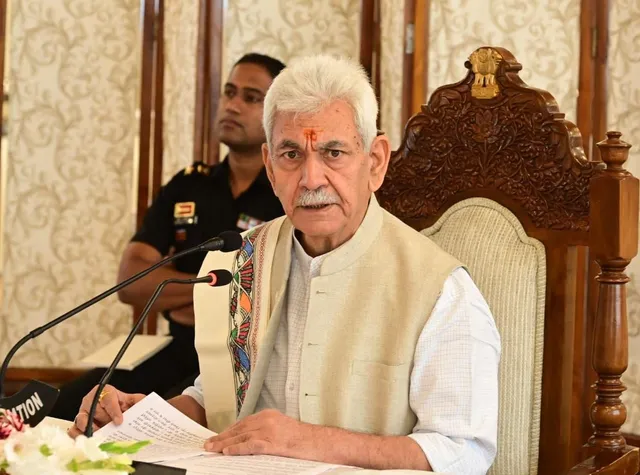
Lieutenant Governor Manoj Sinha on Saturday called for strengthening the grassroots sports ecosystem in the Union Territory, urging institutions, coaches, parents and corporate houses to identify and invest in promising athletes well before they achieve medal-winning success.
Addressing an event organised to mark National Sports Day, Sinha paid tribute to hockey legend Major Dhyan Chand and said the sporting icon had become a symbol of India’s identity through his achievements on the international stage.
“I believe that in that era, Major Dhyan Chand himself became an embodiment of India’s identity, and his stick became a symbol of his unwavering willpower, his dedication on the sporting field and his discipline,” Sinha said.
The Lieutenant Governor described sport as a powerful instrument of character-building and nation-building, stressing that sporting excellence should not be measured solely by medals.
“Sport is life’s most honest teacher,” he said. “It tells you exactly where you stand today and what you need to do to become better tomorrow.”
“There is no shortcut on the sporting field. There is no place for excuses in hockey either. There is only hard work, opportunity and a test of your character,” he added.
Sinha said the young athletes of Jammu and Kashmir represented the region’s enormous potential and the future of the country.
“Today, when I look at the young athletes of Jammu and Kashmir, I see India’s bright future in them,” he said while congratulating athletes who were honoured during the event.
Calling for wider access to professional and scientific training, Sinha said athletes from rural areas and smaller towns should have access to facilities and expertise comparable to those available in Jammu and Srinagar.
“We want to see a farmer’s child in Reasi or Shopian receive the same scientific and technical training in different sports disciplines that a player practising at a centre of excellence in Srinagar or Jammu receives,” he said.
He stressed the need to develop a stronger sports infrastructure at the grassroots level so that talent from remote areas does not remain overlooked due to a lack of resources or professional guidance.
Sinha also advocated strengthening sports science and sports management as academic disciplines in Jammu and Kashmir.
“We need to consider how sports science and sports management can emerge as subjects in universities and institutions, and how our institutions can produce trainers, sports managers, physiotherapists and technical experts in sports,” he said.
According to the Lieutenant Governor, developing a pool of professionally trained coaches, physiotherapists, sports managers and technical specialists would help create a more comprehensive support system for athletes.
Sinha said Jammu and Kashmir should aim beyond participating in international sporting competitions and work towards creating the infrastructure and capabilities required to host major global sporting events.
“We want to see a Jammu and Kashmir that does not merely participate in international games, but is itself capable of hosting international games and is ready to welcome the entire world,” he said.
Expressing confidence in the region’s sporting talent, Sinha said the achievements of J&K athletes could earn increasing recognition on the global stage.
“We believe that in the coming two years, the world will see the dreams of Jammu and Kashmir’s athletes being transformed into discipline and action,” he said.
Sinha emphasised that development of the sporting ecosystem could not be left entirely to government institutions and called for greater participation from the private sector.
“The future is not built only by the efforts of governments. The future is built by those who refuse to give up,” he said.
He urged young athletes to remain disciplined, resilient and committed to their goals.
“Believe in yourself. The country will certainly believe in you,” he told the athletes.
The Lieutenant Governor also highlighted the often-overlooked contribution of coaches, support staff and parents in an athlete’s journey to success.
“Our coaches, support staff and parents are the unique creators behind every medal that Jammu and Kashmir is winning today,” Sinha said.
“History certainly remembers the athlete standing on the stage, but I think we now need to reflect on the fact that we should also remember those who always stand behind the stage as your strength.”
Linking sporting excellence with the broader development of the country, Sinha said national progress should not be assessed only through economic indicators.
“Development is not measured only by GDP,” he said. “It is also measured by the energy of our youth, and by the pride with which the Indian tricolour flies on the world’s biggest sporting stages.”
He called upon corporate houses operating in Jammu and Kashmir to play a greater role in nurturing emerging sporting talent and supporting athletes at the early stages of their careers.
“Do not wait until an athlete wins a medal to provide support,” Sinha said. “Rather, help identify and nurture the talent that is being recognised before the medal is won, in our villages, small towns and streets.”
Sinha’s remarks underscored the need for a comprehensive, grassroots-oriented sporting ecosystem in Jammu and Kashmir, combining better infrastructure, scientific training, academic opportunities, private investment and sustained support for athletes from the earliest stages of their careers.