
By : Syed Salman
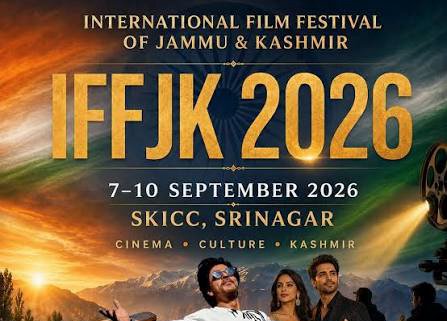
The inaugural IFFJK has generated considerable interest among filmmakers outside India. By late July, the festival had received 875 film submissions from around 50 countries, reflecting the international response to the new initiative.
The festival programme is designed to bring together international and Indian cinema through several sections, including an International Competition, Cinema of the World, Bharat Panorama, J&K Select, documentaries and short films.
The festival is expected to screen 135 films from 41 countries, according to reports on the final programme preparations.
For audiences in Kashmir, this creates an opportunity to experience films, filmmaking traditions and cinematic languages that may otherwise remain outside the region’s cultural mainstream.
For local filmmakers, however, the more important opportunity may lie beyond the screen.
Festivals create networks.
A young filmmaker can meet a producer. A cinematographer can meet a director. A local writer can find collaborators. An independent filmmaker can learn how international festivals evaluate and programme films. A technician can establish professional contacts.
These connections can ultimately be more consequential than a single screening.
A Platform for Kashmiri Stories
Perhaps the most important component of the festival is the space it creates for stories from Jammu and Kashmir.
The J&K Select section is intended to highlight the region’s history, themes, traditions and cultural narratives, giving local stories an institutional platform within an international festival.
For decades, Kashmir has been represented on screen largely through perspectives created outside the region. The emergence of a stronger local filmmaking culture could change that equation.
Kashmiri filmmakers now have an opportunity to tell stories about their own communities, families, landscapes, memories and contemporary realities—not simply as subjects, but as creators.
That distinction matters.
Cinema can preserve oral histories, document disappearing traditions and introduce unfamiliar aspects of a society to audiences elsewhere. It can also create a space for dialogue where conventional forms of communication may not always succeed.
If IFFJK succeeds in encouraging more local productions, the Valley could gradually develop a distinctive cinematic voice of its own.
The glamour associated with international film festivals often dominates public attention. Red carpets, celebrities, premieres and awards provide the visual spectacle.
But the long-term value of IFFJK will be determined by what happens behind the scenes.
The festival programme includes masterclasses, workshops, industry panels and interactive sessions involving national and international experts.
These sessions could be particularly valuable for young people in Jammu and Kashmir.
The region has a large pool of educated and creative young people, many of whom consume cinema extensively but have limited access to professional filmmaking networks.
A sustained programme of workshops in screenwriting, cinematography, editing, sound, animation, visual effects, production and film marketing could help bridge that gap.
The objective should therefore be larger than creating an annual festival.
The real goal should be to create an ecosystem.
The film industry is also an economic ecosystem.
A major production can generate employment far beyond the film crew. Hotels accommodate actors and technicians. Restaurants serve production teams. Transport operators move equipment and personnel. Local artisans can supply costumes and props. Small businesses provide logistical services.
Tourism can benefit as well.
Kashmir’s landscapes have always been a major attraction. If the Valley becomes easier and more attractive for film productions, cinematic exposure can complement traditional tourism promotion.
The festival itself is expected to bring together filmmakers, producers, directors, actors, critics, industry professionals and cinema enthusiasts from India and abroad. The government has also linked the initiative with tourism and the broader development of creative industries.
This creates the possibility of a new economic chain—cinema, tourism, hospitality, local employment and creative entrepreneurship.
Although Srinagar will serve as the principal venue, the festival is being conceived as a Jammu and Kashmir-wide initiative.
Official plans include events and screenings at venues including SKICC Srinagar, INOX Multiplex Srinagar, Movie Time Cinemas KC Central Jammu and the Gulmarg Convention Centre.
This wider geographical footprint is important.
Jammu has its own cultural traditions, landscapes and stories, from the plains and temples to the mountains of the Pir Panjal. The region has considerable potential for filmmakers seeking locations beyond the familiar imagery of the Valley.
A genuinely successful J&K film ecosystem should therefore connect Jammu, Kashmir and the wider mountainous regions rather than concentrating the creative industry in one urban centre.
The idea of reviving Kashmir’s cinematic identity has been central to the government’s preparations for the festival.
Chief Minister Omar Abdullah has described the initiative as part of efforts to revive the region’s cinematic legacy and strengthen its role in film production.
The challenge now is to transform that vision into a sustainable reality.
A festival can create attention. It cannot, by itself, create an industry.
For that, Jammu and Kashmir will need a consistent film policy, efficient permissions, trained local manpower, professional production infrastructure, incentives for filmmakers, modern studios and post-production facilities, location-management services and stronger partnerships with national and international production houses.
The festival can become the catalyst—but the ecosystem must continue growing after the closing ceremony.
IFFJK is also placing significant emphasis on recognising cinematic achievement.
The festival awards include categories such as Best Film, Best Director, Best Actor, Best Actress, Best Cinematography, Best Sound Design, Best Editing, Best Debut Film of a Director and Best Film on Jammu & Kashmir.
The festival has announced a total prize purse of Rs 96 lakh, with the Best Film award carrying Rs 25 lakh, according to recent reports.
Awards can provide emerging filmmakers with more than recognition. They can provide credibility, visibility and access to future opportunities.
For a first edition, such recognition could help establish IFFJK’s identity on the international festival circuit.
There is another dimension to the festival that may ultimately prove even more important: cultural exchange.
Cinema allows societies to encounter one another without passports or borders.
A filmmaker arriving in Kashmir from another country carries a story shaped by a different culture. A Kashmiri filmmaker presents a story rooted in the Valley. When the two meet, the result can be more than a professional collaboration—it can become a conversation between cultures.
That is the deeper promise of an international film festival.
The world does not simply come to Kashmir to watch films. Kashmir gets an opportunity to show the world its own stories.
The inaugural IFFJK arrives at an important moment.
Jammu and Kashmir is seeking to expand its identity beyond conventional tourism and into culture, creativity, technology and new economic opportunities. Cinema can become one of the bridges connecting these ambitions.
But expectations must remain realistic.
The success of the festival should not be measured only by the number of celebrities who attend, the number of films screened or the size of the opening ceremony.
Its real success will be visible months and years later.
Will more films be made in Kashmir?
Will local young people find employment in the film industry?
Will Kashmiri filmmakers gain access to international markets?
Will producers return after the festival?
Will Jammu and Kashmir develop professional production infrastructure?
Will local stories travel beyond the Valley?
And will the festival become an annual meeting point between Kashmir and the global film community?
These are the questions that will determine whether IFFJK becomes a landmark or simply another event on the cultural calendar.
For a region that has spent decades watching itself through the camera lenses of others, the first International Film Festival of Jammu & Kashmir offers a different possibility.
This time, Kashmir is not merely the backdrop.
It is the host.
It is the meeting place.
And, increasingly, it can become the storyteller.
When the first frames of IFFJK appear on screens in September, they will represent more than the beginning of a four-day festival. They could mark the beginning of a sustained effort to reconnect Jammu and Kashmir with its cinematic past while building a new future for filmmakers, artists, technicians and audiences.
The Valley has always had the landscapes that filmmakers dream about.
The challenge—and the opportunity—now is to build the stories, skills and institutions that can make Kashmir a destination for cinema rather than simply a destination within cinema.
That is why the first International Film Festival of Jammu & Kashmir matters.
It is not just a festival.
It is an invitation to the world to see Kashmir through a new frame.