
Agencies | Theran:
Iran’s Islamic Revolutionary Guard Corps (IRGC) on Wednesday claimed that its naval forces had captured a US unmanned underwater vehicle near the entrance to the Strait of Hormuz, describing the operation as a major intelligence and military achievement.
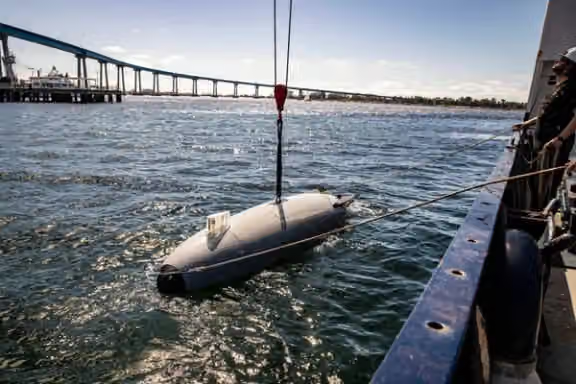
The IRGC said the vessel, identified as a Dive-LD autonomous underwater vehicle developed by US defence company Anduril, was captured during what it described as a “complex intelligence and operational” operation. Iranian state media also released footage purporting to show the captured vehicle.
Iranian officials described the Dive-LD as one of the most advanced unmanned underwater systems and said it was equipped with sophisticated subsurface technology.
The US military, however, sought to play down the significance of the incident, saying the underwater drone had malfunctioned more than a day earlier while surveying regional waters in support of ongoing operations.
A US Central Command spokesperson said the vehicle was an older, defective model that did not collect sensitive information or carry classified sonar or radar equipment.
The Dive-LD is a large autonomous underwater vehicle designed for missions including seabed mapping, mine countermeasures, intelligence gathering and inspection of underwater infrastructure. The approximately 5.8-metre-long system can reportedly operate for up to 10 days and dive to depths of around 6,000 metres.
The incident comes amid a sharp escalation in US-Iranian military tensions around the Strait of Hormuz, a strategically important waterway for global energy shipments.
Separately, the IRGC claimed that its air defence systems had shot down a US MQ-9 Reaper drone over the Strait of Hormuz.
The claim came as Iranian and US forces continued a series of confrontations in and around the strategic waterway. The latest developments have further raised concerns over the security of commercial shipping and global energy supplies.
The United States has also escalated military action against Iranian maritime assets.
The US Central Command (CENTCOM) said its forces destroyed five Iranian crude oil carriers on September 8, after the IRGC allegedly targeted a US Navy warship with ballistic missiles on two occasions over the preceding two days. CENTCOM said the American warship evaded both attacks and that no US personnel were injured.
According to CENTCOM, the vessels targeted were the M/T Kaviz, M/T Charminar, M/T Horizon 1, M/T Riesco and M/T Derya. The command said crews were directed to abandon the ships before they were struck and rendered inoperable.
The strikes followed the destruction of three other Iranian crude oil carriers by US forces on September 5, according to CENTCOM.
Washington has also intensified economic pressure on Tehran.
The US Department of the Treasury on Tuesday announced sanctions against 27 Iranian airlines as part of a broader action targeting Iran’s aviation sector. Treasury said the measures were aimed at entities involved in supporting Iran’s military and procurement networks.
The department also targeted front companies, foreign intermediaries and alleged transshipment networks used to obtain US-origin aircraft and sensitive technology.
Washington has previously sanctioned Iranian airline Mahan Air, which it accused of supporting the Islamic Revolutionary Guard Corps and facilitating the movement of personnel and equipment.
Amid the escalating confrontation, Iranian President Masoud Pezeshkian said Tehran would continue its resistance against what he described as aggression.
In a post on X, Pezeshkian reiterated Iran’s opposition to war while asserting that the country would continue to defend its interests.
He said Iran had consistently opposed war and regarded regional security as dependent on avoiding further escalation. At the same time, he said Tehran would continue its resistance until its adversaries were brought to what he called “complete regret.”
The latest escalation comes after a 60-day negotiating period established under a June 17 US-Iran memorandum of understanding expired on August 17 without a final agreement.
The agreement had envisaged an immediate cessation of military operations and a 60-day period for negotiations towards a broader settlement. It also included provisions concerning the Strait of Hormuz and the US naval blockade of Iran.
The talks subsequently stalled, with tensions again escalating between the two sides.
The latest confrontation around the Strait of Hormuz, including the reported seizure of the US underwater drone and the destruction of Iranian oil carriers, has further complicated efforts to revive diplomacy and raised fresh concerns over the security of one of the world’s most strategically important maritime routes.