
Examiner Bureau | Srinagar:
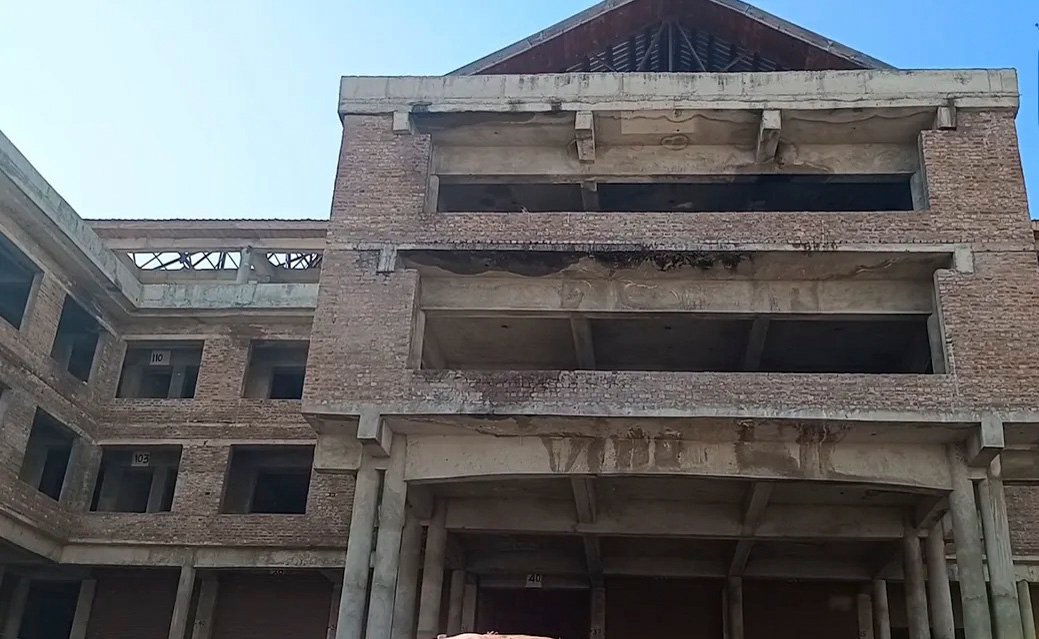
What was conceived as an important public infrastructure project for Anantnag two decades ago has turned into a long-running symbol of delay, with the construction of the SRTC Complex, taken up in 2005, still awaiting completion.
The Jammu and Kashmir Government has now informed the Legislative Assembly that a fresh Detailed Project Report (DPR) amounting to ₹12.10 crore has been prepared for completing the remaining work and is currently under technical vetting.
The project was revived in 2018 under the Languishing/JKIDFC funding mechanism, with an approved allocation of ₹11.42 crore. Following the revival, around 70-75 per cent of the work was completed before the project was handed over to the R&B Division, Anantnag, in February 2020 for further execution.
But the remaining work has continued to languish.
A committee constituted by the government in August 2024 to examine the reasons for the prolonged delay attributed the hold-up to the non-availability of requisite sanctions and approvals. The government, however, did not indicate that responsibility had been fixed on any particular official or agency for the two-decade delay.
The balance work has now been proposed for inclusion in the Revised Estimates under the Capex Budget for 2026-27, subject to approval by the competent authority. The fresh DPR, prepared through the R&B Division, Anantnag, is undergoing technical vetting.
Beyond the financial and administrative questions surrounding the project, the prolonged abandonment of a partially completed public building has also raised concerns among residents about the condition and use of the vacant structure.
With a sizeable portion of the complex remaining incomplete and unused for years, such spaces can become vulnerable to encroachment, vandalism and other forms of misuse. Residents have also expressed concern that neglected structures can provide secluded spaces for drug consumption, gambling and other anti-social activities, particularly when they remain without regular supervision or a defined public use.
The concern is not entirely without precedent in Anantnag. An abandoned government school building in Aishmuqam was reported to have become a haven for drug addicts, drug peddlers, gamblers and other anti-social elements after it remained unused for years.
At the same time, there is no indication in the government’s Assembly reply that the SRTC Complex itself has been officially identified as a site of illegal activities. The issue, therefore, remains primarily a matter of public concern arising from the prolonged vacancy and lack of utilisation of the structure.
For local residents, the unfinished complex represents not only stalled infrastructure but also a lost opportunity to create a functional public facility and an active space that could contribute to the town’s commercial and transport infrastructure.
The issue of the unfinished SRTC Complex was raised by MLA Peerzada Mohammad Syed, who also sought details about persistent waterlogging along K.P. Road in Anantnag.
Responding to the drainage-related concerns, the government said the Municipal Council, Anantnag, was undertaking regular cleaning and desilting of drains at vulnerable locations.
A joint survey by the Border Roads Organisation (BRO) and the Municipal Council was conducted in November 2025 to identify long-term measures for addressing the problem.
As part of the response, a drainage improvement project near Delhi Durbar/Qazibagh has been approved under the Urban Development Sector at a cost of ₹23.77 lakh, through allotment No. 5900-903 dated August 18, 2026.
The department said the Municipal Council was coordinating with the concerned road-owning agency for broader improvements to the drainage network along K.P. Road.
The SRTC Complex has already passed through several stages of funding, partial construction and administrative review since work began in 2005. The latest DPR and proposed inclusion in the 2026-27 Capex Budget offer another opportunity to complete the long-pending project.
For Anantnag residents, however, the expectation is straightforward: after two decades of delay, the project should move beyond fresh proposals and technical scrutiny and finally reach completion.
A public building that has remained unfinished for nearly a generation has increasingly come to represent not just delayed construction, but the wider social and administrative cost of leaving public infrastructure unused.