Agencies | Madrid:
At least 68 people were killed and around 80 injured after two high-speed trains collided in central Spain on Wednesday, triggering a major rescue operation and prompting authorities to launch an investigation into a possible signalling failure.
Emiliano García-Page, head of the regional government of Castilla-La Mancha, where the accident occurred, said around 50 of the injured were seriously hurt, while 15 were in critical condition. Authorities warned that the death toll could rise as rescue teams continued operations at the site.
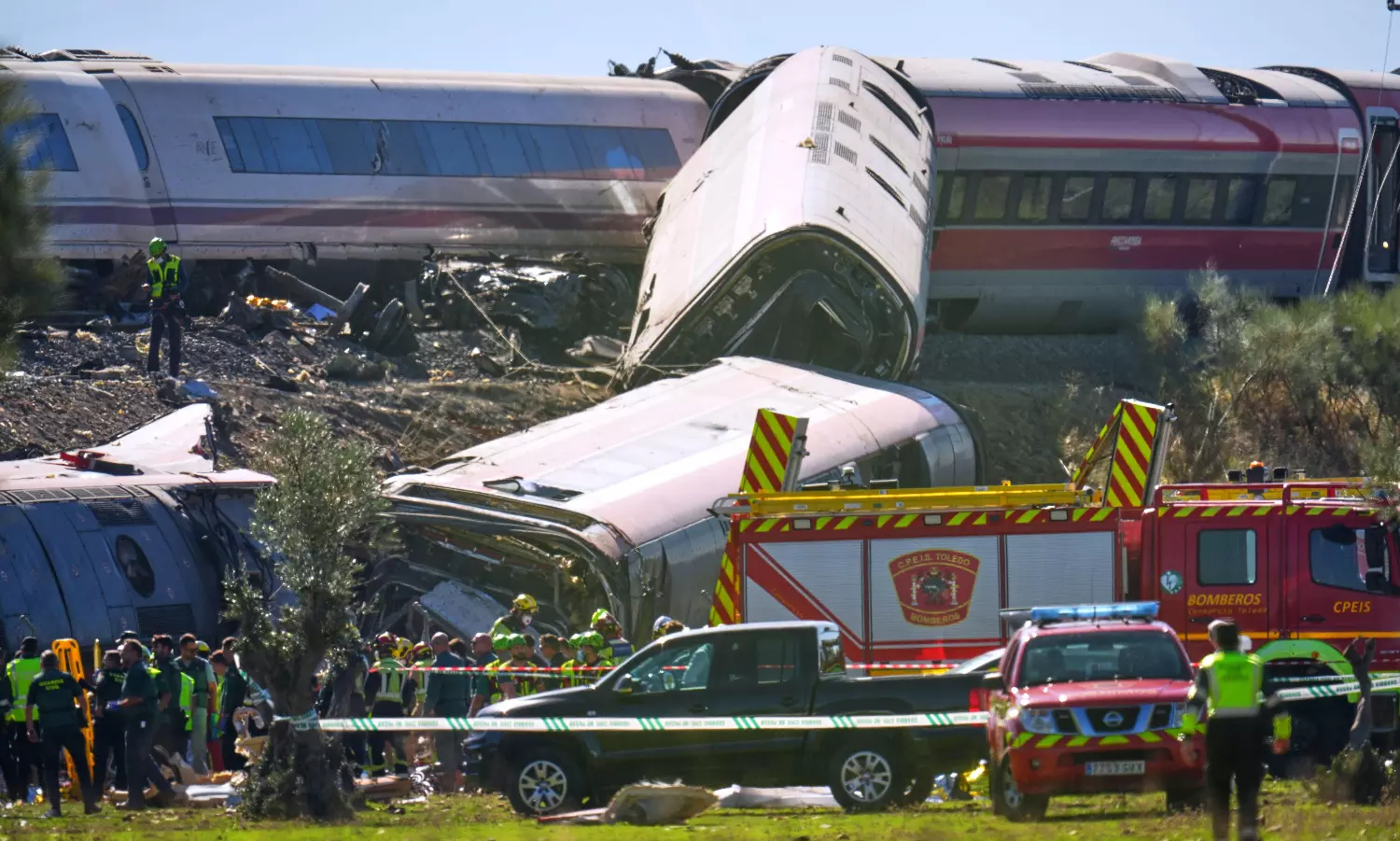
The crash occurred near Urda in Toledo province, south of Madrid, on a high-speed railway line connecting the Spanish capital with Seville. According to regional government spokeswoman Esther Padilla, the trains were travelling in the same direction when one struck the rear of a stationary train, causing two carriages to derail.
The collision involved a Madrid-to-Seville AVE train operated by state railway company Renfe and another train operated by private rail company Iryo. Regional authorities said 397 passengers were aboard the Renfe train and 147 on the Iryo service.
Two carriages of the Iryo train reportedly plunged down an embankment, leaving wreckage scattered across the surrounding slope. Emergency personnel focused on rescuing survivors, recovering bodies and transporting the injured to hospitals across the region.
“It was a high-speed impact, so we are expecting this to be a tragedy,” Health Minister Mónica García told Spanish public broadcaster TVE.
Spain’s Transport Minister Óscar Puente said a failure in the LZB train-control system affected a 63-kilometre stretch of railway, disrupting several services. The failure was reported at around 8:30 am local time, according to the minister.
With the system down, control was transferred to the Atocha control post, where a decision was made to allow the Renfe train to resume its journey, Puente said.
“The decision to resume traffic without the system having been restored corresponds to the control centre,” he said, describing the circumstances as “inexplicable”.
The precise sequence of events leading to the collision remains under investigation, including the decisions taken after the signalling system failed and the circumstances in which the train was permitted to continue.
The accident has renewed concerns over railway safety in Spain, particularly as the country had experienced another deadly high-speed rail collision nine months earlier. That crash killed 46 people and involved trains operated by the same companies on the same line.
Prime Minister Pedro Sánchez, speaking from Urda, announced three days of official mourning from October 29 to 31.
“Spain is in mourning,” Sánchez said, pledging a thorough investigation into the circumstances surrounding the disaster.
He said any negligence would be exposed and any systemic failures would prompt a strong response. Referring to the two fatal rail accidents within the same year, he said such incidents were unacceptable for a country like Spain, while noting that the causes appeared to be unrelated.
In a message on social media, Sánchez expressed solidarity with the victims and their families, saying he remained in contact with the transport minister and regional authorities as rescue operations continued.
More than 200 members of Spain’s Military Emergencies Unit were deployed to the crash site, while local authorities mobilised supplies and assistance for those affected.
Madrid Mayor José Luis Martínez-Almeida said the capital was sending emergency medical teams and firefighters to support rescue efforts.
The railway infrastructure operator ADIF suspended high-speed services between Madrid and the southern region of Andalusia following the collision. The Civil Guard also sent a specialist disaster investigation team to the scene.
Footage from the site showed damaged carriages, scattered debris and rescue workers operating along the railway embankment. Hospitals across the region received injured passengers as emergency services continued searching the wreckage.
The disaster prompted messages of sympathy from across Europe. European Commission President Ursula von der Leyen said she was devastated by the news and extended condolences to the victims’ families.
“Today, Europe mourns with you,” she said.
French President Emmanuel Macron also expressed solidarity with Spain, conveying his thoughts to the victims, their relatives, the injured and the emergency workers involved in the rescue operation.
The investigation is expected to focus on the collision’s immediate cause, the signalling failure and the decisions that allowed railway traffic to resume before the system was restored. Authorities have yet to establish the full sequence of events or determine whether any negligence contributed to the disaster.