
Examiner News Desk | Srinagar:
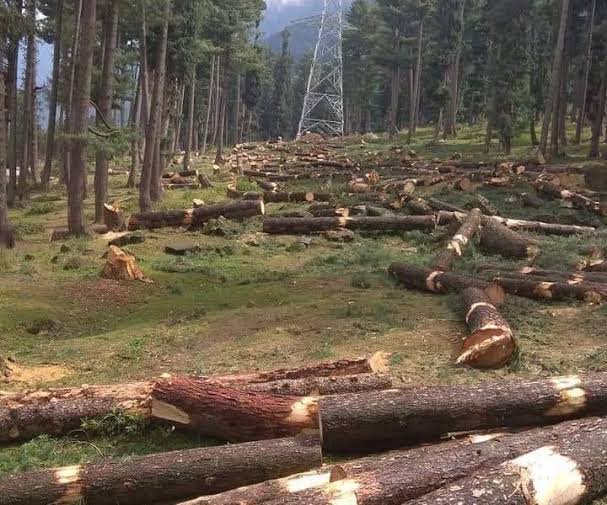
The push to improve all-weather connectivity between Kashmir and the Chenab Valley has come at an environmental cost, with around 543 kail pine and fir trees felled on the Kashmir side for the Singhpora-Vailoo tunnel project. While nearly 16,000 saplings are planned as compensatory plantation, the scale of the tree loss has brought the impact of major infrastructure projects on the region’s forest wealth into focus.
The felling has been completed across around 40 hectares of forest land near Gadole-Ahlan in Anantnag district, following the grant of final Stage-II forest clearance by the Union Ministry of Environment, Forest and Climate Change (MoEFCC) in 2026.
“ Around 543 kail (Himalayan Blue Pine) and fir (Himalayan Silver Fir) trees, yielding approximately 50,000 cubic feet of timber, have been felled across 40 hectares of forest land on the Kashmir side near Gadole-Ahlan,” Divisional Forest Officer (DFO), Anantnag, Mohammad Ashraf Katoo said.
He said nearly 16,000 saplings would be planted over eight hectares under the National Compensatory Afforestation Fund Management and Planning Authority (CAMPA), with NHIDCL having already released the required funds.
“Nearly 700 saplings have also been transplanted to other areas as part of the forest management measures,” he said.
While tree felling on the Kashmir side has been completed, the process is yet to begin near Chatroo-Singhpora on the Kishtwar side, which falls under the Marwa Forest Division.
The forest diversion is limited to the approach road near Gadole-Ahlan and does not involve the underground tunnel itself. The MoEFCC granted Stage-I clearance in 2025, followed by final Stage-II clearance in 2026.
The tunnel is designed to connect Ahlan-Vailoo in Anantnag district with Chatroo-Singhpora in Kishtwar, providing an all-weather link between Kashmir and the Chenab Valley by bypassing the snowbound Sinthan Pass.
Meanwhile, the National Highways and Infrastructure Development Corporation Limited (NHIDCL) has extended the deadline for submission of bids for the Rs 3,567.51-crore project to December 10.
“The date has now been extended to December 10, following which the bids will be opened on December 11,” NHIDCL Engineer for the project Tanveer Sheikh said.
NHIDCL had floated fresh bids on September 10 after an earlier tender was cancelled in 2024 following the denial of security clearance to the lowest bidder, a joint venture of Transrail Lighting and Azerbaijan-based EVRASCON.
The fresh tendering followed the Public Investment Board’s approval of revised proposals for the Singhpora-Vailoo and Sudhmahadev-Dranga tunnels in April 2026. The board had declined the earlier proposals in April 2025, citing cost and technical concerns. The revised proposals were subsequently approved through an Office Memorandum issued by the Department of Expenditure, Ministry of Finance.
Union Minister of State in the Prime Minister’s Office Jitendra Singh had announced the Centre’s approval for the two projects at a combined estimated cost of Rs 9,779.42 crore.
The Singhpora-Vailoo tunnel is part of a 38.611-km highway package connecting Chatroo in Kishtwar with Vailoo in Anantnag along the NH-244 Kishtwar-Vailoo-Khanabal section.
The project includes twin tunnel tubes measuring 10.331 km and 10.363 km beneath the Sinthan Pass. The eastern approach from Chatroo to the tunnel portal will cover 17.088 km, while the western approach towards Vailoo will extend 11.160 km.
The eastern portal near Singhpora will be located at an elevation of around 2,243 metres, while the western portal at Gadole will be around 2,404 metres above sea level.
The project also includes 20 cross-passages, 21 major and minor structures and a 1,345-metre viaduct, besides more than 54 km of roadside and catch drains. Each tunnel tube will have a nine-metre carriageway, footpaths and emergency facilities.
The two tubes will be connected through 20 cross-passages, each 6.1 metres wide and 18.5 metres long, at intervals of around 500 metres to facilitate emergency evacuation. The tunnels will be equipped with semi-transverse ventilation, fire detection and firefighting systems, CCTV surveillance, emergency communication, traffic control, lighting, drainage and waterproofing facilities. Fire hydrants will be installed every 250 metres.
The approach roads will be two-lane roads with paved shoulders. The project will be executed under the engineering, procurement and construction (EPC) mode, with a construction period of 60 months, followed by 120 months of operation and maintenance.
Land acquisition for the approach roads has been completed on both the Kashmir and Jammu sides. NHIDCL has sanctioned Rs 78 crore in compensation, of which more than half has been disbursed.
The existing Anantnag-Kokernag-Kishtwar road frequently faces heavy snowfall and winter closures at Sinthan Pass. The proposed tunnel is expected to provide a more reliable year-round link between the two regions and strengthen the NH-244 corridor.
Meanwhile, land acquisition for the 4.5-km Sudhmahadev-Dranga tunnel has also been completed, with compensation being processed. NHIDCL has floated separate tenders for its construction.
While the tunnel is expected to ease travel and improve connectivity, the felling of hundreds of mature conifers raises important questions about the ecological cost of infrastructure development. Compensatory plantation and transplantation are part of the prescribed forest management measures, but the long-term environmental impact will also depend on the survival and growth of the new plantations and the protection of the surrounding forest ecosystem.