Examiner News Desk | Srinagar:
Jammu and Kashmir Chief Minister Omar Abdullah has voiced deep frustration over the prolonged delay in restoring statehood to the Union Territory, saying the growing anger and disappointment among people is directed not only at the Narendra Modi government but has also cost him significant political capital.
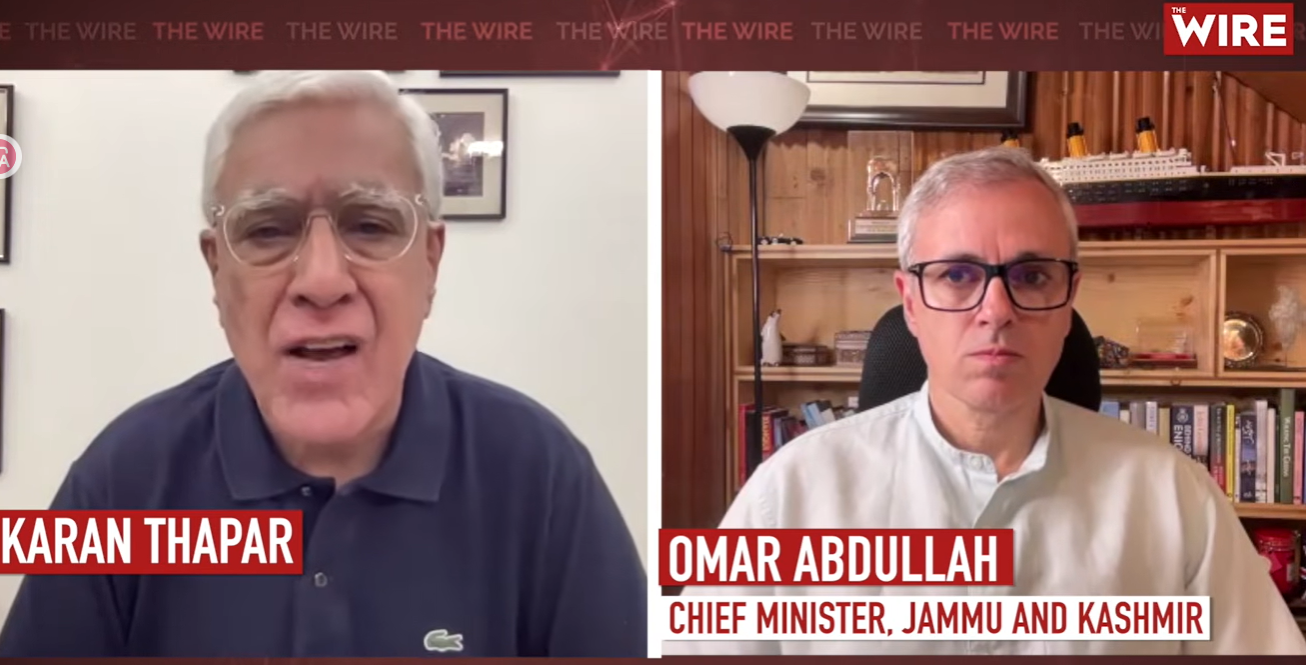
In a social media interview with renowned journalist Karan Thapar for The Wire, Abdullah said he had deliberately pursued a constructive relationship with the Union government in the hope that statehood would be restored at the earliest, but the absence of a clear timeline had severely damaged his political standing among the people of Jammu and Kashmir.
“I put a huge amount of my own political credibility at stake for this. I know for a fact that I’ve eroded a large part of it,” Abdullah said.
The Chief Minister said he continued to “pay the price for sins that are not mine”, arguing that his administration had little control over the factors being cited to justify the delay in restoring statehood.
“I will pay the price for sins that are not mine, and again, I will carry that cross because it’s mine to bear,” he said.
‘Statehood Has Become a Moving Target’
Taking strong exception to the Centre’s repeated reference to restoring statehood at an “appropriate time”, Abdullah said the absence of a defined timeline had created uncertainty and frustration in Jammu and Kashmir.
He compared the situation to running a marathon in which the finishing line keeps moving further away.
“It’s like running a marathon. Instead of completing it in 42 km, every time you reach near the finishing line, they keep shifting it,” he said.
Abdullah urged the Union government to establish clear parameters and a definite roadmap for restoration of statehood, saying this would provide his elected government with a concrete objective rather than leaving the issue open-ended.
‘Why Punish an Elected Government for Terrorism?’
The Chief Minister also rejected arguments that statehood could not be restored until terrorism was completely eliminated from Jammu and Kashmir.
He said his elected government does not control the security and counter-terrorism apparatus operating in the Union Territory and therefore should not be held responsible for conditions over which it has no authority.
“The problem with this argument is that you’re effectively punishing a government that has no role in this,” Abdullah said.
He argued that militancy in Jammu and Kashmir was not a consequence of the existence of an elected government and that the administration had no role in determining the counter-terror strategy currently being implemented.
“In fact, we have absolutely nothing to do with the anti-terror mechanism that is in place in J-K right now,” he said.
Abdullah further questioned whether making the restoration of statehood dependent on the complete elimination of terrorism effectively meant transferring the decision from New Delhi to Islamabad.
“By saying so, you are effectively saying that when Pakistan stops sponsoring terror, you will restore statehood – effectively transferring the decision from our capital to Islamabad,” he said.
‘A Union Territory With an Assembly Is an Abomination’
Expressing his dissatisfaction with the present administrative structure, Abdullah described a Union Territory with an elected Assembly as an inherently problematic arrangement.
“There is no worse form of government than a Union territory with an Assembly. Please, by all means, have Union territories, but don’t give them assemblies,” he said.
He argued that the elected government lacks authority over several important areas of administration and pointed to institutions such as the Jammu and Kashmir Power Development Corporation and Sher-i-Kashmir Institute of Medical Sciences as examples of bodies that remain under the Lieutenant Governor’s authority.
The Chief Minister also said his Cabinet does not have the authority to choose its own administrative secretaries or appoint an Advocate General, highlighting what he described as the structural limitations imposed by the Union Territory framework.
Statehood First, Article 370 Later
Responding to criticism that his government has shifted its focus away from the restoration of Article 370, Abdullah said statehood was a necessary prerequisite for addressing the constitutional distribution of powers.
“Article 370 was basically the division of powers between the Union government and the state government. How can you have a state list when you are not a state? Statehood has to come before (Article) 370 can be restored,” he said.
Abdullah’s remarks underline his administration’s emphasis on restoring statehood as the immediate constitutional and political priority before pursuing broader questions concerning the pre-August 2019 constitutional arrangement.
‘Modi Ka Wada’
The Chief Minister also recalled Prime Minister Narendra Modi’s public assurances that statehood would be restored to Jammu and Kashmir.
Abdullah said Modi had personally backed the commitment during his visits to the region and had described it as “Modi Ka Wada”, giving the assurance a significance beyond an ordinary political promise.
“The prime minister put his personal credibility behind it. He said the restoration of statehood is not just any other promise, it’s a ‘Modi Ka Wada’. Obviously, he holds that promise to a higher standard, giving it greater weightage,” Abdullah said.
He said the continued delay had raised questions about the Union government’s accountability and urged the Centre to honour assurances made to Parliament, the judiciary and the people of Jammu and Kashmir.
‘I Have Lost Huge Political Capital’
Abdullah acknowledged that his decision to place faith in the Centre’s assurances and pursue a cooperative approach had come at a considerable political cost.
He said the public’s disappointment over the delay was palpable and extended beyond criticism of the Union government.
The Chief Minister indicated that many people who had supported his approach expected tangible progress on statehood, and the absence of such progress had weakened the credibility he had built with his political constituency.
Despite the setbacks, Abdullah said he would continue to pursue the demand through democratic and political means.
He said his government would raise the issue through political dialogue as well as protests and demonstrations, including programmes in Jammu and Kashmir and in the national capital.
For Abdullah, the restoration of statehood has therefore emerged as both a constitutional demand and a crucial test of political credibility. With the Centre yet to announce a definitive timeline, the issue is likely to remain at the centre of Jammu and Kashmir’s political discourse, while pressure mounts on New Delhi to translate its repeated assurances into a concrete roadmap.