
Examiner Bureau | Srinagar:
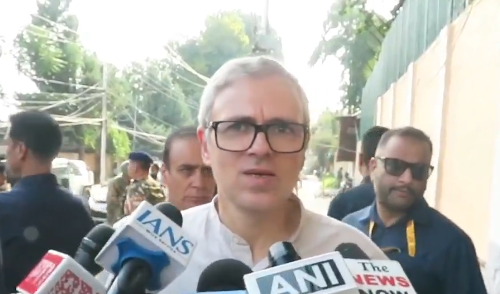
Jammu and Kashmir Chief Minister Omar Abdullah on Monday played down the BJP’s protest against his government in Jammu, saying political parties were free to express their differences, while using the occasion to launch a broader criticism of what he described as the Centre’s increasing interference in matters constitutionally assigned to the states.
Asked about the BJP’s protest against the National Conference-led government, Abdullah appeared dismissive of the agitation.
“They have a difference of opinion. This is what they have to do,” he said. “Okay? They did it. What else?”
However, he quickly turned the discussion towards the larger issue of Centre-state relations, arguing that the growing centralisation of subjects such as education and health was weakening the role of elected state governments.
Referring to the ongoing student protests in Jharkhand, Abdullah said the issue was not confined to one state and highlighted what he described as the constitutional division of responsibilities between the Centre and the states.
“This is not just about Jharkhand,” he said. “These matters, whether it is education or health, in the devolution of powers, these are State issues. They feature in the State List.”
Abdullah said the trend towards centralisation could not be blamed solely on the BJP, arguing that successive governments at the Centre had contributed to the weakening of states.
“This fault is not just the BJP’s. Different central governments have played a role in weakening the states,” he said.
The Chief Minister cited the centralisation of the NEET examination system as an example of how greater control at the national level could also affect accountability.
“So, if NEET had not been centralised, Dharmendra Pradhan would not have had to resign,” Abdullah said. “Because examinations would have been conducted at the state level. If there had been a scam in a state, the minister of that state would have been responsible.”
He said the Centre should focus on matters within its jurisdiction while allowing state governments to manage subjects assigned to them.
“Leave matters that belong to the states with the states. Let the Centre handle matters that belong to the Centre,” Abdullah said.
“This habit the Centre has developed of interfering in the states is the reason Dharmendra Pradhan had to lose his job. Let us do our work; let them do theirs.”
Abdullah’s remarks come amid renewed political friction between the Jammu and Kashmir government and the BJP, which has intensified its criticism of the National Conference-led administration.
While the Chief Minister dismissed the BJP’s protest as an expression of political disagreement, his comments underline the broader political differences between the two sides over governance, federalism and the role of the Centre in Jammu and Kashmir.
Abdullah also sought to play down the controversy surrounding the inclusion and sequencing of Vande Mataram during the Independence Day ceremony.
He said the revised programme was unfamiliar even to him.
“This was my eighth Independence Day parade. But this was the first time Vande Mataram was included,” he said.
Explaining that the new sequence took some time to understand, Abdullah said Vande Mataram was played before the national flag was unfurled, followed by the national anthem.
“It took me some time too to understand that first I would stand there, then Vande Mataram would be played, then I would unfurl the flag, and then there would be the national anthem,” he said.
“Perhaps Congress also needed some time to adjust,” he added.
Asked about criticism surrounding a statement supporting Article 370 that was described by critics as reflecting a “Naxalite mindset”, Abdullah declined to comment on the social-media posts.
“Why are you asking me to explain and speak about what she tweets?” he said. “It is her Twitter account; her daughter runs it. Let her tweet whatever she likes.”
On the ongoing protests by students in Jharkhand, Abdullah favoured dialogue, saying governments should engage with protesters if their grievances were legitimate.
“If the students’ demands are legitimate, if they are valid, then somewhere or the other, they should sit down with them and talk,” he said.
At the same time, he said governments should be clear if they believe the protesters’ demands have no merit.
“If they are not, then say directly that there is no weight or truth in their demands and that there will be no talks with them,” Abdullah said.
He pointed to the decision to hold a second round of talks as an indication that the protesters’ concerns could not simply be dismissed.
“If you have already held one round of talks and are saying there will be a second round, then somewhere their demands must have some truth in them,” he said.
Abdullah’s remarks brought together several issues currently generating political debate—from the BJP’s opposition in Jammu and Centre-state relations to examination reforms, the Independence Day ceremony and student protests in Jharkhand.
While dismissing the BJP’s protest as part of normal political disagreement, the Chief Minister used the occasion to make a larger argument for greater autonomy and accountability at the state level, insisting that governments should be allowed to exercise authority over subjects assigned to them.
His message was clear: the Centre should focus on its responsibilities, while elected state governments should be given space to govern theirs.