
By | Syed Salman
For generations of Kashmiris, cinema was more than an evening of entertainment. It was a social experience—a place where families met, young people discussed their favourite stars and audiences shared laughter, emotion and excitement in darkened halls. But that culture almost disappeared with the eruption of militancy in the late 1980s and early 1990s.
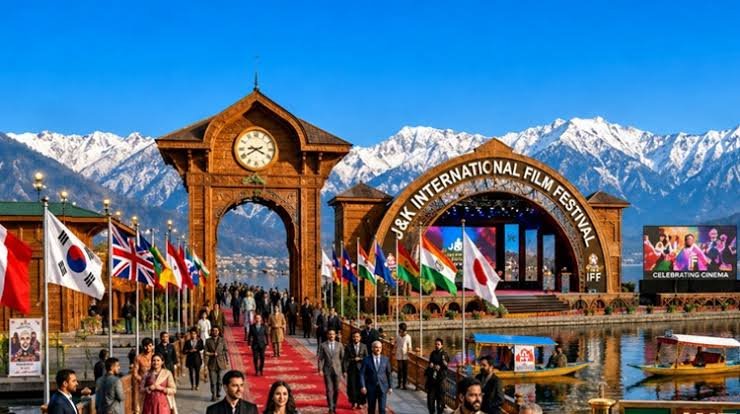
Now, more than three decades later, the International Film Festival of Jammu & Kashmir (IFFJK) 2026 is opening a new chapter. With its first edition being held from September 7 to 10, the festival could become more than a celebration of films. It has the potential to help rebuild a cinema culture that Kashmir once knew and introduce it to a generation that largely experienced films through television, smartphones and digital platforms.
The question is whether a four-day festival can revive something that disappeared for more than three decades. The answer may lie not in the festival alone, but in what it creates beyond its closing ceremony.
Before militancy disrupted everyday life, cinema had a visible place in Kashmir’s urban culture. Srinagar had several theatres, including Regal, Palladium, Broadway, Neelam, Naaz, Shah, Khayam, Shiraz and Firdous, while cinema halls also operated in other parts of the Valley. Contemporary accounts recall crowded shows, popular Bollywood and Hollywood films and families making cinema-going part of their leisure.
That world changed dramatically around 1990. Cinema halls became targets of militant threats and were forced to close. Reports have documented that all operational cinema halls in Kashmir were shut during the period, while several abandoned theatres were subsequently used for other purposes, including as security installations, hospitals or commercial establishments.
Attempts to revive cinema were made later. In 1999, Regal Cinema in Srinagar was reopened, but a militant attack on the venue killed one person and injured several others. The incident effectively ended another attempt to restore regular cinema screenings in the Valley.
For many older Kashmiris, therefore, the word “cinema” carries memories of a very different Kashmir—one of queues outside theatres, posters of film stars, interval conversations and families watching films together.
The return of cinema has been gradual.
In September 2022, Srinagar saw the opening of a modern multiplex, bringing regular theatrical cinema back to the Valley after more than three decades. The development was significant not only commercially but culturally: many young Kashmiris were experiencing a cinema hall for the first time.
The emergence of multiplexes has created an important foundation for the revival of cinema-going. But a genuine cinema culture requires more than buildings and commercial screenings. It requires audiences, filmmakers, critics, students, film societies, discussions, workshops and a sustained ecosystem around cinema.
That is where IFFJK could make a difference.
The first International Film Festival of Jammu & Kashmir, organised by the Directorate of Information and Public Relations, J&K, is being held under the theme “Rang-e-Cinema.” The festival is scheduled from September 7 to 10 and features international competition, curated showcases and sections dedicated to feature films, documentaries, shorts and regional cinema, including J&K Select and Bharat Panorama.
Around 135 films from about 40 countries are expected to form part of the festival, bringing international stories and filmmakers to Jammu and Kashmir.
The festival’s venues also reflect its ambition. Screenings and events are being hosted at the Sher-i-Kashmir International Convention Centre, INOX Multiplex Srinagar, Movie Time Cinemas KC Central Jammu and the Gulmarg Convention Centre.
This combination of international cinema, local stories and multiple venues provides an opportunity to place Jammu and Kashmir on the wider map of film festivals.
One of the most important contributions of a film festival is that it transforms audiences into participants.
IFFJK’s programme goes beyond film screenings. Its official programme includes interactive installations, discussions with film historians and artists, industry sessions and experiences exploring cinema, identity and visual storytelling.
For young people in Kashmir, such exposure could be particularly significant.
A student interested in cinematography can meet professionals. An aspiring director can discover independent cinema. A photographer can learn about visual composition. A young writer can understand screenwriting. Someone interested in documentary filmmaking can encounter stories from different parts of the world.
In this sense, the festival could help create something that Kashmir has lacked for decades: a sustained community of cinema.
Cinema has always been a powerful medium of cultural exchange. Films allow audiences to encounter unfamiliar societies, languages, histories and human experiences without leaving their own city.
For Kashmir, this exchange can work in both directions.
International filmmakers can discover the region’s landscapes, history and stories, while Kashmiri filmmakers can take their own narratives to national and international audiences.
The festival’s J&K Select section is particularly important in this context. A sustainable cinema culture should not merely bring films from outside Kashmir; it should also provide a platform for local filmmakers to tell their own stories.
Kashmir has landscapes that have attracted filmmakers for decades, but the future of the region’s relationship with cinema should not be limited to serving as a location for outside productions. It should also encourage Kashmiris to become filmmakers, writers, cinematographers, editors, producers and storytellers themselves.
IFFJK could also strengthen the connection between cinema and tourism.
The idea of experiencing films in Kashmir, attending screenings in Srinagar and Jammu, participating in workshops and visiting locations associated with filmmaking could create a new form of cultural tourism.
The festival’s inclusion of Gulmarg alongside venues in Srinagar and Jammu gives the event a wider geographical and tourism dimension.
If developed consistently, film festivals can encourage visitors to stay longer, attend cultural events and explore local heritage. For Kashmir, where tourism is already an important part of the economy, cinema could become another cultural attraction.
The biggest test for IFFJK will come after September 10.
A successful festival should not end when the final film is screened. It should leave behind film clubs, workshops, student programmes, local screenings, script-development initiatives and opportunities for young filmmakers.
There is also a need for more cinema halls and accessible screening spaces across the Valley. Srinagar’s multiplex has demonstrated that there is an audience for theatrical cinema, but a wider cinema network could take the experience beyond the capital.
Regular film festivals, travelling cinema programmes and screenings in educational institutions could help build audiences in districts across Jammu and Kashmir.
Reviving cinema culture does not necessarily mean recreating the Kashmir of the 1980s. The new cinema culture can be different—more diverse, digital, independent and globally connected.
The old cinema hall was primarily a place to watch a commercial film. The new cinema ecosystem can become a space for films, ideas, education, debate, creativity and cultural exchange.
That distinction is important.
Kashmir does not simply need more screens; it needs more storytellers.
It needs young people who see filmmaking as a profession, documentaries as a form of social expression, cinema studies as an academic pursuit and local stories as material worthy of national and international audiences.
Perhaps it can—but only if the festival becomes the beginning rather than the destination.
The reopening of cinemas in 2022 demonstrated that the appetite for the big screen had survived years of disruption. IFFJK now offers an opportunity to take that revival one step further by creating a cultural ecosystem around cinema.
For older Kashmiris, it may bring back memories of a lost era. For younger audiences, it can create their first memories of cinema not as something watched on a phone, but as a shared cultural experience.
And for aspiring Kashmiri filmmakers, it could send a powerful message: the Valley is not only a place where films are shot—it can also be a place where films are imagined, created, discussed and celebrated.
The first IFFJK may therefore be remembered not simply for the films it screens, but for the doors it opens.
After decades in which the sound of projectors disappeared from many parts of Kashmir, the festival offers a chance to hear that sound again—and perhaps, this time, keep it running.