
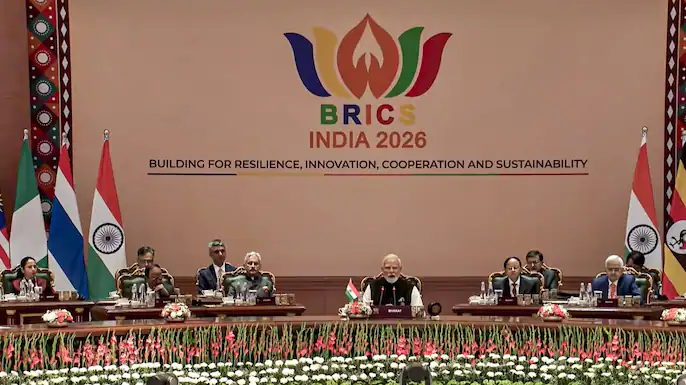
Agencies | New Delhi:
The BRICS nations on Saturday adopted the New Delhi Declaration 2026, marking a key diplomatic outcome of India’s chairship and signalling the expanded grouping’s push for a greater role in global governance.
Prime Minister Narendra Modi, addressing the summit at Bharat Mandapam, described the deliberations as “very fruitful and creative” and said the outcome demonstrated that a new world order could not be built with old rules.
The declaration comes after intensive negotiations among member states, with India working to bridge differences over geopolitical issues, particularly the conflict in West Asia involving BRICS members Iran and the United Arab Emirates (UAE).
The grouping reaffirmed its commitment to multilateralism, sovereignty, international law and peaceful resolution of disputes, while calling for reforms to global institutions to give greater representation to emerging and developing economies.
Modi has advocated a more ambitious agenda for BRICS over the next three decades, describing the grouping as being at a “coming of age” moment.
He stressed that annual changes in the BRICS chairmanship should not disrupt the bloc’s institutional momentum. India has proposed a Committee on Continuity and Implementation, working through the BRICS Troika and supported by a digital repository to track initiatives, nodal points and implementation timelines.
India has also proposed a Seafarers Emergency Support Network connecting maritime authorities and fishermen across BRICS countries. The initiative is aimed at facilitating distress alerts, medical assistance, evacuation support and communication with families during emergencies at sea.
Modi has further called for greater representation of the Global South in international decision-making, including reforms to the UN Security Council and global financial institutions.
The New Delhi Declaration reiterated the grouping’s support for comprehensive reform of the United Nations, including the Security Council, to make global institutions more representative, democratic and effective.
BRICS called for greater participation of developing countries from Africa, Asia and Latin America in international decision-making.
The declaration also backed greater representation of emerging and developing economies in senior positions across international organisations and highlighted the continuing gender imbalance in global leadership.
BRICS specifically reiterated support for greater representation of India and Brazil in the UN Security Council, with China and Russia backing their aspirations for a larger role in the world body.
The declaration called for a greater voice for developing countries in the World Bank Group, supporting a realignment of shareholding to address what it described as historic underrepresentation.
On the International Monetary Fund, BRICS called for meaningful quota reform reflecting changes in the global economy and greater voting shares for emerging and developing countries.
The grouping also called for restoration of a fully functioning, two-tier and binding World Trade Organization dispute settlement mechanism, including the appointment of new Appellate Body members.
BRICS expressed concern over unilateral tariff and non-tariff measures, warning that protectionism and trade restrictions could disrupt global trade, supply chains and economic development.
The declaration reaffirmed BRICS’ opposition to terrorism in all its forms and called for zero tolerance and rejection of double standards in counter-terrorism efforts.
It also condemned the April 22, 2025 terrorist attack in Pahalgam, Jammu and Kashmir, in which 26 people were killed.
BRICS reiterated its opposition to cross-border movement of terrorists, terror financing and the use of safe havens, while calling for accountability of those involved in terrorist activities and their supporters under national and international law.
The grouping also welcomed the Guwahati Declaration adopted by BRICS heads of anti-drug agencies, aimed at strengthening operational and technical cooperation against illicit drug production, trafficking and abuse.
The summit also advanced cooperation in peaceful space exploration.
BRICS welcomed progress in drafting the Terms of Reference for a BRICS Space Council and efforts to expand the bloc’s Remote Sensing Satellite Constellation by allowing additional member space agencies to participate.
The initiatives are aimed at strengthening cooperation in space technology and reducing disparities in space capabilities among developing countries.
The conflict in West Asia emerged as one of the most difficult issues during negotiations on the declaration, given the differing positions of Iran and the UAE.
The two leaders, Iranian President Masoud Pezeshkian and UAE President Sheikh Mohamed bin Zayed Al Nahyan, held talks on the sidelines of the summit in New Delhi, their first known face-to-face meeting since the war began on February 28.
Earlier disagreements between Tehran and Abu Dhabi had threatened to delay consensus on the joint declaration.
The declaration condemned unilateral coercive measures and sanctions that are contrary to international law, saying such measures can negatively affect development, health and food security, particularly in vulnerable economies.
Chinese President Xi Jinping said the continuing conflict in the Middle East and Gulf region was causing serious losses and did not serve the common interests of the international community.
Xi also described BRICS as one of the world’s most influential platforms for cooperation among emerging-market and developing countries and announced that China will assume the BRICS presidency in 2027.
India’s 2026 chairship has sought to place practical cooperation, economic development and the concerns of the Global South at the centre of the BRICS agenda.
Modi said India’s approach had been people-centric and humanity-first, with resilience, innovation, cooperation and sustainability forming the key priorities of its chairship.
More than 350 meetings were organised across around 30 Indian cities during the year, according to Modi, reflecting an effort to expand BRICS cooperation beyond leaders and ministers and connect it with wider sections of society.
The adoption of the New Delhi Declaration marks an important test of the expanded BRICS grouping’s ability to find common ground despite significant political differences among its members.
With the bloc now seeking a larger role in global economic governance, trade, technology, security and development, the Delhi summit has placed renewed emphasis on whether BRICS can translate its growing economic weight into sustained institutional and political influence.