
Examiner News Desk | Srinagar:
Six years after the erstwhile State of Jammu and Kashmir was divided into two Union Territories, the dispute over its properties outside the region continues to carry both an administrative and political legacy.
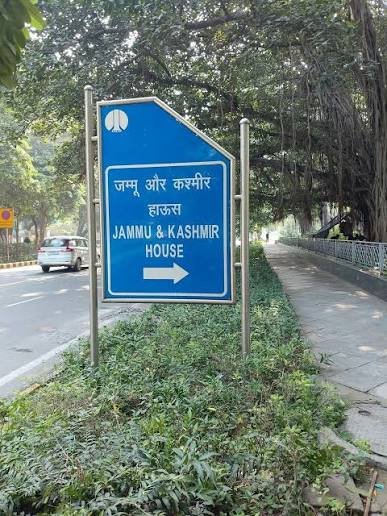
At the centre of the controversy are the Jammu and Kashmir House in Chanakyapuri, New Delhi, and properties in Chandigarh. The popular political narrative is that Jammu and Kashmir “lost” both its Delhi and Chandigarh houses to Ladakh. The official record, however, tells a more nuanced story: Ladakh received the main blocks of the J&K House complex in Chanakyapuri and part of the accommodation there, but J&K retained its property at Sector 17-A in Chandigarh.
The division was rooted in the Jammu and Kashmir Reorganisation Act, 2019, under which the assets and liabilities of the erstwhile state had to be apportioned between the successor Union Territories of Jammu and Kashmir and Ladakh. Section 84 placed the apportionment under a committee constituted by the Central Government, while Section 85 provided for advisory committees for related issues.
What followed was a politically sensitive process in which the two sides disagreed over the division of valuable properties outside the erstwhile state.
The most consequential division concerned the Jammu and Kashmir House at Chanakyapuri.
In June 2020, the Ministry of Home Affairs ordered an interim apportionment of the complex. Under the arrangement, the main entrance from Kautilya Marg, along with Block A containing 10 rooms and four suites, the old Block B with 14 rooms and three suites, 16 Type-B staff quarters and eight Type-C staff quarters, was allocated to Ladakh.
Jammu and Kashmir retained the second entrance, the new Block B with 24 rooms, Block C with 21 rooms and seven suites, and 10 Type-A staff quarters. The MHA said the arrangement followed an interim report of the advisory committee constituted under the Reorganisation Act, while noting that the two successor UTs had differences over the committee’s recommendations.
The political controversy was immediate.
The Jammu and Kashmir Apni Party objected to the allocation, arguing that a substantially larger share of the accommodation had gone to Ladakh despite the enormous difference in population between the two UTs.
Apni Party leader and former minister Mohammad Dilawar Mir said in June 2020 that Ladakh had received two main blocks containing 24 standard rooms, seven suites and 24 staff quarters, while J&K had been left with smaller rooms and facilities that were particularly important for patients and other visitors. He called for a review of the decision.
The criticism was not limited to one political party. A delegation of the Apni Party also raised the transfer with the then Lieutenant Governor, arguing that J&K’s larger population, Assembly, High Court, MPs and workforce meant that its accommodation requirements in Delhi were considerably greater.
The final J&K Government notification issued on October 30, 2020, however, makes an important distinction that is often lost in political debate.
The order confirmed that J&K would retain:
- J&K House at 5-Prithviraj Road, New Delhi
- Rajaji Marg property
- BR-II Guest House, Shalimar Bagh
- J&K Emporium at Baba Kharak Singh Marg
- Guest House at Amritsar
- SCO 28-31, Sector 17-A, Chandigarh
The same order specified that House No. 36, Sector 5-A, Chandigarh, along with certain Mumbai properties and properties of the Ladakh Autonomous Hill Development Councils in Jammu and Srinagar, would remain with Ladakh.
Most importantly, the order provided that J&K would have only a right of use of the third floor of Block B at Chanakyapuri until December 31, 2021, after which it would fully transfer to Ladakh.
That provision explains much of the subsequent perception that J&K had “lost” its Delhi House.
In practical terms, J&K lost control of a major part of the Chanakyapuri accommodation complex. But it did not lose all of its Delhi properties.
The distinction is important.
The 5-Prithviraj Road J&K House remained with J&K, as did the Rajaji Marg property and other Delhi assets. The Chanakyapuri complex, meanwhile, was divided, with substantial portions eventually going to Ladakh.
This is why describing the entire J&K property portfolio in Delhi as having been transferred to Ladakh would be inaccurate.
Yet the loss of a substantial part of Chanakyapuri had a real consequence: J&K was left with less accommodation in the national capital for ministers, legislators, officials, patients and visitors.
That accommodation problem was acknowledged by Chief Minister Omar Abdullah in the Assembly in March 2025.
The issue resurfaced prominently after the elected government returned to power.
Responding to a question from NC MLA Tanvir Sadiq about the shortage of accommodation in Delhi and Chandigarh, Omar Abdullah said J&K had received relatively fewer assets in the apportionment process.
He said the distribution had been carried out on the recommendations of the committees constituted under the Reorganisation Act and stressed that his government preferred resolving outstanding issues through mutual understanding rather than prolonged litigation.
Omar also confirmed that a significant portion of the Chanakyapuri Guest House had been allocated to Ladakh, leaving J&K with limited accommodation.
The government’s response was to create new accommodation rather than attempt to reverse the allocation.
J&K acquired a 3,179.58-square-metre plot in Dwarka on perpetual lease from the Delhi Development Authority for a new J&K Bhawan.
The government has also been examining additional accommodation at the J&K property on Prithviraj Road.
The Chandigarh story is more complicated—and this is where political statements have sometimes blurred separate properties.
During the 2025 Assembly discussion, NC MLA Nazir Ahmad Gurezi reportedly raised the concern that the entire J&K property in Chandigarh had gone to Ladakh and asked where patients from J&K travelling to the PGI would stay.
Omar Abdullah responded that the Sector 17 structures remained with Jammu and Kashmir and would be modified and developed so that patients and other visitors from J&K could use them.
That statement is consistent with the 2020 official apportionment order, which specifically says that SCO Nos. 28-31, Sector 17-A, Chandigarh, would remain with J&K.
In other words, J&K did not lose its Sector 17-A Chandigarh property to Ladakh.
What Ladakh received was House No. 36, Sector 5-A, Chandigarh.
The two properties should therefore not be treated as one and the same “J&K House”.
The answer lies partly in the nature of the 2019 reorganisation itself.
Before October 31, 2019, these were assets of a single State government. After reorganisation, the Centre had to divide assets, liabilities, corporations, employees and institutional arrangements between two new Union Territories.
The process was not simply a population-based division.
A 2019 report on the work of the asset-division committee said it was examining factors including backwardness, area, remoteness and historical deprivation of Ladakh. The committee had proposed an 80:20 formula for divisible resources, while J&K officials argued that the population ratio was roughly 97:3 and questioned the fairness of the proposed formula. The same report noted that prime immovable properties in Delhi, Amritsar, Chandigarh and Mumbai were among the most contentious issues.
Thus, the political dispute was not simply about buildings. It was about what criteria should determine the value and distribution of the assets of the former State.
J&K-based politicians emphasised population and present administrative requirements. The asset-division process, meanwhile, also considered Ladakh’s geographical size, remoteness and historical development needs.
There is evidence of political contestation, but the available record does not establish that a particular political party secretly intervened to secure the properties for Ladakh.
The documented chain is different.
The Central Government constituted the asset-apportionment mechanism under the Reorganisation Act. A three-member committee headed by former Defence Secretary Sanjay Mitra, with Arun Goyal and Giriraj Prasad Gupta as members, was constituted in September 2019 to examine the division.
The committee’s work generated disagreements between the two successor UTs. The MHA’s June 2020 letter specifically recorded that there was a difference of opinion between J&K and Ladakh over the interim recommendations concerning the Chanakyapuri property.
Political parties then entered the debate publicly.
In 2020, the Apni Party criticised the Delhi allocation and sought a review. In 2025, the issue returned to the Assembly under the Omar Abdullah government, with NC legislators questioning the distribution and the Chief Minister acknowledging that J&K had received relatively fewer assets.
The political positions therefore changed over time, but the underlying allocation remained linked to the post-2019 statutory and administrative process.
The perception that J&K has been stripped of all its major outside properties is also contradicted by the government’s own property record.
In Delhi, J&K retains 5-Prithviraj Road and the Rajaji Marg property, besides other assets.
The Rajaji Marg property itself illustrates another problem: ownership and physical control are not always the same thing. The government has reported that a substantial portion of its 114-kanal-and-11.2-marla Kashmir House property had been occupied by the Ministry of Defence, while efforts were continuing to resolve the issue.
In Chandigarh, J&K retains the Sector 17-A property, which the government plans to redevelop.
The administration has also been moving towards creating new accommodation infrastructure rather than depending entirely on legacy properties.
The consequence of the property division is perhaps most visible in the government’s current spending and construction plans.
Instead of relying on the full Chanakyapuri complex, J&K is developing a new Bhawan at Dwarka. In March 2026, officials said new accommodation projects were also being pursued in Delhi, Chandigarh, Mumbai and Amritsar, with an allocation of Rs 36.61 crore for seven projects in those locations during 2025-26. The Chandigarh project involved conversion of the existing SCO building into a J&K House.
Thus, the post-2019 asset division has created a peculiar situation: J&K retained significant real estate outside the UT, but simultaneously had to invest in new accommodation because part of the old institutional infrastructure was no longer available to it.
The controversy over the Houses is ultimately part of a much larger political dispute created by the 2019 reorganisation.
For the Centre and the institutional process, the division was a consequence of creating two successor Union Territories with separate administrative requirements.
For critics in J&K, the issue became a symbol of what they regarded as the unequal consequences of the reorganisation.
For the present J&K administration, the issue has become one of practical governance: how to provide accommodation to patients, officials, legislators and visitors in major cities after losing access to part of the old infrastructure.
And for Ladakh, acquiring part of the former state’s outside-UT assets was linked to the creation of a separate Union Territory and the need to establish its own institutional infrastructure.
The facts are therefore more precise than the political slogan.
J&K did not lose both its Delhi and Chandigarh Houses wholesale to Ladakh.
It lost major portions of the Chanakyapuri J&K House complex to Ladakh, while retaining other major Delhi properties, including 5-Prithviraj Road.
In Chandigarh, J&K retained its Sector 17-A property, while House No. 36, Sector 5-A went to Ladakh.
The controversy arose from the wider post-2019 asset-apportionment process, in which the Central Government-appointed committees considered factors beyond population and in which J&K and Ladakh differed over the allocation of several properties.
The political dispute has continued—from the 2020 protests over the Chanakyapuri allocation to the 2025 Assembly debate under Omar Abdullah. What remains unresolved is less the legal ownership of individual properties—the 2020 notification provides considerable clarity on that—and more the broader political question of whether the distribution adequately reflected the needs and relative size of the two successor UTs.
That question continues to shape J&K’s efforts to build new Houses in Delhi and Chandigarh, years after the original properties were divided.