
Examiner News Desk | Srinagar:
The long-pending issue of regularising daily wagers and other temporary employees in Jammu and Kashmir continues to hang in the balance, with the Omar Abdullah-led government yet to announce a concrete policy despite repeated assurances and an electoral commitment to address the grievances of this sizeable workforce.
More than a year and a half after the government constituted a high-level committee to examine the issue and recommend a comprehensive framework, there is still no publicly announced final report or clear roadmap explaining when and how the regularisation process will move forward. The committee, which was given six months to complete its exercise, missed its deadline, prolonging the uncertainty for thousands of workers who have spent years serving in different government departments.
For the workers, the issue is not merely about a change in employment status. It concerns job security, a stable income, social protection and the prospect of retiring with dignity after years of service. For the government, however, the challenge involves addressing a large and diverse workforce while navigating legal requirements, recruitment rules, sanctioned-post availability and the long-term financial implications of any regularisation policy.
The question that now confronts the administration is whether it can translate its stated commitment into a workable policy or whether the issue will continue to remain under consideration without a definite timeline.
Regularisation of daily wagers was among the promises made by the National Conference in its 2024 Assembly election manifesto. The party had pledged to formulate a time-bound policy for daily wagers, casual labourers, CIC operators, contractual employees, Home Guards, Rehbar-e-Kheel and other categories of temporary employees.
After assuming office, the government moved to examine the matter by constituting a high-level committee through Government Order No. 384-JK(GAD) of 2025, dated March 19. The committee was headed by the then Chief Secretary, Atal Dulloo, and was asked to submit its recommendations within six months.
Its mandate was extensive. It was required to examine the nature and duration of workers’ engagement, determine eligibility criteria, assess the availability of sanctioned posts, review applicable recruitment rules and evaluate the financial implications of regularisation. The exercise was intended to provide the government with a comprehensive basis for framing a policy that could address the claims of different categories of temporary employees.
However, the six-month deadline passed without any publicly announced submission of the committee’s recommendations or a final policy decision. The retirement of Atal Dulloo on October 31 added another dimension to the pending exercise, leaving the new administrative leadership to take the matter forward.
With Sajjan Singh Yadav taking over as Chief Secretary on November 1, the responsibility of advancing the committee’s work now rests with the new administrative leadership and the political executive.
The delay has also attracted attention within the ruling establishment. National Conference spokesperson and MLA Tanvir Sadiq had urged the then Chief Secretary to submit the pending report before his retirement on October 31. However, no submission was publicly announced before the deadline.
Minister for Rural Development and Panchayati Raj Ali Mohammad Sagar acknowledged on November 1 that the committee had missed its deadline, citing administrative constraints under the Union Territory framework.
The government’s response in the Legislative Assembly on September 29 had also indicated that a definite timeline for regularisation could not be provided. It cited the multiplicity of employee categories and the legal, administrative and financial implications involved in taking a final decision.
While these challenges underline the complexity of the exercise, they have done little to address the concerns of workers who continue to wait for clarity. There is no publicly announced revised deadline for the committee’s recommendations, nor has the government outlined the next steps it intends to take once the exercise is completed.
The absence of a timeline has left several basic questions unanswered: Which categories will be considered eligible? Will the length of service be a determining factor? How will workers engaged under different schemes and terms of appointment be treated? Will the government consider separate arrangements for those nearing retirement? And how will the policy be implemented across departments?
Until these questions are addressed, workers have little clarity about the prospects of their regularisation.
The figures available with the government indicate the magnitude of the issue. As many as 1,00,501 casual and other daily-rated workers have been registered through Aadhaar-based biometric identification and skill profiling across various government departments and institutions.
The registered workforce includes 69,696 casual labourers, 8,534 seasonal labourers, 8,836 daily-rated and work-charged employees, 3,092 part-time workers, 5,757 hamals and drivers associated with the Food, Civil Supplies and Consumer Affairs Department, 1,929 Hospital Development Fund workers, 2,153 part-time sweepers, 156 CIC operators and 348 settlement assistants in the Revenue Department.
The Public Health Engineering and Irrigation and Flood Control sectors account for 38,585 workers, followed by the Power Development Department with 13,616, Education with 12,646, Forest with 8,317 and Public Works (R&B) with 6,801.
The figures reflect the presence of temporary employees across departments that provide essential public services. Many of these workers have been performing duties for years, contributing to the functioning of government institutions while remaining outside the regular employment structure.
Their varied categories and terms of engagement, however, make the formulation of a uniform policy a challenging task. A framework that addresses one category may not automatically apply to another, particularly where the nature of work, recruitment process, source of funding and service conditions differ.
This is precisely why the committee’s recommendations are considered important. A detailed assessment could help establish the categories to be considered, the applicable eligibility conditions and the administrative mechanism required to process individual cases.
For a large section of daily wagers, the uncertainty is compounded by low monthly earnings. Jammu and Kashmir Casual Daily Wagers Forum president Sajad Ahmad Parray has said that the monthly income of daily wagers ranges between Rs 2,500 and Rs 9,000, depending on their category of engagement.
Such earnings, workers’ representatives argue, are difficult to reconcile with the rising costs of household expenses, children’s education, healthcare and other basic requirements. The absence of regular service benefits and long-term employment security adds to their financial vulnerability.
For many workers, regularisation represents the possibility of a predictable income and greater security after years of service. Their demand is also linked to the expectation that prolonged engagement in government departments should be recognised through a transparent and legally sustainable policy.
The situation is particularly concerning for those who have spent two or three decades working in government institutions. Having devoted a significant part of their working lives to public service, they now face uncertainty over whether they will receive regular employment status or reach the end of their service without the benefits associated with regular government employment.
The age profile of the workforce has emerged as another major concern. Parray has said that nearly 30 per cent of daily-rated employees are approaching the age of superannuation within the next six to seven months.
If the estimate is borne out by official records, it points to an urgent need for the government to examine the cases of employees nearing retirement. For workers who have served for 20 to 30 years, further delay could mean reaching retirement without clarity about their employment status or financial security.
The government has not publicly outlined a separate mechanism for workers nearing superannuation. Nor has it clarified how the cases of employees who have already retired while awaiting regularisation will be dealt with.
This is an aspect that could require specific attention in the committee’s recommendations. A policy framework may need to distinguish between workers with long service records, those engaged for shorter periods and employees whose engagement falls under different categories. Any such distinction, however, would have to be based on the applicable rules and the government’s assessment rather than assumptions about automatic eligibility.
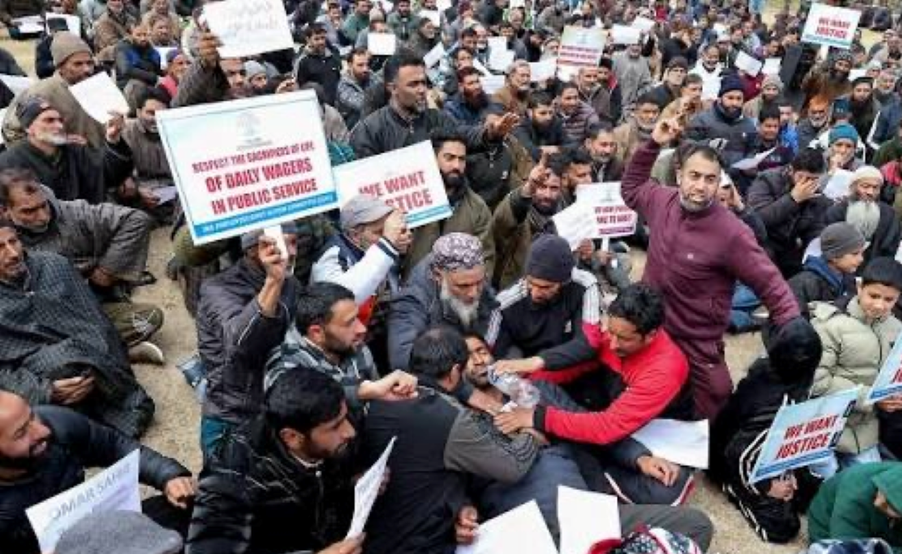
The prolonged wait has increasingly found expression in protests and public demands. On November 3, hundreds of daily wagers affiliated with the All J&K Daily Wagers Sangharsh Samiti attempted to march towards the Civil Secretariat in Jammu, demanding regularisation and implementation of the Minimum Wages Act.
In Kashmir, the Jammu and Kashmir Casual Daily Wagers Forum has also repeatedly raised the issue of the pending committee report. Parray has warned that continued neglect could compel workers to intensify their agitation, including disrupting essential services, while maintaining that their grievances should be resolved through dialogue.
The protests underline the growing impatience among workers, but they also highlight the wider public-service dimension of the issue. Many of the employees concerned are engaged in departments that support essential services. Any prolonged confrontation or disruption could have implications beyond the workforce itself.
A clear and time-bound process could help reduce uncertainty, provide workers with an opportunity to understand their eligibility and allow the government to address the issue through an institutional mechanism.
The government’s challenge is not limited to administrative or legal considerations. The financial implications of regularising more than one lakh temporary workers are likely to be substantial and would require careful assessment.
Senior government officials have indicated that bringing such a large workforce into the regular employment structure could increase recurring expenditure on salaries, pensions and other employee-related liabilities.
A significant portion of Jammu and Kashmir’s annual budget is already committed to meeting salary and pension obligations. Any additional recurring expenditure would therefore have to be assessed against the government’s available fiscal resources and competing development priorities.
The financial exercise would also need to consider the availability of sanctioned posts, the nature of existing engagements and the long-term cost of extending regular service benefits. The government would have to determine how any proposed policy could be implemented without creating financial obligations that cannot be sustained in subsequent years.
These considerations explain why regularisation cannot be treated as a simple administrative order covering every category in an identical manner. At the same time, financial constraints cannot indefinitely substitute for a policy decision. The government needs to establish the actual financial burden, examine possible options and communicate its findings to the affected employees.
The immediate priority is the completion of the high-level committee’s exercise and the submission of its recommendations to the government. The new Chief Secretary and the concerned departments will have a key role in determining whether the pending work can be expedited and a revised timeline announced.
Once the recommendations are available, the government will have to examine the proposed eligibility criteria, the status of sanctioned posts, the legal position of different categories and the financial resources required for implementation. It will also need to clarify whether the policy will cover all registered categories or whether separate mechanisms will be required for employees engaged under different terms and conditions.
Equally important will be transparency. Workers need to know what the government is considering, which categories are being examined and what documents or service records may be required for the assessment of their cases. A publicly communicated roadmap could help prevent further uncertainty and provide a basis for meaningful dialogue with employee representatives.
The government may also need to consider the concerns of employees nearing retirement, whose cases cannot remain unresolved indefinitely. Any special arrangement for such workers would, however, have to be examined within the applicable legal and financial framework.
For now, the fate of daily wagers’ regularisation remains uncertain. The government has acknowledged the delay and the complexities involved, but the workers are still waiting for a concrete outcome.
The National Conference’s electoral commitment has placed an expectation before the government, while the committee’s missed deadline has made the need for a clear response more pressing. Whether the administration can now move from examination to a workable policy will determine the direction of an issue that affects more than one lakh registered temporary workers across Jammu and Kashmir.
For those who have spent years working in government departments, the question is no longer simply whether regularisation is being considered. They want to know when a decision will be taken, what criteria will govern it and whether their years of service will receive due consideration. Until the government provides those answers, the uncertainty surrounding their future is likely to continue.