
Agencies | New Delhi:
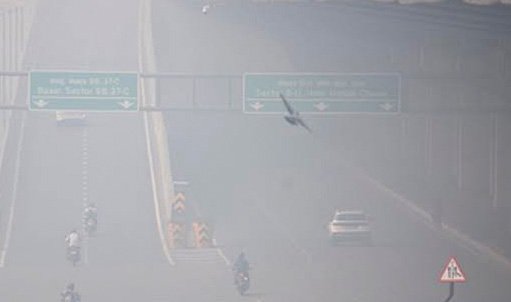
A thick blanket of smog continued to engulf Delhi on Thursday morning, with the national capital recording an average Air Quality Index (AQI) of around 314, placing it in the ‘very poor’ category, according to Central Pollution Control Board (CPCB) data.
IIT Delhi was among the worst-affected monitoring locations, with its AQI touching 412, falling in the ‘severe’ category. NSUT, Jaffarpur and ITO each recorded an AQI of 394, while North Campus reported 392 and Chandni Chowk 388.
Air quality across the National Capital Region (NCR) also remained poor. Noida recorded an AQI of 284, Gurugram 300, Ghaziabad 280 and Faridabad 270.
The pollution situation has remained a major concern even days after Diwali, with Delhi continuing to experience elevated pollution levels. The latest figures shared from monitoring dashboards put the city’s average AQI at around 319 on Thursday morning.
Delhi’s air quality had begun worsening ahead of the festival. An analysis by the Centre for Science and Environment (CSE) found that the average PM2.5 concentration during the week preceding Diwali stood at 236 micrograms per cubic metre, the highest for the corresponding period in three years.
The concentration was 97 per cent higher than the 120 micrograms recorded in 2025 and 32 per cent above the 179 micrograms reported in 2024, according to the analysis.
Pollution levels remained elevated around Diwali. Delhi recorded an average AQI of 376 on November 8, compared with 345 on Diwali in 2025. The AQI subsequently stood at 344 on November 9 and 299 on November 10 before rising to 313 on November 11, as per the reported CPCB figures.
Firecrackers also added to the pollution burden. Real-time source analysis estimated that they contributed 7.4 per cent of Delhi’s PM2.5 pollution on Wednesday, November 11.
The worsening air quality has triggered a political confrontation between the BJP and the Aam Aadmi Party (AAP), with both sides blaming each other for the pollution crisis.
Delhi BJP minister Kapil Mishra accused Punjab, governed by AAP, of contributing to the pollution through stubble burning. He alleged a sudden increase in farm fires around Diwali and called for an investigation into the incidents.
BJP MP Praveen Khandelwal also accused AAP of a conspiracy to keep pollution levels high in the national capital. These allegations have been rejected by AAP.
Former Delhi minister Saurabh Bharadwaj questioned the BJP-led Delhi government’s handling of the pollution situation. He argued that smoke from Punjab could not reach Delhi within minutes, claiming that its movement would take two to three days. AAP also questioned the reliability of pollution-monitoring data and the locations of monitoring stations.
With air quality remaining in the ‘very poor’ category across much of the capital, the latest readings underline the continuing pollution challenge facing Delhi and the wider NCR.