Examiner Bureau | New Delhi:
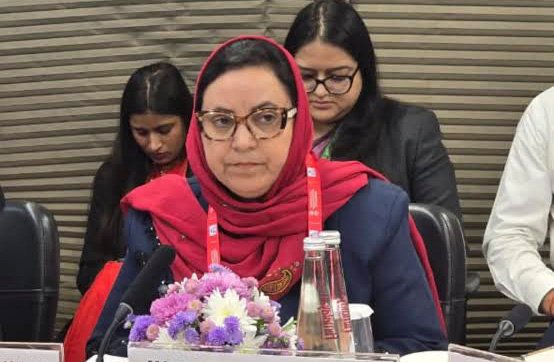
Jammu and Kashmir Minister for Health and Medical Education and Social Welfare Sakeena Itoo has called for district-specific action plans to tackle drug abuse, stressing the need to move beyond awareness campaigns towards measurable interventions focused on prevention, treatment and rehabilitation.
Addressing the second day of the National Social Justice Summit, ‘Samaveshi Niti Sankalp’, at Sushma Swaraj Bhawan in New Delhi on Wednesday, Itoo proposed a coordinated framework based on four principles: “One District, One Action Plan; One School, One Prevention Programme; One Patient, One Recovery Plan; and One Year of Follow-up”.
She said every district should prepare a dedicated action plan by identifying vulnerable areas and high-risk groups, with the Health, Education and Police departments working in coordination to ensure early identification and timely intervention.
Emphasising the role of educational institutions, the minister said schools and colleges should become centres of drug abuse prevention. She proposed appointing trained nodal teachers to educate students, identify early warning signs and facilitate confidential counselling and professional assistance.
Itoo stressed that rehabilitation must go beyond admission to de-addiction centres, saying individuals battling addiction need personalised recovery plans incorporating medical treatment, psychological counselling, family support, vocational training and employment opportunities.
“Sending an individual to a de-addiction centre cannot be considered the end of our responsibility. Recovery is a continuous process,” she said, underlining the need to help those affected rebuild their lives.
Citing an example from Kulgam, the minister said the rehabilitation of a young person affected by substance abuse should extend beyond medical treatment to include family involvement, counselling, skill development and livelihood support.
She also proposed a structured one-year follow-up mechanism after treatment, under which designated counsellors or health workers would remain in regular contact with recovered individuals to monitor their progress and help prevent relapse.
“Treatment must not end with discharge from a facility. The real test of our efforts lies in ensuring that the individual remains connected to the support system,” she said.
On enforcement, Itoo called for coordinated, intelligence-led action to dismantle drug trafficking networks and stringent legal action against those involved in drug peddling and distribution.
She said the approach must combine compassion towards victims, support for affected families and zero tolerance towards drug traffickers.
“Our approach must be compassionate towards the victim, supportive of the family and uncompromising towards the drug peddler,” she said, describing addiction as a serious health and social challenge.
The minister also stressed that the effectiveness of anti-drug initiatives should be assessed through tangible recovery outcomes rather than the number of awareness programmes, seminars and rallies organised.
“We must move beyond counting awareness programmes and start measuring the lives recovered, families restored and young people brought back into productive society,” she said.
Reaffirming Jammu and Kashmir’s commitment to the national campaign against drugs, Itoo said every district should be held accountable for implementing its action plan, while educational institutions must play an active role in prevention and recovered individuals should receive sustained support.
During the summit, the minister also raised issues relating to disability and scholarships.
On the inaugural day, while speaking during a thematic session on ‘One Nation, One Scholarship Portal – Accessible Scholarships, Empowered Students’, Itoo highlighted the difficulties faced by students from remote and far-flung areas of Jammu and Kashmir in accessing scholarships and welfare schemes.
She said limited digital connectivity and challenging geographical conditions often affect students in areas such as Basholi, Kishtwar, Reasi, Doda, Tanghdar, Machil, Keran, Gurez and Uri.
The minister informed the summit that the Social Welfare Department would issue a comprehensive verification calendar well in advance of 2027 to streamline the process, ensure timely processing of applications and facilitate the delivery of benefits to eligible students.
The two-day National Social Justice Summit, held on November 18 and 19, was organised to strengthen Centre-State coordination for effective implementation of social justice and empowerment initiatives in line with the vision of Viksit Bharat@2047.