
Agencies | New Delhi:
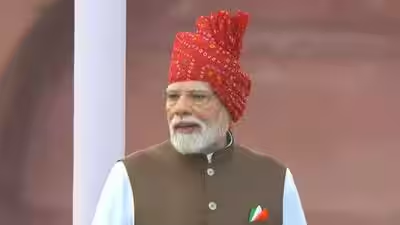
Leading the national celebrations on India’s 80th Independence Day, Prime Minister Narendra Modi hoisted the Tricolour from the ramparts of the historic Red Fort and delivered his 13th consecutive address to the nation.
Marking 150 years of the National Song, the event saw ‘Vande Mataram’ rendered live during the official ceremony for the first time, echoing across the venue as two Indian Air Force Mi-17 helicopters showered flower petals. Assisted by Captain Sonia Singh Chauhan during the flag-hoisting ceremony, the Prime Minister—sporting a traditional red, yellow, and white Bandhani turban—paid tribute to India’s freedom fighters and outlined a bold trajectory toward becoming a fully developed nation (Viksit Bharat) by 2047.
The celebrations hosted nearly 5,000 special guests, including youth innovators, PM Vishwakarma artisans, sanitation workers, street vendors, and ‘My Bharat’ volunteers. Real-time AI translation powered by digital platforms like Bhashini made the address accessible across 22 Indian languages.
Key Highlights from the Prime Minister’s Address
Breakthrough in Clean Mobility & Rail Infrastructure
- Hydrogen-Powered Mobility: PM Modi announced that India has entered a new frontier in sustainable transport with the operational rollout of its first indigenous hydrogen-powered train, describing it as a major milestone for green infrastructure.
- 100% Railway Electrification: Highlighting rapid modernization over the past decade, the Prime Minister noted that while only 30% of the rail network was electrified between 1925 and 2014, the nation achieved 100% electrification in the last 10 years.
- Manufacturing Surge: Modern railway coach production has surged 21-fold, and overall mobile phone manufacturing expanded 33-fold over the past 12 years.
Semiconductor & Tech Self-Reliance (Aatmanirbhar Bharat)
- Semiconductor Hub: With three major semiconductor fabrication facilities already operational, PM Modi projected that 5 to 8 additional chip-manufacturing plants will become operational over the next 7 to 8 years.
- Domestic Tech Expansion: Asserting that India cannot remain dependent on foreign supply chains for critical components, he emphasized domestic chip production as vital for electronics, medical systems, and advanced transportation.
Scaling Energy Security & Green Energy
- Solar Energy Adoption: Under the PM Surya Ghar Muft Bijli Yojana, over 50 lakh households have adopted rooftop solar installations.
- Solar & Nuclear Targets: India’s solar capacity has expanded from 2 GW to 160 GW over the last 12 years. The Prime Minister reiterated a long-term goal of producing 100 GW to 200 GW of clean nuclear energy by 2047 to power expanding data centers and high-tech industries.
- Piped Gas Reach: City gas distribution networks expanded from ~70 cities (covering ~20 lakh households) prior to 2014 to 700 cities reaching nearly 1.75 crore households.
- Offshore Exploration: Overcoming past regulatory inertia, the government opened up 99% of India’s coastline—previously designated as “no-go zones”—for resource exploration.
Inclusive Growth, Socio-Economic Reforms, and National Solidarity
- Poverty Reduction: Highlighting social welfare achievements over the past decade, PM Modi stated that 25 crore citizens have been successfully lifted out of poverty.
- Modernizing the Legal Framework: Reaffirming legislative reforms, the Prime Minister stated that 21st-century India cannot progress using outdated colonial-era laws.
- Flood Solidarity: PM Modi expressed deep empathy and full national support for communities affected by recent severe weather, heavy rainfall, and landslides across various regions.
Looking Ahead to 2047
Ending his address with a call to reject incremental goals, Prime Minister Modi urged 140 crore citizens to rally around the Vocal for Local and Swadeshi movements. He declared that as the world’s most populous country transforms into a developed economy by its centenary of independence, global perspectives on India will irrevocably shift.