
Agencies | Washington:
The Strait of Hormuz, already at the centre of the escalating US-Iran confrontation, has emerged as a dangerous new flashpoint after US President Donald Trump threatened Oman with military action if it interferes with Washington’s efforts to reopen the strategic waterway.
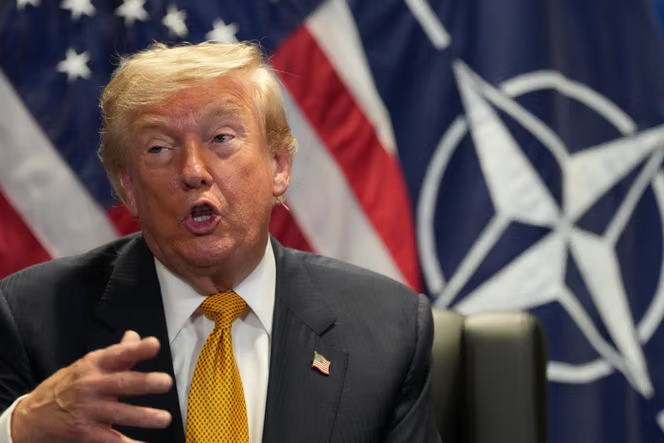
In a stark warning, Trump said the United States would “bomb the shit out of” Oman if Muscat “gets in the way” of US efforts to restore shipping through the strait. The threat has placed traditionally neutral Oman in an increasingly difficult position between Washington and Tehran.
The warning came as the US-Iran conflict appeared to have reached an impasse, with the 60-day window created under a June memorandum of understanding expiring on August 17 without a broader agreement. In an interview with Fox News on Monday, Trump was asked about parallel discussions between Iran and Oman on arrangements for commercial shipping through Hormuz. His response was blunt: “If Oman gets in the way, we’ll bomb the shit out of them.” Trump also demanded that Iran “surrender” to bring the war to an end.
The latest remarks mark another sharp escalation in Washington’s rhetoric towards Muscat. They also follow an earlier warning in May, when Trump told Oman to “behave” or face military consequences after reports emerged that Muscat and Tehran were discussing possible fees and controls for shipping through the waterway.
Oman’s importance in the dispute stems from its geography as well as its longstanding role as a mediator between the United States and Iran. The Strait of Hormuz is bordered by Iran to the north and Oman to the south, meaning any arrangement aimed at establishing a secure shipping corridor necessarily involves both countries.
For years, Oman has maintained diplomatic channels with both Washington and Tehran and has played an important role in facilitating backchannel contacts. Its ability to communicate with both sides has made Muscat one of the few regional actors capable of helping bridge the widening divide.
Emerging proposals reportedly involve commercial vessels using a southern route through Omani waters, with the arrangement coordinated with Iran. This gives Oman an important role in determining whether international shipping can safely move through the strait. However, the same influence has increasingly placed Muscat in the crosshairs of Washington’s pressure campaign.
At the heart of the dispute is the question of who controls shipping through Hormuz and under what conditions. The United States wants commercial vessels to regain the freedom of passage that existed before the war and opposes Iranian demands for tolls, approvals or other conditions on international shipping.
Washington also wants any new security arrangement to be presented as a US-Oman security guarantee, rather than as recognition of Iranian control over the waterway.
Iran takes a fundamentally different position. Tehran argues that the strait cannot return to normal while the US naval blockade and what it describes as American “aggressive actions” continue.
Iran has issued shipping guidance directing vessels towards routes closer to its coastline and has at times treated portions of the Omani side as restricted. Tehran has also linked the reopening of the waterway to broader political and security concessions, including an end to hostilities and relief from US pressure.
Oman, meanwhile, faces a delicate balancing act. Continued disruption of shipping through Hormuz poses a direct economic and strategic threat to the Gulf state, while maintaining its role as a neutral mediator remains central to its regional diplomacy.
Muscat wants the waterway reopened and commercial traffic restored, but it also needs Iran’s cooperation to ensure the safety of ships using routes near its coastline. That position has become increasingly difficult as Washington presses for an arrangement that Tehran may reject.
The dispute is particularly dangerous because of the enormous global importance of the Strait of Hormuz. The waterway is one of the world’s most critical energy corridors, through which a substantial share of global oil and liquefied natural gas supplies traditionally passes.
Any prolonged closure or disruption could send energy prices sharply higher, increase transportation costs and trigger wider economic consequences far beyond the Middle East.
The confrontation also carries implications for the wider Gulf security architecture. Oman hosts US forces and provides access to American military facilities, making Trump’s threat particularly significant.
A direct confrontation between Washington and Muscat would represent an extraordinary deterioration in relations with a country that has traditionally been regarded as an important US security partner and diplomatic bridge to Tehran. Other Gulf states could also begin reassessing their dependence on American security guarantees if the confrontation escalates.
The latest crisis follows the collapse of the framework established under the June US-Iran memorandum. The agreement was intended to provide a path towards ending the conflict, with both sides committing to negotiations aimed at reaching a final settlement within 60 days. It also envisaged arrangements for commercial shipping through Hormuz.
However, disagreements emerged almost immediately over how the commitments should be implemented. Washington accused Iran of obstructing the reopening of the waterway, while Tehran accused the United States of failing to meet its commitments and maintaining economic and military pressure.
By July, Trump had declared the agreement effectively over, leaving the August 17 deadline as more of a formal endpoint than a genuine negotiating milestone.
With the deadline now expired, the immediate challenge is whether Washington, Tehran and Muscat can establish a new mechanism for restoring commercial traffic before the confrontation spirals further.
Iran and Oman have indicated that discussions over the strait have progressed, but both have warned that reopening the waterway cannot be separated entirely from the wider security situation.
Trump’s latest threat appears designed to put maximum pressure on Muscat to support a US-backed shipping arrangement. Yet the tactic could produce the opposite result. Rather than forcing Oman to comply, an overt threat of military action could push Muscat to harden its position, strengthen coordination with Tehran or seek alternative diplomatic and security guarantees.
The stakes therefore extend well beyond a dispute between three countries. Hormuz has become a test of whether diplomacy can prevent the US-Iran confrontation from expanding into a wider regional crisis.
Washington wants unrestricted shipping and greater pressure on Tehran. Iran wants the US blockade lifted and rejects what it sees as an attempt to undermine its influence over the waterway. Oman, meanwhile, is attempting to keep the strait open without abandoning its carefully maintained role as a neutral mediator.
For global markets, the question is increasingly urgent: Can Hormuz be reopened through diplomacy, or will the battle over control of the world’s most important energy chokepoint become the next dangerous stage of the US-Iran confrontation?