
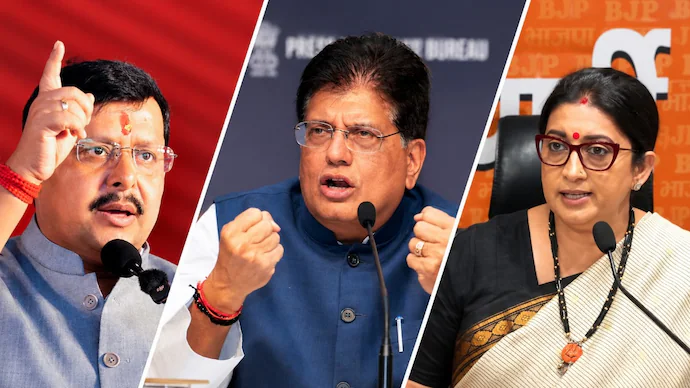
Agencies | New Delhi:
The Bharatiya Janata Party’s (BJP) new national team under party president Nitin Nabin may appear, at first glance, to be a routine organisational reshuffle. But beneath the list of appointments lies a much more immediate political message: Uttar Pradesh is firmly at the centre of the BJP’s preparations for the 2027 Assembly elections.
Of the 65 office-bearers announced, nearly 50 are new. The team brings together leaders from 23 states and Union Territories, with a relatively younger profile, 12 women and representation from several social communities. Yet one state stands out for the scale and political weight of its representation—Uttar Pradesh.
Eight leaders from Uttar Pradesh have found places in the new national organisation, the highest representation for any state. Their profiles reflect a deliberate mix of electoral experience, caste representation, minority outreach and organisational expertise.
The emphasis is significant. With 403 Assembly seats and 80 Lok Sabha constituencies, Uttar Pradesh remains the BJP’s most important electoral battleground. It is also the state where the party suffered one of its sharpest setbacks in the 2024 Lok Sabha elections.
The new national team therefore appears less like a conventional organisational exercise and more like an early blueprint for the BJP’s 2027 campaign.
Why Uttar Pradesh Is Nitin Nabin’s Biggest Test
Nabin took over as BJP national president around seven months ago, but his national team has been announced only now, as the party moves closer to the 2027 Assembly elections.
The BJP has ample reason to approach the next election cautiously.
In 2019, the party won 62 of Uttar Pradesh’s 80 Lok Sabha seats. In 2024, its tally fell dramatically to 33. The NDA’s combined tally dropped from 64 to 36, while the Samajwadi Party emerged as the single largest party in the state with 37 seats.
The BJP’s vote share also declined significantly, from around 50 per cent in 2019 to roughly 41 per cent in 2024.
The defeat in Faizabad, the constituency that includes Ayodhya, carried particular symbolic significance. Despite the BJP’s enormous political investment in the Ram Temple issue, the seat was won by the Samajwadi Party by more than 48,000 votes.
The 2027 Assembly election will therefore be much more than a contest for power in Lucknow. It will be an opportunity for the BJP to demonstrate whether it has understood and corrected the weaknesses exposed by the 2024 verdict.
The Eight Faces From Uttar Pradesh
The composition of the Uttar Pradesh contingent is revealing. It is not concentrated around one caste, region or political profile.
Among the prominent appointments are Smriti Irani and Harish Dwivedi, who have been made national general secretaries. Rekha Verma and former Aligarh Muslim University vice-chancellor Tariq Mansoor have been appointed national vice-presidents.
The team also includes two national secretaries and leaders heading the BJP’s OBC and Minority Morchas from Uttar Pradesh.
The social arithmetic is equally significant.
Harish Dwivedi represents the Brahmin community, while Rekha Verma, Sangeeta Yadav and Amarpal Maurya add OBC representation. Maurya has been given responsibility for the party’s OBC Morcha. BJP MP Bhola Singh represents the Scheduled Caste community.
The party has also given prominence to its Pasmanda Muslim outreach, with Tariq Mansoor and Kunwar Basit Ali emerging as two important Muslim faces from Uttar Pradesh in the national structure.
Taken together, the appointments indicate an attempt to rebuild and broaden the BJP’s social coalition in a state where caste alignments played a crucial role in the 2024 election.
Smriti Irani’s Return Carries Political Weight
Among the Uttar Pradesh appointments, Smriti Irani’s return to the BJP’s national organisation is perhaps the most politically significant.
Irani has been appointed national general secretary after remaining outside the party’s central organisational structure following her defeat in the 2024 Lok Sabha election from Amethi to Congress candidate KL Sharma.
Her political identity remains closely linked with Uttar Pradesh.
In 2019, Irani defeated then Congress president Rahul Gandhi in Amethi, ending his long association with the constituency. The victory transformed her into one of the BJP’s most prominent political faces in the state.
Five years later, however, she lost the seat.
Her return as national general secretary therefore carries a strong political message. The BJP is once again placing one of its most recognisable Uttar Pradesh campaigners in a key organisational position ahead of the next Assembly election.
Her role could extend beyond electoral campaigning. As a national general secretary, Irani can serve as an important bridge between the central leadership and the state organisation.
Her stated focus on strengthening the party organisation at the grassroots also suggests that the assignment could be heavily oriented towards election preparation.
Sunil Bansal and the Organisational Factor
Another name with considerable significance for Uttar Pradesh is Sunil Bansal, who has been associated with the BJP’s booth-level organisational strategy in the state.
Bansal is widely credited with helping strengthen the BJP’s grassroots machinery and contributing to the party’s impressive performance in the 2017 Assembly elections.
His return is important because the BJP’s 2024 setback cannot be explained simply through national messaging or campaign personalities.
The party’s traditional strength has been its extensive booth-level organisation and its ability to convert electoral support into votes through a highly structured ground network.
The prominence of organisational strategists therefore suggests that the BJP is preparing for 2027 as a booth-by-booth battle, not merely a contest dominated by speeches, rallies and personalities.
The Caste Calculation
Perhaps the clearest political message from the new team is its social composition.
The Samajwadi Party’s PDA—Pichhda, Dalit, Alpsankhyak strategy helped it consolidate support among sections of OBCs, Dalits and Muslims.
The BJP’s response appears to involve a broader representation of these communities within its own organisational structure.
By bringing together Brahmin, OBC, Dalit and Pasmanda Muslim faces, the party appears to be signalling that it wants to widen its social base rather than rely primarily on its traditional upper-caste support combined with Hindutva consolidation.
This does not necessarily guarantee electoral gains. But it does reveal where the party believes greater political attention is required.
Why Pasmanda Outreach Matters
The elevation of Tariq Mansoor and Kunwar Basit Ali is particularly noteworthy.
For several years, the BJP has sought to expand its outreach to Pasmanda Muslims, approaching minority politics through social and economic categories rather than treating Muslims as a single electoral bloc.
Giving two Pasmanda leaders from Uttar Pradesh national organisational roles provides the party with a wider platform for that strategy.
Whether this outreach can produce a significant electoral shift in 2027 remains uncertain. But their inclusion suggests that the BJP has no intention of abandoning the strategy.
Women and Youth in the New BJP Structure
The reshuffle also reflects an attempt to give greater organisational space to women and younger leaders.
The new national team includes 12 women, while six office-bearers are below the age of 40 and another 15 fall within the 40-49 age bracket.
Uttar Pradesh contributes three women to the national structure—Smriti Irani, Rekha Verma and Sangeeta Yadav.
The move comes at a time when women have emerged as an increasingly important electoral constituency in Uttar Pradesh and across India.
The BJP has invested heavily in welfare schemes and direct outreach targeting women voters. A stronger presence of women within the organisation could help the party translate those programmes into grassroots political mobilisation.
The younger profile of the new team similarly reflects an attempt to strengthen the BJP’s appeal among younger voters, a particularly important constituency in a state with a vast youth population.
What the BJP Is Trying to Fix After 2024
The new organisational structure can broadly be understood as a response to the lessons of the 2024 Lok Sabha election.
For years, the BJP’s Uttar Pradesh strategy rested on several pillars: Prime Minister Narendra Modi’s popularity, the Yogi Adityanath government, Hindutva politics, welfare delivery and an extensive organisational network.
The 2024 election demonstrated that the formula was not invincible.
The party lost 29 Lok Sabha seats compared with 2019, while the Samajwadi Party expanded beyond its traditional Yadav support base. The Congress-Samajwadi Party alliance also demonstrated that opposition consolidation could turn previously strong BJP constituencies into competitive contests.
The new team appears to address these weaknesses on three fronts.
First, rebuild the social coalition. The party has brought in OBC, Dalit, Brahmin and Pasmanda Muslim faces.
Second, strengthen the organisation. The return of experienced organisational figures points towards renewed emphasis on booth-level mobilisation.
Third, restore political firepower. Smriti Irani’s return gives the BJP a high-profile Uttar Pradesh campaigner with a proven electoral profile.
The Road to 2027 Begins Now
For Nitin Nabin, Uttar Pradesh could become the first major test of his leadership as BJP president.
The organisational reshuffle suggests that the party is already preparing for the contest, even though the Assembly election is still months away.
The challenge will be formidable. The BJP must defend the Yogi Adityanath government, rebuild support among sections of OBCs and Dalits, strengthen its appeal among women and young voters, counter the Samajwadi Party’s social coalition and restore the organisational dominance that helped it sweep Uttar Pradesh in previous elections.
At the same time, the party must ensure that its national messaging and state-level campaign remain aligned.
The BJP’s new national team, particularly its unusually strong Uttar Pradesh representation, suggests that the party has already identified the battlefield.
The 2027 Uttar Pradesh election may ultimately determine whether the BJP can turn the lessons of 2024 into an electoral comeback—and Nitin Nabin’s organisational strategy will face its biggest examination in doing so.