
Agencies | Lebonan:
Iran has reportedly been invited to join the Mecca Joint Defence Agreement signed by Saudi Arabia, Türkiye and Pakistan on August 7, a development that, if confirmed, could significantly alter the emerging regional security architecture.
Iranian officials are said to be considering the reported offer as regional powers explore new security arrangements beyond the traditional US-led framework.
Mehdi Rahimi, head of Khaneh Mellat, the official news agency of Iran’s parliament, told Lebanon-based Al Mayadeen that Tehran had received an invitation and that the matter was “under consideration”, according to Pakistan’s SAMAA TV.
Details surrounding the reported invitation remain unclear. Rahimi did not identify which government had extended the invitation, when it was received or what conditions might be attached to possible Iranian membership.
Neither Saudi Arabia, Türkiye nor Pakistan has publicly confirmed the reported approach.
The possibility of Iran joining the grouping would carry considerable geopolitical significance. The defence pact emerged against the backdrop of heightened regional tensions and conflict involving Iran, including missile and drone attacks and threats to critical infrastructure and shipping routes.
If Tehran were to become a member, the pact could undergo a fundamental transformation—from a security arrangement widely viewed through the lens of concerns over Iranian influence into a broader regional framework that includes Iran itself.
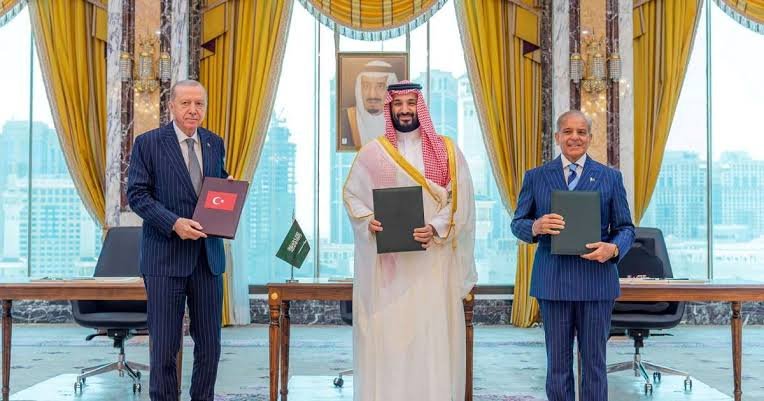
Saudi Crown Prince Mohammed bin Salman, Turkish President Recep Tayyip Erdoğan and Pakistani Prime Minister Shehbaz Sharif signed the Mecca Joint Defence Agreement in Mecca on August 7.
A central provision of the agreement states that an armed attack against one member would be considered an attack against all three.
The arrangement has been compared with Article 5 of the North Atlantic Treaty Organisation (NATO), although the publicly available text does not prescribe specific military action that members must undertake following an attack.
The pact has consequently been described by some analysts and media outlets as an “Islamic NATO”, although its precise institutional and military structure differs from that of NATO.
The agreement focuses on four broad areas: collective defence, defence-industrial cooperation, joint military exercises and intelligence sharing.
It envisages greater cooperation in defence production, including technology transfer and joint manufacturing, alongside regular military exercises and mechanisms for exchanging intelligence and strategic information.
However, the agreement does not publicly specify the exact nature or scale of assistance that a member would be required to provide if another member came under attack. The form and extent of any response would instead be determined through consultations.
The pact also reportedly contains a provision under which a member that initiates aggression or permits its territory to be used to attack another country could lose the protection offered by the agreement.
Pakistan has indicated that the defence arrangement should not necessarily remain restricted to its three founding members.
Defence Minister Khawaja Asif has said the pact should not become an “exclusive club”, while Foreign Minister Ishaq Dar has described the arrangement as “purely defensive in nature”.
Egypt has emerged publicly as a possible future participant, while Syria and Bangladesh have also been reported as examining the framework.
However, a possible Iranian entry would represent a far more consequential development because of Tehran’s longstanding strategic rivalry with Saudi Arabia and its broader role in regional security affairs.
Saudi Arabia and Iran restored diplomatic relations in 2023 following years of regional rivalry. However, their rapprochement has faced renewed pressure amid the latest escalation of tensions in West Asia.
Iranian membership of the Mecca pact could bring two longstanding regional rivals into the same collective-defence framework, creating both opportunities and complications.
Such a development could potentially encourage dialogue and regional de-escalation, but it would also raise questions about how collective-defence commitments would operate if members held conflicting strategic interests or faced security threats involving Iran.
The agreement was established as Saudi Arabia, Türkiye and Pakistan sought to deepen security coordination. Bringing Tehran into the framework would therefore substantially alter the strategic character of the arrangement.
Iran’s reported invitation could prove to be a major geopolitical development because it would potentially change the strategic purpose and identity of the Mecca pact.
A grouping that emerged amid regional tensions and was widely viewed as part of a broader effort to strengthen collective security among Muslim-majority states could instead evolve into a more inclusive regional security mechanism incorporating Tehran.
Iran’s participation could also reinforce a growing push among regional powers for greater strategic autonomy and reduced dependence on Western-led security arrangements.
For Saudi Arabia and Iran, membership in the same defence framework could represent a dramatic shift in their long-running rivalry and potentially open new channels for regional confidence-building.
At the same time, integrating Iran into a collective-defence arrangement would present complex diplomatic and military challenges. Questions over mutual defence obligations, command structures, intelligence sharing and responses to future conflicts would require careful negotiation.
If Tehran ultimately joins, the Mecca pact could become an important pillar of a more multipolar West Asian security order, potentially influencing the security of vital energy corridors and regional trade routes.
For now, however, the reported invitation remains unconfirmed by the pact’s founding members, while Tehran’s reported position is that the matter is still under consideration.