
Agencies | Kathmandu:
The death toll from devastating flash floods across parts of Nepal and Tibet has risen above 470, as rescue teams on both sides of the Himalayan border continue efforts to locate survivors and recover those missing.
Nepal’s Prime Minister’s Office said on Friday that 469 people had been confirmed dead, while 977 remained missing. In Tibet, Chinese authorities reported at least three deaths and 558 people missing.
Nepalese authorities said 644 of those reported missing are foreigners. Around 1,550 people have so far been rescued, with emergency teams using helicopters and ground operations to reach isolated communities.
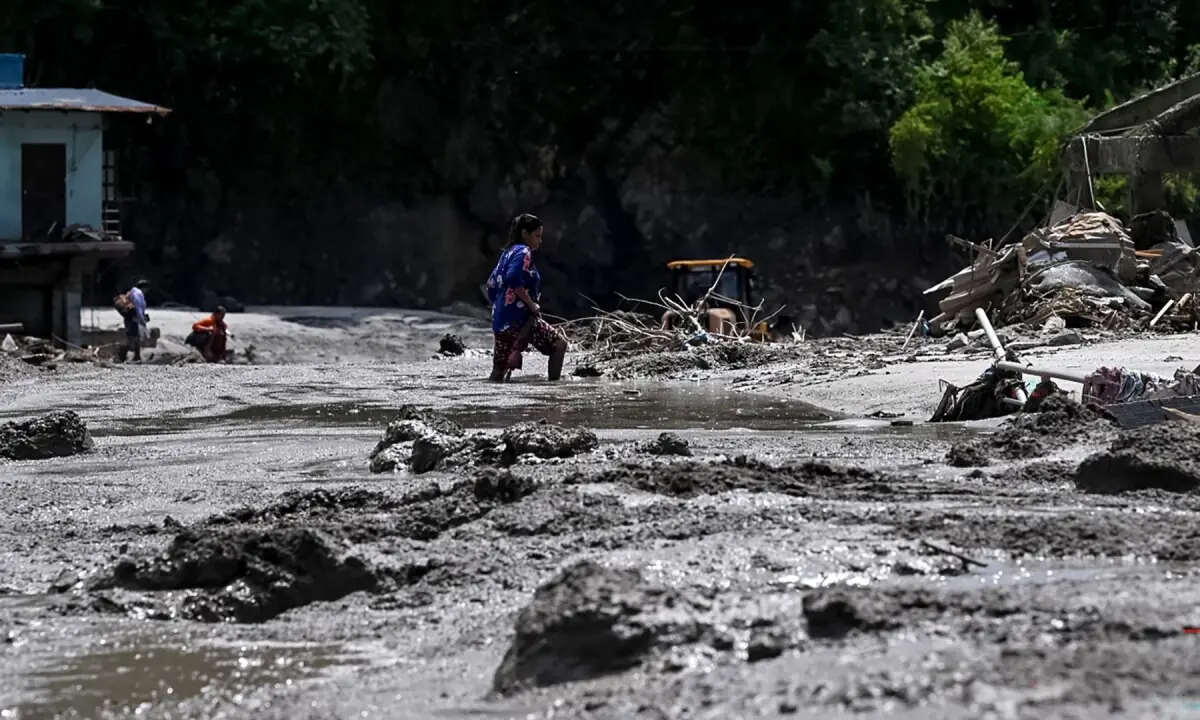
The disaster struck on Wednesday after a glacier collapse triggered a massive surge of ice, water, rocks and mud through Himalayan river valleys. Entire villages were inundated, while roads, bridges and hydropower infrastructure were damaged or destroyed.
Bishal Nath Upreti, president of the Nepal Centre for Disaster Management, described the situation in the affected areas as “extremely difficult”, particularly for people stranded in remote locations that rescuers are unable to reach by road.
“Almost 42km of road is completely wiped out, and, except for the helicopters, the rescuers cannot go there,” Upreti said.
He said approximately 800 people had been rescued by helicopter and another 700 by land, while emergency supplies were being airlifted to survivors.
With many people having spent more than 72 hours without adequate shelter or food, concerns are mounting over the humanitarian situation in isolated areas.
The number of missing people could rise further as rescue teams gain access to previously unreachable locations.
China has deployed around 500 military and paramilitary personnel to support rescue and relief operations in the affected areas of Tibet. Chinese Premier Li Qiang has also travelled to the region to oversee the response.
The deployment underlines the urgency of the situation as authorities confront widespread destruction and difficult terrain along the Himalayan border.
Nepal, meanwhile, has mobilised around 30,000 security personnel for search-and-rescue operations across remote valleys.
Rescue operations are being complicated by fears of further flooding and landslides.
Particular concern has focused on a newly formed barrier lake along the Nepal-China border, which authorities in both countries have warned could become unstable and potentially burst.
Barrier lakes are created when floods or landslides block a river, causing water to accumulate behind a natural dam made up of debris.
Chinese authorities estimated that the lake currently contains approximately two million cubic metres of water and could receive an additional three million cubic metres over the next three days.
The potential threat has forced some rescue and military teams attempting to reach the border port of Gyirong to temporarily halt operations because of the risk of mudslides.
Buildings in the area have reportedly been buried under around 1.5 metres of mud, further complicating efforts to search for survivors and recover bodies.
The possibility of another major surge has created an increasingly urgent race against time, with rescuers attempting to locate survivors before additional flooding or mudslides make the affected areas even more inaccessible.
Nepal’s Foreign Ministry said on Friday that the country did not currently require international assistance for search-and-rescue operations.
Foreign Ministry spokesperson Lok Bahadur Chhetri said Nepal’s security agencies were leading the rescue effort and were capable of handling the initial response.
However, officials indicated that Nepal remained open to other forms of international support, particularly financial assistance, given the enormous scale of the disaster.
Authorities are facing the difficult task of reaching isolated communities, providing food and shelter, restoring damaged infrastructure and accounting for hundreds of missing people.
In Kathmandu, the disaster has left families anxiously searching for information about relatives who remain unaccounted for.
Large crowds gathered outside Tribhuvan University Teaching Hospital seeking information about missing family members, amid uncertainty over the fate of those caught in the floods.
For families across the affected region, the rescue operation has become a desperate search for survivors as authorities continue to battle damaged roads, unstable terrain, landslides and the threat of further flooding.
With hundreds still missing on both sides of the Himalayan border, rescue teams remain under intense pressure to reach isolated communities and provide urgent assistance to survivors.