Agencies | Bishkek:
Leaders of the Shanghai Cooperation Organisation (SCO) have strongly condemned military strikes on Iran and criticised unilateral sanctions, calling for disputes to be resolved through political and diplomatic means.
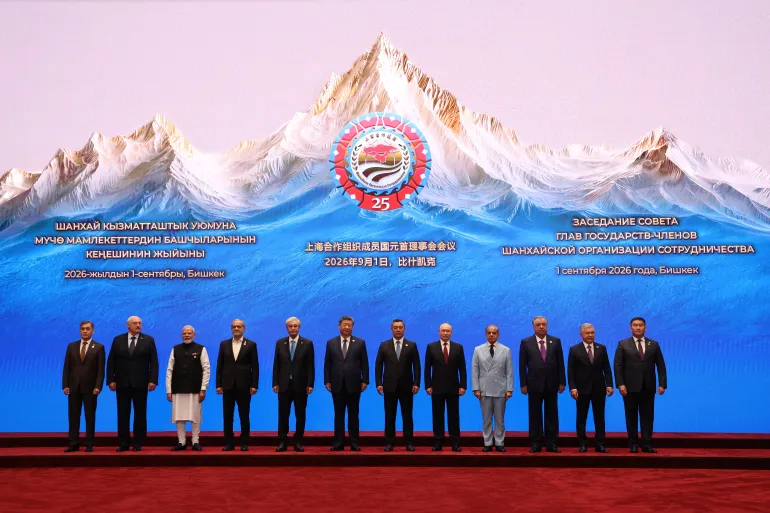
The position was outlined in the Bishkek Declaration adopted at the conclusion of a two-day SCO summit in Kyrgyzstan. The declaration was endorsed by Chinese President Xi Jinping, Russian President Vladimir Putin, Indian Prime Minister Narendra Modi, Pakistani Prime Minister Shehbaz Sharif and other leaders of the grouping.
The SCO comprises India, China, Russia, Pakistan, Iran, Belarus, Kazakhstan, Kyrgyzstan, Tajikistan and Uzbekistan.
The grouping condemned what it described as military strikes on Iranian territory that resulted in civilian casualties and extensive economic damage.
SCO members said such attacks violated principles of international law and the UN Charter and posed risks to regional and international peace and stability.
The declaration also expressed condolences to Iran over the reported death of Supreme Leader Seyyed Ali Khamenei and to the families of those killed in the conflict.
The member states reaffirmed their support for Iran’s sovereignty and territorial integrity and called for an end to the conflict through political and diplomatic channels.
The SCO also criticised Israeli military action in Palestine, saying the continuing conflict had contributed to instability across West Asia. It said a comprehensive and just resolution of the Palestinian issue was essential for lasting peace in the region.
Without naming individual sanctions regimes, SCO leaders opposed what they called “unilateral coercive measures” that violate international rules and could negatively affect the global economy.
The declaration called for an open, transparent and inclusive multilateral trading system, with fair market access and greater consideration for developing economies.
The position comes amid continuing disruption to global trade and energy markets linked to the conflict in West Asia, particularly concerns surrounding the Strait of Hormuz, a critical route for international energy supplies.
The grouping also reaffirmed Iran’s right under the Nuclear Non-Proliferation Treaty (NPT) to develop and use nuclear technology for peaceful purposes.
SCO members stressed the “inalienable right” of countries to research, produce and use atomic energy for peaceful purposes and called for international cooperation in the nuclear sector without discrimination.
The declaration said measures aimed at restricting such rights were contrary to international law.
Iran has consistently maintained that its nuclear programme is intended for peaceful purposes, while the United States has accused Tehran of seeking the capability to develop nuclear weapons. Tehran has rejected those allegations.
Economic cooperation also featured prominently at the summit, with SCO members seeking to strengthen regional trade, financial cooperation and energy partnerships amid disruptions to global markets.
The leaders reaffirmed their commitment to implementing the SCO Economic Development Strategy up to 2030 and agreed to deepen practical cooperation in finance and trade.
They also backed expanded energy cooperation and implementation of the SCO Member States’ Energy Cooperation Strategy to 2030, highlighting the importance of secure and mutually beneficial energy partnerships.
Terrorism remained another major issue at the summit, with India and Pakistan reiterating their sharply contrasting positions.
Prime Minister Narendra Modi described terrorism as a “grave challenge to all of humanity” and called for a unified international response against terrorist financing, recruitment, radicalisation and safe havens.
“We must speak with one voice and make it clear that there can be no place for double standards on this serious issue,” Modi said.
He also called on countries to ensure that terrorism is never used as an instrument of state policy.
Although Modi did not name any country, his remarks were widely seen as directed at Pakistan.
Pakistan Prime Minister Shehbaz Sharif, meanwhile, emphasised Pakistan’s own experience with terrorism and said Islamabad had made significant sacrifices in combating militancy.
“Recalling Pakistan’s immense sacrifices in the fight against terrorism, I reiterated that terrorism must be condemned in all its forms and manifestations,” Sharif said.
The Bishkek Declaration stated that SCO members would continue joint efforts to combat terrorism, separatism and extremism.
The leaders also rejected double standards in counterterrorism efforts and called for stronger international cooperation against terrorism, including the cross-border movement of militants.
The summit thus combined a strong political message on Iran and West Asia with calls for deeper economic, energy and security cooperation, underscoring the SCO’s growing role as a platform for coordination among major Asian powers.