
Agencies | New Delhi:
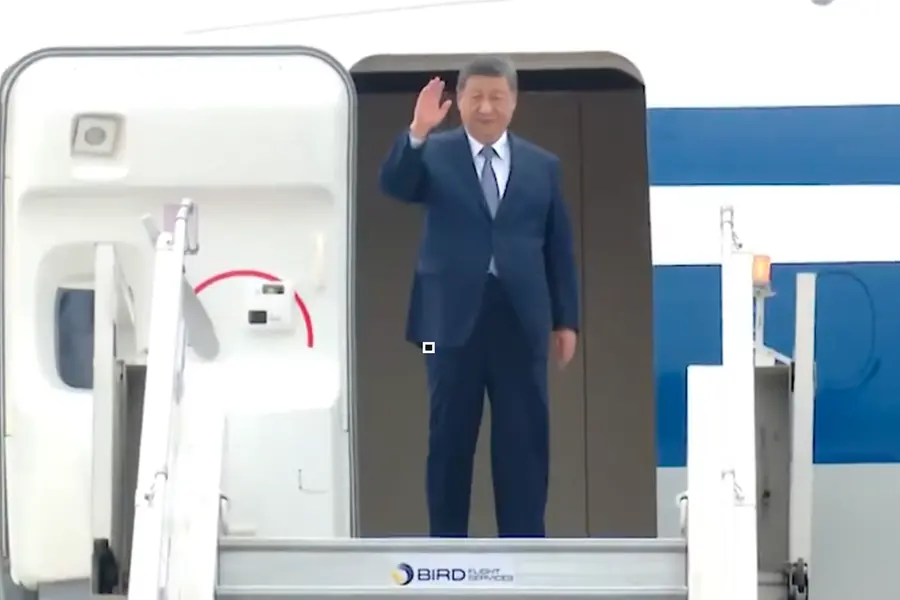
Chinese President Xi Jinping arrived in New Delhi on Saturday to attend the 18th BRICS Leaders’ Summit, beginning his first visit to India in seven years as New Delhi and Beijing seek to stabilise bilateral ties following years of tensions.
Prime Minister Narendra Modi is scheduled to hold bilateral talks with Xi on Saturday evening, with trade, investment and the broader trajectory of India-China relations expected to figure prominently in the discussions.
Ahead of Xi’s arrival, Beijing called for India and China to approach their relationship from a strategic and long-term perspective while managing differences appropriately.
Chinese Foreign Ministry spokesperson Mao Ning said the upcoming Modi-Xi meeting would mark the third consecutive year of talks between the two leaders, following their meetings in Kazan and Tianjin.
“China will work with India to act on the strategic guidance of the two leaders, handle the bilateral relations from a strategic height and long-term perspective, step up communication, enhance cooperation, properly handle differences, and be friends enjoying good-neighbourliness and partners helping each other succeed,” she said.
Xi’s visit comes against the backdrop of sustained efforts by New Delhi and Beijing to repair relations following the military standoff in eastern Ladakh that began in 2020.
The two sides have taken a series of confidence-building measures in recent months, while diplomatic and military channels have remained active in an effort to maintain peace and stability along the Line of Actual Control.
The latest round of Special Representatives’ talks in Beijing on August 25 produced an eight-point consensus, including commitments to maintain peace along the border, advance discussions on boundary settlement and border management, establish additional meeting points and military hotlines, and strengthen cooperation in border trade and pilgrimage.
India’s National Security Adviser Ajit Doval and Chinese Foreign Minister Wang Yi, who are the respective Special Representatives on the boundary question, also agreed to continue discussions on an “early and substantial harvest” in boundary delimitation and border management. The next round of Special Representatives’ talks is scheduled to be held in India in 2027.
Despite these developments, unresolved issues along the border continue to weigh on bilateral relations. The upcoming Modi-Xi talks are therefore being closely watched for indications of whether the recent diplomatic thaw can translate into a broader stabilisation of ties.
Xi last visited India in 2019, when he held an informal summit with Modi in Mamallapuram near Chennai.
Before that, he travelled to Goa in 2016 for the BRICS Summit. His first visit to India came in September 2014, when he held extensive talks with Modi during the first terms of both leaders.
His return to New Delhi now comes at a significant juncture, with both countries attempting to move beyond the prolonged freeze that followed the eastern Ladakh standoff.
Xi is accompanied by a high-level delegation comprising senior Chinese officials and business representatives.
India, which currently holds the BRICS chair, is hosting the grouping’s 18th Leaders’ Summit in New Delhi on September 12 and 13.
Xi’s participation gives the bilateral engagement added significance as the expanded BRICS grouping seeks to strengthen economic cooperation and amplify the voice of emerging and developing economies amid a volatile global environment.
BRICS originally comprised Brazil, Russia, India, China and South Africa. The grouping expanded in 2024 with the inclusion of Egypt, Ethiopia, Iran and the UAE, while Indonesia joined in 2025. Saudi Arabia’s status has been subject to differing official descriptions, and is therefore best treated separately from the core membership list.
India is a founding member of BRICS and has previously chaired the grouping in 2012, 2016 and 2021. It assumed the chairship for a fourth time on January 1, 2026.
The year 2026 also marks 20 years since the establishment of BRICS, adding further significance to India’s presidency and the New Delhi summit.
For India and China, however, the most closely watched engagement will be the Modi-Xi meeting, which could provide a fresh indication of whether the two Asian powers are ready to move from cautious border stabilisation towards a broader reset in bilateral relations.