
Agencies | Amman:
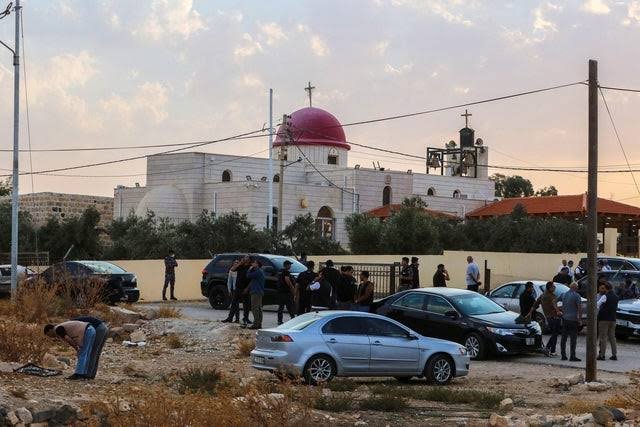
At least seven people were killed and 34 others wounded when gunmen opened fire during a funeral at a Greek Orthodox church in Jordan’s Karak governorate on Friday, authorities said.
Director of Jordan’s Public Security Directorate Obaidullah Al-Maaytah confirmed the casualties at a press conference, identifying the site of the attack as a Greek Orthodox church in the village of Hamoud. He said 27 of the wounded were receiving treatment in hospitals.
Authorities have launched a search for the attackers, with Al-Maaytah vowing that those responsible would be apprehended. He also stressed that the attack would not undermine national unity.
Survivors said they heard an explosion as the funeral procession began, after which masked gunmen entered the church and opened fire for several minutes.
Jordan’s state-owned television channel Al-Mamlaka reported that security forces had been deployed to the scene and were pursuing two suspects who allegedly got out of a vehicle and began shooting.
Funeral attendee Khaled Burqan told the broadcaster that dozens of people had gathered for the procession. According to his account, one attacker was carrying a pistol while the other had a rifle.
No group had immediately claimed responsibility for the attack.
Interior Minister Mazen al-Faraya described the incident as an unprecedented terrorist attack, condemning the perpetrators in strong terms without identifying any specific group as responsible.
“This country will never be dragged into terrorism and violence,” he said, emphasising Jordan’s determination to prevent further violence.
Earlier, King Abdullah II vowed that those responsible would face severe punishment.
“The blood of Jordanians is precious, and we will strike with an iron fist against anyone who overreaches against this country,” the King said in a post on X.
The attack has raised concerns over security in a country where such incidents are rare and where Muslim and Christian communities have coexisted for generations.
The latest incident comes against the backdrop of a deadly attack in Karak in 2016, when Islamic State of Iraq and the Levant (ISIL/ISIS) fighters took refuge in a Crusader-era castle and killed 10 people, including security personnel and a Canadian tourist. Jordanian security forces subsequently killed the attackers.
Located around 120 kilometres south of Amman, Karak is home to Muslim and Christian communities with a long history of coexistence.
Regional observers have noted that an attack targeting a religious gathering could carry implications beyond the immediate loss of life, particularly if it seeks to inflame sectarian tensions.
Jordan is home to approximately 300,000 Christians in a population of around 11.5 million. The country also hosts several sites of religious significance that attract Christian pilgrims from around the world.
The incident also poses a challenge to Jordan’s longstanding emphasis on religious coexistence and its diplomatic role in safeguarding Muslim and Christian holy sites in Jerusalem.
Authorities are continuing their investigation, pursuing suspects and examining the circumstances surrounding the attack.