
Agencies | Washington:
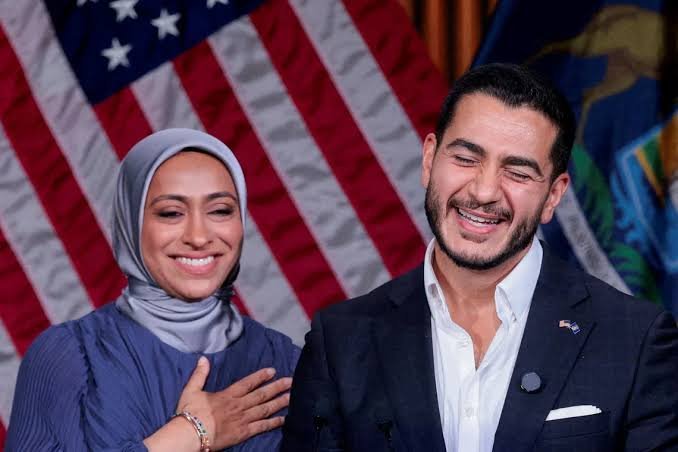
Democratic candidate Abdul El-Sayed has defeated his Republican rival, Mike Rogers, to win Michigan’s US Senate seat, overcoming a campaign marked by anti-Muslim rhetoric and attacks led by President Donald Trump and his allies.
With his victory on Tuesday, El-Sayed is set to become the first Muslim senator in US history. He is scheduled to be sworn in on January 3.
The result has been widely seen by his supporters as a rejection of religious bigotry and an endorsement of a more inclusive political landscape. Maya Berry, executive director of the Arab American Institute (AAI), said Republicans had made anti-Arab and anti-Muslim rhetoric a central part of their campaign against El-Sayed, but the strategy had failed.
“The electorate rejecting that bigotry is tremendous,” Berry told Al Jazeera, describing the outcome as significant for children from all communities and for the future of inclusive democracy in the United States.
El-Sayed, a former public health official and critic of Israel’s policies, secured a hard-fought Democratic primary victory in August. During the contest, the American Israel Public Affairs Committee (AIPAC) reportedly spent more than $30 million opposing him.
Following his primary win, he faced a series of accusations from Trump and other Republicans, including being labelled a “jihadist”. El-Sayed rejected the attacks and focused his campaign on domestic economic and social issues.
His key promises included expanding government-funded healthcare to all Americans, reducing the influence of money in politics and addressing the rising cost of living. He also criticised Israel’s actions in Gaza, describing them as genocide, and called for redirecting money spent on foreign wars towards addressing problems at home.
The final days of the campaign were further complicated when Democratic Congresswoman Haley Stevens, El-Sayed’s former primary rival and a strong supporter of Israel, endorsed Rogers.
Republicans also sought to exploit racial and religious divisions, invoking tensions between Arab and African American communities in an effort to weaken Democratic support for El-Sayed. Trump claimed that Black or Jewish voters supporting the Democrat were “crazy”.
However, early results indicated that El-Sayed performed strongly among Black voters in Detroit. Voters in the city criticised the rhetoric directed against him, with many describing the election as an opportunity to reject divisive politics and the Trump administration’s agenda.
The campaign also brought immigration enforcement and the rising cost of living into sharp focus. Frank Espinosa, a teacher volunteering at a polling station in southwest Detroit, said protecting immigrant communities from the Trump administration’s crackdown was a major concern for voters.
“I think the number one thing we want is ICE out of our streets,” he told Al Jazeera, adding that people were also demanding an end to foreign wars and relief from rising expenses.
In Dearborn, a Detroit suburb with a large Arab American population, the election carried particular significance. Community leaders said the anti-Muslim campaign had encouraged greater political participation among Arab and Muslim voters.
Ali Baleed Almaklani, a leader in the Yemeni American community, said voters were tired of hate and wanted candidates to address issues such as healthcare and the economy rather than make baseless accusations.
Sally Howell, an emeritus history professor at the University of Michigan-Dearborn, said El-Sayed’s victory reflected a desire for political change and a rejection of anti-Muslim prejudice.
For many Arab Americans in Michigan, she said, the result represented recognition of their contribution to public life and an assurance that their voices would be heard.
El-Sayed’s victory is also expected to strengthen the Democrats’ position in the Senate, making the outcome significant beyond Michigan and potentially reshaping the balance of power in Washington.