
Agencies | Patna:
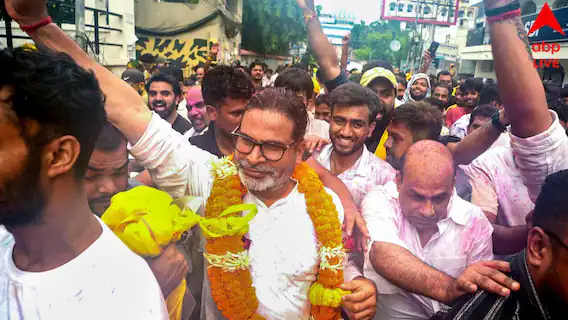
Political strategist-turned-politician Prashant Kishor appears to be reshaping his public image as he seeks to establish himself as a grassroots leader rather than merely an election strategist.
Once known for holding political consultations in the coffee shops of five-star hotels in New Delhi, Kishor is now operating from a modest thatched accommodation named Jan Bihar Navnirman Ashram. The shift from his earlier sprawling temporary residence at Sheikhpura Palace following the Bihar Assembly elections is being viewed as a symbolic attempt to project a simpler, people-centric political persona.
Kishor entered Bihar’s political arena with a campaign centred on governance, employment and economic development. Rather than relying solely on conventional electoral narratives, he sought to raise questions about the large-scale migration of Bihar’s youth, the lack of industrial growth and employment opportunities, and the social stigma often faced by migrants from the state.
His emphasis on jobs, development and a politics that transcends caste distinctions offered an alternative discourse in a state where electoral contests have traditionally been shaped by caste equations and identity politics. While the message attracted attention, many political observers remained sceptical of his electoral prospects, viewing him primarily as a successful political strategist attempting to transition into active politics.
One criticism that emerged during the Assembly elections was Kishor’s decision not to contest personally. Many analysts argued that remaining outside the electoral fray weakened his credibility as the face of a new political movement.
Since then, Kishor appears to have recalibrated his strategy. Following organisational setbacks, including the departure of some party leaders, he chose to enter the electoral contest himself by contesting the high-profile Bankipur Assembly by-election, a constituency regarded as a Bharatiya Janata Party (BJP) stronghold and vacated by BJP state president Nitin Nabin.
His campaign coincided with student protests in Delhi, while Bankipur—an urban constituency that includes Patna University—has a sizeable student and middle-class electorate. Political observers believe these factors may have influenced the campaign’s dynamics, although the precise electoral impact remains open to interpretation.
The by-election also highlighted the evolving political landscape in Bihar. While the contest posed a challenge for the BJP in one of its key constituencies, it also underscored the difficulties faced by the principal Opposition parties, including the Rashtriya Janata Dal (RJD) and the Congress, in positioning themselves as the primary alternative.
Having spent more than a decade designing successful election campaigns for several political parties across the country, Kishor possesses an intimate understanding of electoral strategy, voter behaviour and political messaging. His transition from backroom strategist to frontline politician marks a significant shift in his career.
Whether this transformation translates into sustained electoral success remains to be seen. What is evident, however, is that Prashant Kishor has moved beyond the role of political consultant and has embarked on a new phase as a politician seeking to build his own political base in Bihar.