
Examiner Bureau | Pulwama:
Jammu and Kashmir Lieutenant Governor Manoj Sinha on Monday called for integrating nature-based solutions into development planning to strengthen climate resilience and safeguard livelihoods in the Himalayan region, stressing that sustainable development and environmental conservation must go hand in hand.
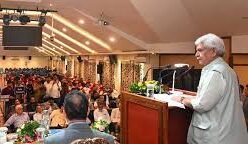
Addressing a conference on “Strengthening Climate Resilience and Livelihoods in the Himalayan Region through Nature-based Solutions” at the Islamic University of Science and Technology (IUST), Sinha said climate change poses an increasing threat to the ecologically fragile Himalayan region, with frequent flash floods, cloudbursts and other extreme weather events causing widespread damage to infrastructure and disrupting essential services.
Emphasising the importance of working with nature rather than against it, the Lieutenant Governor said there was no contradiction between development and conservation, asserting that “nature itself is infrastructure.”
“A watershed serves as an effective flood-control system. Wetlands function as natural reservoirs by absorbing excess rainwater during the monsoon and sustaining surrounding areas during dry periods, while dense forested mountain slopes protect villages from landslides,” he said.
Sinha urged scientists, engineers and policymakers to mainstream nature-based solutions in development planning by incorporating them into project design, budgeting, appraisal and monitoring processes.
Highlighting the role of technology in environmental management, he called for greater use of remote sensing, geospatial mapping and artificial intelligence to monitor glacier retreat, spring discharge, soil health and forest cover. He also stressed the need to actively involve farmers, shepherds, orchardists and tribal communities in conservation initiatives, describing them as key stakeholders in preserving the region’s ecological balance.
The Lieutenant Governor said universities should promote nature-based solutions as a multidisciplinary field of study encompassing ecology, hydrology, engineering, economics, disaster management and traditional knowledge systems to equip future generations with the skills needed to address climate challenges.
Referring to the Green Jammu and Kashmir Drive launched in 2020, Sinha said sustained conservation efforts had contributed to an increase in forest cover and underscored the importance of protecting watersheds, wetlands and rivers to ensure long-term environmental sustainability.
“By placing nature at the centre of development, integrating modern technology with traditional wisdom, and involving communities as equal partners, the Himalayan region can build resilience against climate change,” he said.
On the occasion, the Lieutenant Governor inaugurated the Civil and Mechanical Engineering Block at the IUST main campus, the university’s Larmoo Campus, and the School of Law.
He also released a special edition of IUST’s monthly magazine Times Echo, dedicated to the 100-Day Anti-Drug Campaign, and unveiled a policy brief on the Nasha Mukt Jammu Kashmir Abhiyan, prepared by a team of experts.
The conference was attended by Acting Chief Justice of the High Court of Jammu & Kashmir and Ladakh Justice Sanjeev Kumar, IUST Vice-Chancellor Prof. Shakil A. Romshoo, Registrar Prof. Shamim Ahmad Shah, Conference Convener Prof. Javed Hussain Mir, along with scientists, researchers, policymakers, government officials, faculty members and students.