
Agencies | Washington:
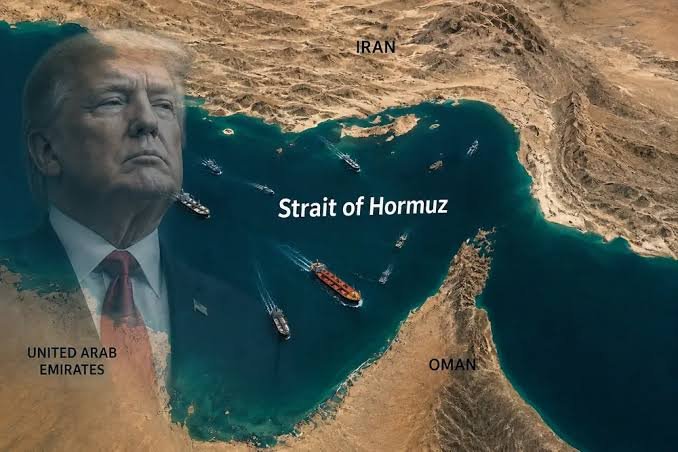
US President Donald Trump on Friday threatened to declare the strategically vital Strait of Hormuz a US territory after what he described as the eventual defeat of Iran, sharply escalating his rhetoric over the key global energy route.
Speaking at a rally in New York state, Trump said the United States would take control of the waterway once the conflict with Iran was concluded.
“After we finish defeating Iran, which is being very badly defeated — pretty soon I’ll be declaring the Hormuz Strait a territory of the United States,” Trump said, adding, “It’s true.”
The remarks came amid a sharp decline in commercial shipping through the Strait of Hormuz, as attacks on vessels and a US naval blockade of Iranian ports continue to disrupt traffic through one of the world’s most important energy corridors.
The Strait of Hormuz carries a significant share of the world’s oil and gas shipments, making any prolonged disruption a major concern for global energy markets.
Traffic through the waterway has fallen dramatically since the war began in late February, with only a small number of vessels reported to have crossed in recent days.
According to Reuters, citing ship-tracking data from Kpler, only two commodity vessels crossed the strait on Friday, while no crude oil shipments were visible. Nine commodity vessels crossed on Thursday, compared with an average of around 12 vessels a day during August.
The slowdown has heightened concerns that the continuing conflict could have a wider impact on global energy supplies and prices.
The latest disruption followed attacks on two vessels operated by the Abu Dhabi National Oil Company, which the United Arab Emirates blamed on Iran. Tehran had not immediately commented on the allegations.
Trump has repeatedly claimed that the United States has “total control” over the Strait of Hormuz and has vowed to keep the waterway open under US protection.
His latest comments, however, went significantly further by suggesting that Washington could seek to formally declare the waterway US territory after the conflict.
US Defence Secretary Pete Hegseth said on Thursday that the United States could maintain its naval blockade of Iranian ports for an indefinite period by rotating forces deployed to the region.
“Indefinitely the United States Navy can maintain a blockade like that because we’ll rotate ships in and out, as we have, and we’ll continue to,” Hegseth told reporters during a visit to Panama.
The comments underline Washington’s determination to sustain pressure on Tehran despite the logistical and military demands of an extended deployment.
Trump’s latest remarks came as diplomatic efforts to revive a ceasefire between the United States and Iran remained stalled.
Washington and Tehran have traded competing claims over control of the Strait of Hormuz, while continued attacks and countermeasures have raised concerns that the disruption could persist for an extended period.
The strategic importance of the waterway means that any prolonged reduction in shipping could have consequences well beyond the immediate region, affecting oil supplies, transportation costs and global markets.
The growing uncertainty has already contributed to higher oil prices.
Brent crude settled at $88.52 a barrel on Friday, reflecting heightened market concerns over the security of the Strait of Hormuz and the possibility of a prolonged interruption to energy shipments.
With the US maintaining pressure on Iran and commercial traffic through the waterway continuing to decline, the Strait of Hormuz has emerged as one of the most closely watched flashpoints in the ongoing conflict.