
Agencies |Washington:
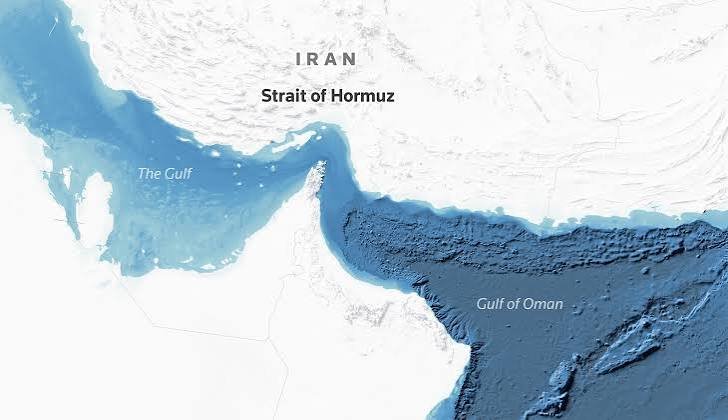
US President Donald Trump on Tuesday escalated his rhetoric over the strategically vital Strait of Hormuz, posting a map on his Truth Social platform depicting the waterway as “New U.S. Territory” as Iran continues to restrict commercial navigation through the strait.
Trump’s latest move came after he previously claimed that the United States had “total control” over the strategic waterway, which serves as a critical passage for global energy shipments.
The post coincided with renewed warnings from Tehran that the Strait of Hormuz would remain closed until Washington meets a series of Iranian demands, further raising tensions between the two countries.
Iran’s top negotiator, Mohammad Bagher Ghalibaf, said the waterway would not be reopened until the United States fulfils commitments that Tehran says were included in a June memorandum of understanding.
“I want to state clearly that the Strait of Hormuz will not be opened until the American commitments stipulated in the memorandum of understanding… are implemented,” Ghalibaf said in a speech broadcast on Iranian state television.
According to Ghalibaf, Iran is demanding the removal of what it describes as a US naval blockade, the lifting of sanctions targeting its oil exports and the unfreezing of Iranian assets held abroad.
Tehran maintains that these issues formed part of a truce reached between the two sides in June, although the broader understanding subsequently collapsed.
The Strait of Hormuz connects the Persian Gulf with the Gulf of Oman and the Arabian Sea and is regarded as one of the world’s most important energy corridors. Any prolonged disruption to shipping through the waterway could have significant consequences for global oil and gas markets.
Iran has maintained restrictions on navigation through the strait since the conflict began, including requirements for vessels to obtain permission and pay transit-related fees. Washington and several regional countries have strongly opposed the arrangement.
Amid the standoff, Iran and Oman have continued discussions over the future of navigation through the waterway. Both countries have coastlines along the Strait of Hormuz, giving Oman a crucial role in any attempt to establish a safe maritime corridor.
Tehran said on Monday that negotiations with Muscat were continuing “in a serious manner”, with the two sides exchanging views on a proposed joint statement.
Iran also said the geographical coordinates for a navigation route agreed upon by the two countries had been settled, potentially opening the way for a mechanism to facilitate commercial shipping.
However, the arrangement remains complicated by the wider US-Iran dispute and disagreements over who should determine the terms under which international vessels can transit the strait.
The latest confrontation follows the outbreak of war between Iran and the United States on February 28, following US-Israeli attacks on Iran. The conflict triggered a series of military strikes and retaliatory attacks across the region.
Diplomatic efforts since April 8 have helped reduce the intensity of the fighting, although tensions have remained high, particularly around the Strait of Hormuz.
Ghalibaf, meanwhile, warned that Iran remained prepared to respond forcefully to what it considers hostile actions, saying Tehran could deliver what he described as an “even more crushing defeat” to its opponents.
The situation at sea also remained tense on Tuesday after an “unknown projectile” struck a vessel travelling through the Strait of Hormuz, according to the United Kingdom Maritime Trade Operations agency.
The agency said the impact damaged the vessel’s engine room and resulted in one crew casualty, while the remaining crew members were being assisted by the Omani Coast Guard.
The incident added to concerns over the safety of commercial shipping through one of the world’s most heavily trafficked maritime chokepoints.
Trump has also increased pressure on Oman, which has traditionally maintained close diplomatic channels with both Washington and Tehran.
The US president previously threatened military action against Oman if Muscat “gets in the way” of efforts to reach an agreement with Iran over the Strait of Hormuz.
At the same time, Trump’s envoy and son-in-law, Jared Kushner, struck a more diplomatic tone, saying Washington and Tehran were engaged in “very positive and active conversations.”
Kushner acknowledged that trust between the two countries remains extremely limited but said Trump was prepared to take his time rather than rush into an agreement.
“President Trump is going to be very patient… he doesn’t want to rush to a deal,” Kushner told Fox News, adding that the US president would accept an agreement only if he believed its terms were satisfactory.
Trump said on Monday that Iranian officials wanted an agreement but remained unwilling to accept the terms demanded by Washington.
He again emphasised his central condition: Iran must not be allowed to possess a nuclear weapon.
With the Strait of Hormuz still restricted, negotiations continuing and Washington and Tehran maintaining sharply opposing positions, the waterway has emerged as the most dangerous flashpoint in the broader US-Iran confrontation. Any further escalation could threaten regional stability and send fresh shockwaves through global energy markets.