
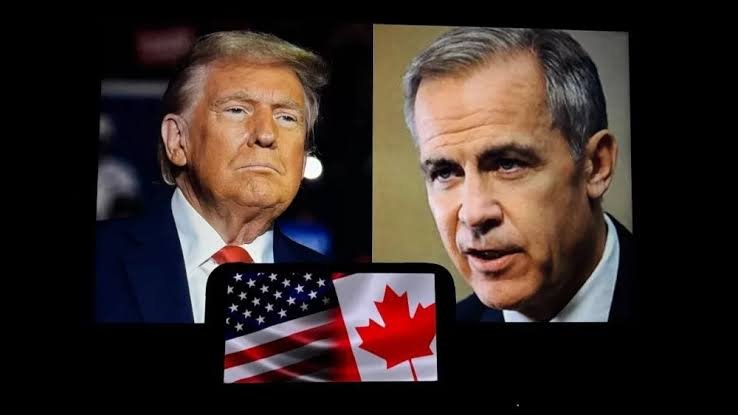
Agencies | Ottawa/ Washington:
The United States and Canada exchanged approximately $880 billion in goods and services last year, highlighting the extraordinary depth of their economic relationship. Businesses in both countries rely heavily on cross-border trade, while industries such as manufacturing, energy, agriculture and transportation are closely interconnected.
The latest tariffs had initially been scheduled to take effect earlier in the week. Trump subsequently extended the deadline by three days to provide negotiators with additional time to reach an agreement.
Those talks ultimately failed.
The two countries have long-standing disagreements over issues including Canadian softwood lumber exports and access to Canada’s protected dairy market. However, such disputes have historically been managed within a broader framework of close political, economic and security cooperation.
The current confrontation represents a sharp departure from that tradition.
The United States and Canada share one of the world’s longest international borders, stretching for roughly 5,525 miles. Unlike many major international borders, it has traditionally remained largely undefended, reflecting the longstanding security relationship between the two countries.
Hundreds of thousands of people cross the border regularly, while billions of dollars worth of goods move between the two economies every day.
Canada has also been a close US security partner for decades. Canadian forces fought alongside American troops in Afghanistan following the September 11, 2001 attacks, while the two countries remain closely linked through continental defence arrangements.
Yet the Trump administration’s approach to Canada has challenged that traditional relationship.
Trump has repeatedly criticised Canada’s trade policies and has also floated the idea of Canada becoming the 51st US state, comments that have generated widespread political anger north of the border.
His administration has argued that tariffs are necessary to encourage manufacturing and investment in the United States and reduce what it considers unfair trade practices.
The escalating trade dispute has also fuelled growing public resentment in Canada.
A petition calling for the removal of US Ambassador Pete Hoekstra had reportedly attracted nearly 248,000 signatures since July 21. The petition criticised the ambassador’s handling of Trump’s comments regarding Canada and accused him of normalising the US president’s remarks about the country becoming part of the United States.
The dispute has also contributed to a broader debate within Canada about reducing the country’s dependence on the US market.
That dependence remains substantial. Nearly 72 per cent of Canada’s goods exports reportedly went to the United States last year, making the American market critically important to Canadian businesses.
The challenge for Ottawa is therefore complicated: while Canada can retaliate against US tariffs, its economy remains deeply integrated with its southern neighbour.
The consequences of the escalating trade dispute may not be limited to Canada.
US businesses importing Canadian goods will initially bear the cost of the tariffs. Those companies may subsequently pass higher costs on to consumers, potentially increasing prices for a range of products.
That could add to concerns about inflation and the cost of living in the United States, particularly at a politically sensitive time ahead of the November midterm elections.
The administration’s strategy is based on the argument that tariffs can protect American industries, encourage domestic production and strengthen the US negotiating position.
Critics, however, warn that prolonged tariff battles can raise costs, disrupt supply chains and ultimately place pressure on businesses and consumers.
The latest breakdown in negotiations suggests that the US-Canada trade dispute is becoming more than a temporary disagreement over individual products or market access.
It now represents a broader test of the economic relationship between two countries whose economies have been closely connected for generations.
Carney’s pledge to respond dollar for dollar indicates that Ottawa is unwilling to absorb the latest US measures without retaliation. Washington, meanwhile, appears determined to use tariffs as leverage to secure broader economic and political concessions.
For businesses on both sides of the border, the immediate priority will be stability and clarity.
For governments in Washington and Ottawa, the challenge will be finding a way back to negotiations before retaliatory measures turn a tariff dispute into a prolonged trade war.
The stakes are high—not only for the two economies, but for the millions of workers, businesses and consumers whose livelihoods depend on the uninterrupted movement of goods across the US-Canada border.