
Examiner Bureau | Samba:
In a major step towards modernising irrigation infrastructure and promoting efficient water management, the Command Area Development Department, Jammu, has launched the first pilot project in Jammu and Kashmir under the Modernisation of Command Area Development and Water Management (MCAD-SAMRIDHI) scheme at Patyari Cluster in Ghagwal block of Samba district.
The project, among 38 pilot projects approved by the Government of India for implementation across the country, covers nearly 400 hectares of rainfed agricultural land that currently lacks assured irrigation facilities. The project has been sanctioned at an estimated cost of Rs 1,198.26 lakh.
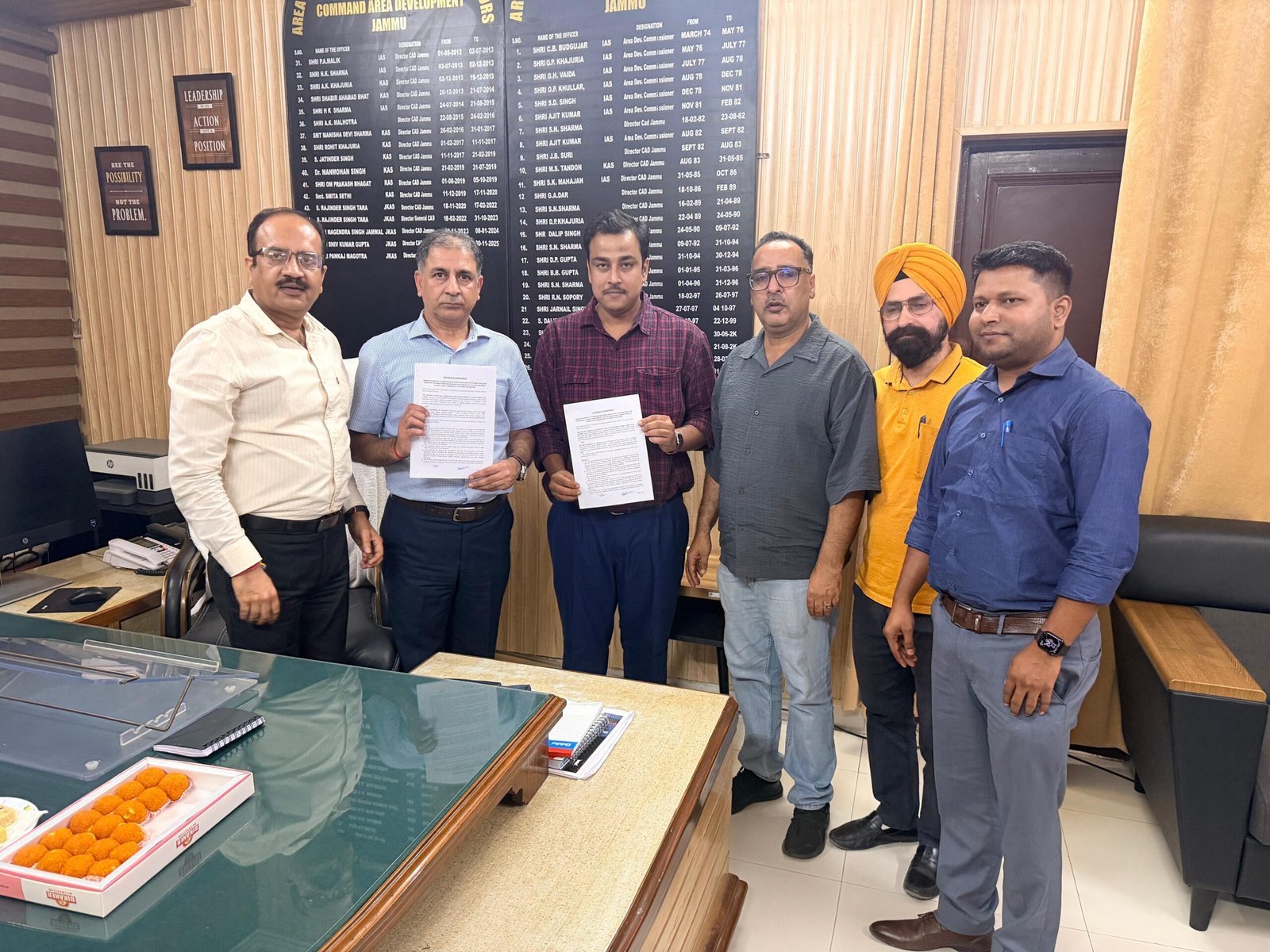
A key milestone was achieved with the signing of an agreement between the Command Area Development Department, Jammu, and M/s RMS Contractors and Consultancy, Bhopal, the Irrigation Service Provider. With the agreement, the project has entered the implementation phase.
The initiative envisages the development of a Pressurised Pipe Irrigation Network (PPIN) to facilitate efficient conveyance and distribution of irrigation water to agricultural fields. The network will be integrated with SCADA (Supervisory Control and Data Acquisition) and Internet of Things (IoT) technologies for real-time monitoring, regulation and improved management of water distribution.
The pressurised irrigation system is expected to reduce conveyance and distribution losses while ensuring more controlled, efficient and equitable delivery of water to farms. Technology-based monitoring will also facilitate better assessment of water use and improve the overall efficiency of the irrigation network.
Speaking on the occasion, Director, Command Area Development, Jammu, Pankaj Magotra, JKAS, said the project marked an important shift towards technology-driven and sustainable irrigation management in the Union Territory.
“Our guiding principle is ‘Per Drop More Crop’. Our endeavour is not merely to provide irrigation water, but to ensure that every drop of available water is utilised judiciously and efficiently to produce more,” Magotra said.
He said the project would combine pressurised pipe irrigation with SCADA and IoT-based interventions, farmer participation and a proposed solar power on-grid facility to establish a modern and sustainable irrigation model that could eventually be replicated in other command areas of Jammu and Kashmir.
The department has placed significant emphasis on community participation, with Water User Societies (WUSs) expected to play a central role in the operation, management and sustainable utilisation of the irrigation infrastructure.
Around 400 farmers of the Patyari cluster have already registered a Water User Society and expressed their willingness to take over the operation and maintenance of the project after its commissioning. The society has also signed a Memorandum of Understanding (MoU) with the Command Area Development Department for the purpose.
Officials said greater farmer participation would help create a sense of ownership, strengthen community-based water management and encourage more efficient utilisation of irrigation resources.
The project is also expected to promote wider adoption of drip and sprinkler irrigation, facilitate crop diversification and encourage improved agricultural practices. With assured irrigation, the initiative is aimed at enhancing crop productivity and increasing farm incomes in the project area.
The department said the project would also contribute to reducing water wastage and promoting its judicious and equitable use, while supporting climate-resilient agricultural practices. The integration of digital technologies is expected to provide greater control over the irrigation network and enable data-based management of water distribution.
The MCAD-SAMRIDHI initiative focuses on modernising Command Area Development and Water Management through advanced irrigation technologies, efficient water distribution systems and participatory management.
The department expressed hope that the Patyari pilot would serve as a replicable model of technology-driven irrigation management for other command areas across Jammu and Kashmir. The experience gained during its implementation is expected to provide inputs for scaling up similar interventions across the Union Territory.
The agreement-signing ceremony was attended by the Project Officer, Command Area Development, Jammu; the concerned Assistant Soil Conservation Officer, CAD Samba; SMS-DL; other officers and officials of the Command Area Development Department, Jammu; and representatives of M/s RMS Contractors and Consultancy, Bhopal, Madhya Pradesh.