
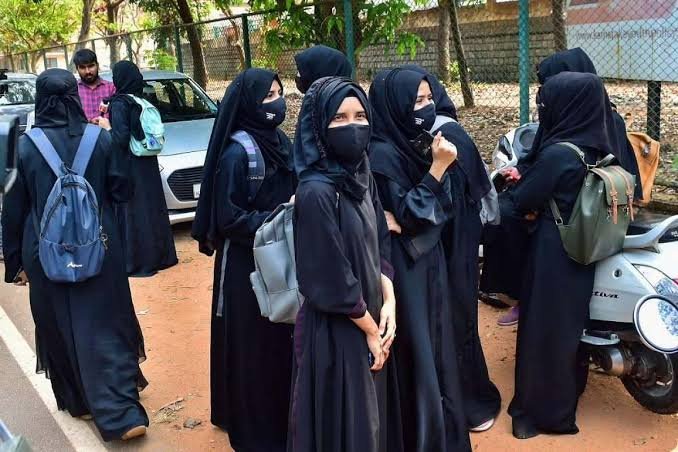
Agencies | Lucknow :
The Allahabad High Court has declined to permit a Muslim student to wear a hijab in addition to her prescribed school uniform, holding that she had not established that covering her head was an essential religious practice that the institution was legally required to accommodate.
A Division Bench comprising Justice J.J. Munir and Justice Indrajeet Shukla dismissed a petition filed by Sukaina Rizvi, a minor student of Tagore Public School in Prayagraj, who sought permission to continue wearing a headscarf while attending Class XI.
The court held that a school is entitled to enforce its prescribed dress code provided it is uniform, bona fide and non-discriminatory and is intended to maintain discipline and institutional identity.
“So long as the dress code is uniform, bona fide, nondiscriminatory and intended to maintain discipline and institutional identity, the choice of the prescribed uniform primarily lies within the domain of the School,” the Bench observed.
Rizvi had studied at the Attarsuiya-based school from Class VI to Class X and claimed that she had been allowed to wear a headscarf during those years without objection.
According to her petition, the situation changed when she sought admission to Class XI. She alleged that the school was unwilling to permit her to continue wearing the headscarf.
Through her mother, the student approached the High Court seeking directions allowing her to wear the headscarf “in addition to the uniform prescribed by the School for all their students”.
She argued that wearing the hijab was an essential part of her religious practice and that preventing her from doing so violated her constitutional rights, including those under Articles 14 and 19(1)(a).
The school opposed the petition, maintaining that its prescribed uniform applied equally to all students.
The institution argued that permitting an additional item of clothing for one student would effectively create an exemption from the uniform policy. The school’s principal also pointed out that other female students belonging to the same religious community were attending classes while following the prescribed uniform.
The court accepted the school’s position that a uniform policy, when implemented consistently, can serve legitimate institutional purposes.
The student also relied on the fact that the school had previously allowed her to wear the headscarf.
The High Court, however, held that earlier tolerance or non-enforcement of the dress code did not prevent the institution from subsequently implementing its uniform policy.
The Bench observed that the school might previously have refrained from objecting to the headscarf for various reasons, including non-enforcement, courtesy or hesitation, but such past conduct could not create an estoppel against the institution when it later decided to enforce its dress code.
The judges also noted that the school had not changed its prescribed uniform. Instead, the dispute concerned the student’s request to add a headscarf to an otherwise common dress code.
The Bench said school uniforms serve purposes beyond simply prescribing what students should wear.
According to the court, a common dress code can promote discipline, establish a shared institutional identity and minimise visible distinctions among students. The court also referred to the role of uniformity in maintaining what it described as a “religion-neutral atmosphere” within educational institutions.
The judges cautioned that allowing individual students to seek exemptions from a common dress code based on subjective grounds could undermine the purpose of having a uniform policy and potentially shift decisions regarding school discipline from the institution to individual students.
A key issue before the court was the student’s claim that wearing a headscarf constituted an essential religious practice.
The Bench found that the petition did not provide sufficient factual or religious material to establish that wearing the headscarf inside the classroom was obligatory in a manner that would fundamentally affect the student’s faith if she did not wear it.
The court considered previous judgments from other High Courts dealing with similar requests for exemptions from school uniform policies.
It also examined the 2022 Full Bench judgment of the Karnataka High Court concerning the hijab controversy, which had held that wearing the hijab was not an essential religious practice in Islam.
The Allahabad High Court described that ruling as “persuasive authority of great value” and said it found no reason to take a different view in the present case.
The Bench also took note of photographs submitted during the proceedings showing female students at the school, including students from the same religious community, following the prescribed uniform without wearing a headscarf.
The court considered this relevant to the school’s contention that its dress code was being applied uniformly rather than selectively against the petitioner.
Ultimately, the High Court declined to grant the requested exemption and dismissed the petition, upholding the school’s authority to enforce its uniform policy under the circumstances presented before it.