
Agencies | Kathmandu:
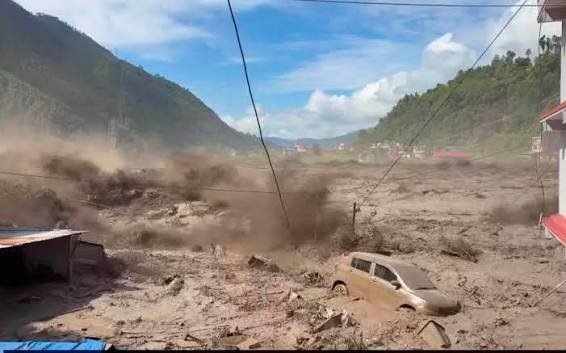
At least seven people have been killed and 41 security personnel are missing after a massive flash flood swept through Nepal’s Rasuwa district, causing widespread destruction along the Bhote Koshi River, officials said on Wednesday.
Of those missing, 32 are personnel of the Nepal Police and nine belong to the Armed Police Force, according to authorities. Rescue teams have been deployed across the affected region as emergency agencies continue searching for those trapped or unaccounted for.
The sudden surge in the Bhote Koshi River devastated areas around Timure and Syapru Besi, close to the Nepal-China border, sweeping away villages, vehicles and sections of critical infrastructure.
Roads and bridges have been damaged, while several hydropower projects and other infrastructure facilities have also reportedly suffered extensive losses.
The scale of the flooding has prompted a major rescue and relief operation involving Nepal’s police, armed forces and other emergency agencies.
Prime Minister Balendra Shah said emergency teams, including police and military personnel, had been dispatched to the affected areas.
He directed authorities to move residents living in vulnerable downstream areas to safer locations and urged communities along the river to remain alert.
“People along the river are advised to exercise extra caution and remain alert,” Shah said.
Rasuwa district administrator Narendra Pariyar said authorities had received reports of extensive destruction.
“There are reports of villages and infrastructure project sites being washed away,” Pariyar told Reuters, warning that the final toll could rise as rescue teams reach areas that remain inaccessible.
“There could be heavy casualties or loss of property. But I cannot say for sure now,” he said.
Nepal’s water resources ministry said several hydroelectric projects had been damaged by the flooding, while roads and bridges were also washed away or severely affected.
Damage to electricity infrastructure has disrupted power supplies in parts of the region, adding to the difficulties faced by rescue and relief teams.
Authorities have placed communities downstream along the Trishuli River basin on heightened alert and advised people living in low-lying areas to move to safer ground.
Authorities are investigating the cause of the extraordinary rise in the Bhote Koshi River.
One possibility being examined is a glacial lake outburst flood (GLOF), a phenomenon in which water from a glacial or supraglacial lake is suddenly released, potentially generating a destructive surge downstream.
Regional climate monitoring reports have indicated that the flooding may have been triggered by the drainage of a supraglacial lake in Tibet.
The development has renewed concerns over the vulnerability of Himalayan communities to sudden glacial and weather-related disasters.
The Bhote Koshi originates in Tibet before entering Nepal and eventually joining the Trishuli River, which flows into India as the Gandak River.
In a separate but related development, a major mudslide on the Nepalese side of the China-Nepal border has reportedly left several people feared dead or missing near the Gyirong Port in Tibet’s Gyirong County.
China’s state-run Xinhua news agency reported that the mudslide occurred at around 10:30 a.m. local time on August 26, causing casualties and leaving people missing in the area.
The disaster also disrupted access to the Gyirong Port, with roads, communication networks and electricity supplies reportedly affected.
Search and rescue teams have been deployed, while Chinese President Xi Jinping has directed authorities to make every effort to locate and rescue those missing and strengthen monitoring and early-warning systems.
The latest disaster has brought back memories of another major flash flood along the Bhote Koshi region just over a year ago.
That disaster reportedly killed nine people and left 24 others missing, while destroying the Friendship Bridge linking Nepal and China and severely disrupting cross-border movement and trade.
A regional climate monitoring agency subsequently linked that flooding to the sudden drainage of a supraglacial lake in Tibet.
With large areas still difficult to access, authorities are continuing efforts to determine the full extent of the destruction and locate those missing.
Helicopters, security personnel, medical teams and emergency responders are being deployed as rescue operations intensify.
Officials have warned residents in vulnerable areas to remain alert and follow evacuation instructions as the possibility of further flooding remains a concern.
The disaster has once again highlighted the growing risks faced by communities living in the fragile Himalayan region, where glacial activity, extreme weather and sudden water releases can rapidly turn river valleys into disaster zones.