
Agencies | Kathmandu:
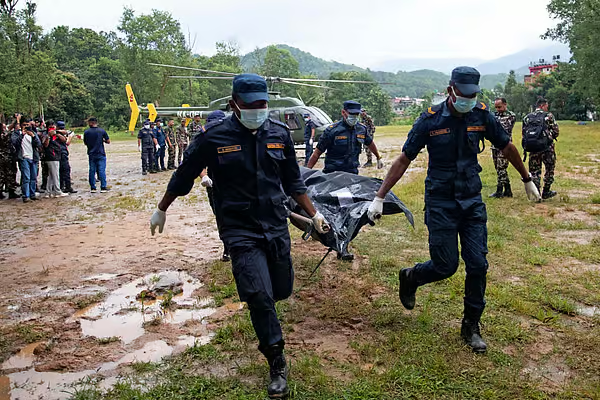
The death toll from devastating flash floods in Nepal and China rose to 586 on Friday, while more than 2,400 people remained missing as rescue teams intensified efforts to reach isolated and severely affected areas amid fears of further flooding from unstable barrier lakes.
Nepal’s disaster authorities reported 579 deaths across eight districts, while Chinese authorities confirmed seven fatalities in Tibet. The number of people reported missing in Nepal nearly doubled to 1,924, up from 977, while another 554 people remain unaccounted for in Gyirong County of Tibet.
At least 540 of those missing are foreigners, many of them believed to be Hindu pilgrims travelling towards Mount Kailash.
The disaster was triggered by a glacier collapse that unleashed a massive surge of ice, water, rock, mud and debris into Himalayan river systems, according to the US Geological Survey.
Rescue operations were briefly disrupted on Friday after a debris-created lake began overflowing towards the Lhende Khola and Trishuli rivers. Nepali police issued an urgent warning to rescue teams to move to safer locations after receiving information that a water barrier had breached on the Tibetan side.
Operations resumed after the immediate threat subsided. In Tibet, China also temporarily suspended rescue activities in Gyirong before state broadcaster CCTV reported that conditions had stabilised.
Authorities in Nepal continue to closely monitor two barrier lakes upstream, warning that the risk of further flooding will persist until the lakes drain. Satellite imagery has shown one of the lakes continuing to expand without a visible outlet, raising concerns over increasing water pressure and the possibility of another breach.
Chinese experts have separately warned that more than 100 glacial lakes in the region could pose potential risks.
The disaster has also affected a large number of Indian nationals, including workers, trekkers and pilgrims.
India’s Ministry of External Affairs said on Friday that 84 Indian nationals had been rescued, including 21 residents of Tamil Nadu who have returned to India and 63 workers associated with the Trishuli-I hydropower project.
Another 149 Indians safely crossed into Nepal from China, while around 400 Indian nationals remain safe on the Chinese side and are being assisted by the Indian Embassy in efforts to facilitate their evacuation.
However, approximately 320 Indian nationals remain missing or uncontactable, largely because widespread telecommunications disruptions have made communication with affected areas extremely difficult.
The disaster has also significantly affected hydropower projects and tourism routes. Nepal’s disaster authorities added 933 hydropower workers to the list of missing people as rescue and tracing operations continued.
The formation of temporary lakes behind natural barriers of rock, mud and debris has emerged as a major concern for rescue agencies.
Such barrier lakes can become increasingly dangerous as water accumulates behind unstable natural dams. A sudden breach could send another powerful surge downstream, threatening communities and rescue personnel already operating in difficult terrain.
Authorities have therefore been forced to balance the urgency of reaching survivors with the need to protect rescue teams from further flooding and landslides.
Chinese President Xi Jinping has called for stronger monitoring of glacial lakes and landslide risks as authorities continue rescue and relief operations in the affected areas.
Beijing has also offered support to Nepal in dealing with the humanitarian emergency.
The scale of the disaster, combined with destroyed roads, damaged infrastructure, disrupted communications and continuing geological hazards, has made rescue operations exceptionally challenging.
With thousands of people still missing and several areas difficult to access, authorities on both sides of the Himalayan border are racing against time to locate survivors, provide emergency supplies and prevent further loss of life.