
Examiner Bureau | Kargil:
The Ladakh Autonomous Hill Development Council (LAHDC), Kargil, has been plunged into a fresh political crisis after four BJP councillors resigned, citing the recent reorganisation of Ladakh into additional districts and the creation of new Hill Development Councils, according to media reports.
The resignations are significant as the constituencies represented by the four councillors have reportedly been brought under the jurisdiction of newly created Hill Councils, altering the territorial basis on which the existing Kargil Council was constituted.
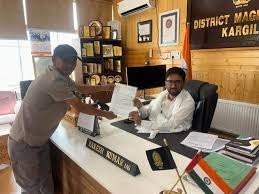
According to a report published by Daily Excelsior, the four BJP councillors who submitted their resignations to the Kargil Deputy Commissioner-cum-Council Chief Executive Officer are Stanzin Lakpa of Cha, Padma Dorjay of Bodhkharbu, and nominated councillors Stanzin Gurmet and Namgyal Punchok.
The four are among the BJP’s six councillors in the 30-member Kargil Council. The remaining two BJP councillors have not resigned and represent areas that continue to fall within the jurisdiction of the reorganised Kargil Hill Council, the report said.
The development follows the Union Ministry of Home Affairs’ announcement of five new districts in Ladakh, carved out of the existing Leh and Kargil districts.
The Ladakh administration subsequently notified seven Hill Development Councils covering the Union Territory’s districts, according to media reports.
The territorial reorganisation has created an unusual administrative and political situation for the existing Kargil Council, whose elected term is scheduled to continue until October 2028. The Leh Hill Council, meanwhile, completed its five-year term in October 2025.
The reorganisation has raised questions over the status and functioning of the existing Kargil Council, particularly as some of its constituencies are now reportedly part of newly constituted administrative and council jurisdictions.
The immediate political impact of the resignations could be felt in the balance of power within the council.
With four councillors resigning, the effective strength of the 30-member House would fall to 26, putting the halfway mark for a majority at 14.
Council Chairman-cum-Chief Executive Councillor Dr Mohammad Jaffar Akhoon has so far relied on BJP support to maintain his position.
Akhoon was not available for comment on the latest development, according to reports.
BJP Ladakh UT president Tashi Gyalson Kachu told Daily Excelsior that the four councillors resigned because their constituencies had become part of other Hill Councils following the reorganisation.
Asked about Akhoon’s position, Kachu said the council chairman would have to decide on the future course of action.
The latest crisis comes months after a major confrontation over Akhoon’s continuation as chairman.
The Kargil Council was constituted on October 18, 2023, following elections in which the National Conference and Congress emerged as the principal political forces.
Under a power-sharing arrangement between the two parties, each was to hold the chairman-cum-CEC position for two-and-a-half years.
Akhoon, who represents the National Conference, completed his first two-and-a-half-year term on April 18, 2026. Congress was expected to take over the position, with Nassir Munshi tipped to succeed him.
Akhoon, however, declined to step down, arguing that the creation of five new districts in Ladakh—including two carved out of Kargil—had fundamentally altered the territorial structure of the council.
The dispute escalated on May 14, when 16 councillors submitted a no-confidence motion against Akhoon. The group comprised nine Congress councillors, five National Conference councillors and two Independents.
The Ladakh administration did not order a floor test.
Akhoon subsequently demonstrated that he continued to command significant support in the House when the council’s budget was passed on July 13 with the backing of 20 councillors.
The vote included 12 National Conference councillors, six BJP councillors, one Congress councillor and one Independent.
Congress subsequently did not pursue the no-confidence motion, while BJP support enabled Akhoon to retain a working majority.
The resignation of four BJP councillors has now changed that political arithmetic.
According to media reports, the reduced 26-member House could leave Akhoon more vulnerable if another confidence or no-confidence motion is moved and the two remaining BJP councillors do not support him.
The developments have therefore revived questions over the stability of the council and the political arrangement that has enabled Akhoon to continue in office.
Beyond the immediate political implications, the resignations have raised a broader institutional question over the future of the existing Kargil Hill Council.
The key issue is how the council will function when several of its constituencies have reportedly been transferred to newly created districts and Hill Councils before the expiry of its elected five-year term.
Reports indicate that other councillors may also represent constituencies that have now fallen within the jurisdiction of newly established districts and Hill Councils.
This could add another layer of uncertainty over the future composition, territorial jurisdiction and functioning of the Kargil Hill Council as Ladakh’s administrative reorganisation takes effect.