
Examiner Bureau | Srinagar:
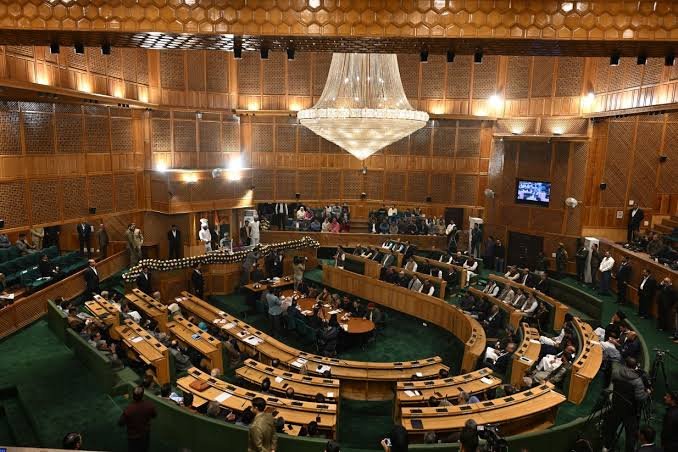
The Jammu and Kashmir Legislative Assembly was adjourned sine die on Wednesday, formally bringing the Autumn Session to a close after seven sittings spread over the 10-day calendar from September 21 to 30.
The session witnessed extensive legislative business, discussions on public issues, passage of key Bills and resolutions, as well as sharp exchanges between the treasury and Opposition benches, particularly over the demand for restoration of full statehood to Jammu and Kashmir.
According to the Assembly’s official eVidhan portal, the sixth session of the Assembly was scheduled from September 21 to September 30, with government business, Private Members’ Bills and resolutions taken up on different sitting days.
The concluding sitting on Wednesday lasted around seven hours. Speaker Abdul Rahim Rather, while winding up the proceedings, thanked legislators, Assembly staff, officials and various departments for their contribution to the smooth conduct of the session.
Rather said the responsibility of the Chair was to provide members an opportunity to raise issues concerning the public and convey the concerns and expectations of their constituents.
He said he had tried to accommodate members irrespective of their political affiliations and reiterated that he did not belong to any political party.
Acknowledging that the session was relatively brief, Rather said longer sittings would provide legislators greater opportunity to participate in debates and raise constituency-specific issues.
He said it was difficult to accommodate every member within limited sittings and asked legislators to understand the constraints faced by the Chair.
Referring to disruptions and heated exchanges witnessed during the session, Rather said such incidents occurred in legislatures across the world but urged members to raise their concerns in a constructive manner.
He also said the Opposition had its own compulsions, which needed to be taken into consideration.
“I could have marshalled them out, but I didn’t. I have to keep patience,” Rather said.
The Speaker urged members to bring to his notice any instance where issues raised in the House or assurances given by ministers were not subsequently acted upon.
The session began on September 21 with obituary references to former legislators, followed by Question Hour and government business. The House also took up a report of the committee on alleged irregularities in the implementation of the Jal Jeevan Mission.
On September 22, the Assembly passed the Jammu and Kashmir Cooperative Societies (Amendment) Bill, 2026, moved by Cooperative Minister Javid Ahmad Dar.
The legislation amended the Jammu and Kashmir Cooperative Societies Act, 1989, repealed the Jammu and Kashmir Self-Reliant Cooperative Act, 1999, and provided a transitional framework for self-reliant cooperative societies under the principal Act. The Bill was passed after detailed discussion in the House.
The House also took up a resolution moved by School Education Minister Sakeena Itoo seeking an amendment to Section 23 of the Right of Children to Free and Compulsory Education Act, 2009, to exempt teachers appointed before October 31, 2019, from appearing in the Teacher Eligibility Test.
After a two-day discussion, the resolution was passed by voice vote, urging the Union Government to take necessary legal measures and issue the requisite notification through the National Council for Teacher Education.
The Assembly also considered Private Members’ Bills and resolutions during the session.
Among the issues discussed was a Private Members’ Bill moved by Langate MLA Sheikh Khursheed Ahmad seeking mandatory enrolment of children of public representatives and government servants in government schools. The House defeated the Bill after the government opposed mandatory enrolment, arguing that children had the right to choose their educational institutions and that the focus should instead remain on improving government schools.
The House also discussed a range of issues during Question Hour, including agriculture, health, education, staffing in government schools, crop insurance, government vehicle use and other constituency-specific matters.
One of the most contentious developments of the session came on September 25, when Chief Minister Omar Abdullah moved a resolution seeking the immediate and urgent restoration of full statehood to Jammu and Kashmir.
The resolution referred to earlier Assembly resolutions of June 26, 2000, and November 6, 2024, and called for the fresh resolution to be forwarded to the Government of India.
The move triggered strong protests from BJP legislators, who objected particularly to the references to the earlier autonomy resolution. The House witnessed slogan-shouting and confrontations between members, prompting the Speaker to adjourn the proceedings temporarily and later for the day.
The statehood resolution was taken up again after the weekend break. Several amendments were submitted, including proposals concerning references to Jammu and Kashmir’s earlier constitutional provisions and previous Assembly resolutions.
On September 28, the Assembly ultimately passed the resolution calling upon the Government of India to immediately restore full statehood to Jammu and Kashmir. BJP legislators opposed the resolution, staged protests and walked out of the House during the voting.
The Assembly also witnessed substantial government legislative business during the final days of the session.
On September 29, the House passed five Bills moved by Chief Minister Omar Abdullah covering municipal governance, ease of doing business and ease of living, taxation, pension benefits for members of the legislature, and rationalisation and decriminalisation of offences.
The Bills included the Jammu and Kashmir Municipal (Amendment) Bill, 2026; Jammu and Kashmir Ease of Doing Business Bill, 2026; Jammu and Kashmir Goods and Services Tax (Amendment) Bill, 2026; Jammu and Kashmir State Legislature Members’ Pension (Amendment) Bill, 2026; and legislation seeking to rationalise and decriminalise certain offences.
The House, however, withdrew two Bills relating to increases in the salaries and allowances of ministers and Members of the Jammu and Kashmir Legislature after objections were raised by BJP members.
The withdrawal of the salary-related Bills also led to a brief disruption in the House on Wednesday, with an MLA raising the issue at the beginning of the proceedings.
In his concluding remarks, Rather praised the Council of Ministers for handling multiple departments and acknowledged the participation of members throughout the session.
Referring to Leader of Opposition Sunil Sharma’s remarks on schooling, the Speaker asked him to take his observations positively, saying Sharma was young and had a long political future ahead.
“He is dear to me and expectations from him are high,” Rather said, adding that young people also had expectations from their leaders.
The Speaker also commended Chief Minister Omar Abdullah for his regular attendance and participation in the proceedings.
According to Rather, the Chief Minister responded personally to issues raised in the House and came prepared with substantial legislative and administrative work. He said Abdullah had wanted to attend the concluding proceedings but was unable to do so because of official commitments.
Rather also acknowledged the contribution of Assembly staff, security personnel, the Public Health Engineering Department, Power Development Department and other line departments in facilitating the session.
He praised Assembly employees for managing the proceedings despite limited manpower and said work was under way on service-related issues raised by them, including promotions.
The Speaker also acknowledged the role of the press and media, describing it as an important pillar of democracy and a link between the Assembly and the public.
He said journalists highlight people’s concerns and keep citizens informed about legislative proceedings, while acknowledging the sensitive nature of media coverage during Assembly sessions.
With the completion of the scheduled business, the Speaker adjourned the House sine die, formally concluding the 2026 Autumn Session.
The session thus ended after seven sittings, with statehood, education, cooperative reforms, legislative amendments and constituency-level public concerns featuring prominently in the proceedings.