Examiner Bureau | Leh:
The political dialogue between the Centre and Ladakh’s representative bodies has hit a fresh roadblock, with the Leh Apex Body (LAB) and the Kargil Democratic Alliance (KDA) rejecting the Union Ministry of Home Affairs’ draft proposal for a new elected Union Territory-level institution, citing major differences over its powers, constitutional safeguards and relationship with the existing administration.
The disagreement has renewed concerns over the future of democratic governance in Ladakh, where demands for constitutional protection, greater control over land and natural resources, and an elected institution with legislative, executive and financial powers have remained central to the agitation since the region became a Union Territory in 2019.
The latest round of talks, held in Leh on October 15, remained inconclusive after the MHA presented a 32-page draft outlining the proposed institution and constitutional safeguards. The LAB and KDA alleged that the Centre had moved away from understandings reached during discussions in May, particularly regarding the institution’s authority over the administration.
The next meeting of the sub-committee has been scheduled for October 22 in New Delhi.
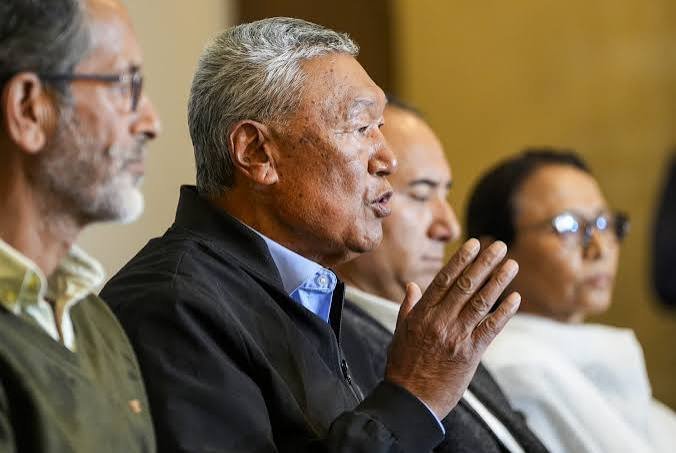
LAB chairman Chering Dorjay Lakruk said the proposals presented by the Centre fell short of the expectations raised during earlier discussions. He said the two representative bodies had submitted responses to seven questions raised by the MHA during the September 9 meeting, but the latest draft did not reflect their demands.
“There was huge gap between what the MHA offered to us and what we have been demanding,” Lakruk said after the October 15 meeting. He clarified that the talks had not failed and would continue.
KDA co-chairman Asgar Ali Karbalai was more critical, saying the proposed arrangement appeared to place the new institution below the existing councils in the administrative hierarchy. He described the perceived departure from earlier understandings as a negative signal for the negotiations.
One of the main points of contention concerns the authority over the Annual Performance Reports (APRs) of the Chief Secretary. According to Lakruk, the Centre had agreed in principle in May that the head of the proposed elected institution would write the Chief Secretary’s APRs, giving the body a measure of executive oversight over the Union Territory’s senior-most bureaucrat.
The latest draft does not incorporate this arrangement. Instead, the MHA has proposed creating the post of Chief Executive Secretary (CES), an officer of at least the rank of Secretary, who would work under the head of the proposed institution.
For the LAB and KDA, the issue goes to the heart of their demand for an institution with substantive executive authority rather than a consultative or subordinate role alongside the existing administration.
The proposed institution’s name and the designation of its head have also emerged as contentious issues. The LAB suggested the names “Government of Ladakh” or “Legislature of Government of Ladakh” and proposed that its head be designated Chief Minister. The Centre has reportedly rejected the suggested names, maintaining that the arrangement would neither confer statehood nor create a Union Territory with a legislature.
Ladakh Chief Secretary Ashish Kundra said the proposed institution would be a Union Territory-level Frontier Agency, with four to five names under consideration. He said the LAB and KDA could also suggest names.
Defending the draft, Kundra said it was intended to facilitate further discussions and did not represent a final decision. He criticised the Ladakh bodies for rejecting the proposal within two hours of receiving the document, arguing that they could have submitted suggestions for consideration.
Kundra said the proposed framework envisaged a two-stage process: a constitutional amendment followed by a separate regulation under Article 240 of the Constitution. The constitutional amendment would introduce Article 371-K specifically for Ladakh, while the subsequent regulation would define the functioning of the proposed institution.
The framework envisages a directly elected Union Territory-level body with safeguards relating to land, natural resources, culture and other concerns raised by Ladakh’s representatives.
Several details remain unresolved, including the institution’s name and composition, the election process, representation of women and underrepresented communities, nominated and ex-officio membership, delimitation of constituencies, electoral rolls and tenure. Its relationship with the existing Ladakh Autonomous Hill Development Councils (LAHDCs), panchayats and municipalities would also require further examination.
Urging the Ladakh leadership to continue negotiations, Kundra said the government did not want to rush into an arrangement that could shape the region’s governance for decades without adequately addressing public expectations.
“There is no reason for anyone to lose hope,” he said, expressing confidence that the process could move towards a conclusion in the coming weeks and months.
The inconclusive talks have nevertheless triggered disappointment among sections of Ladakh’s political leadership and civil society.
Climate activist Sonam Wangchuk, a prominent voice in the campaign for constitutional safeguards, said people were “very sad, angry and surprised” by the outcome of the latest meeting.
In a video posted on X, Wangchuk questioned the government’s commitment to assurances made after Ladakh’s reorganisation as a Union Territory in 2019. He said people had been promised the restoration of democratic governance through a special Assembly under which the bureaucracy, including the Chief Secretary, would function.
Referring to the May discussions, Wangchuk said assurances had been given about constitutional protection under Article 371 rather than the Sixth Schedule. He described the latest round as crucial in view of those discussions but said major differences remained between the two sides.
His remarks reflected wider frustration over the pace and substance of the negotiations, although the October 22 meeting leaves the dialogue open.
The negotiations have also been complicated by recent changes to the legal and administrative framework governing the LAHDCs.
The amendments, introduced through the Ladakh Autonomous Hill Development Councils (Amendment) Regulation, align the councils’ terminology, administrative structure and electoral provisions with the Jammu and Kashmir Reorganisation Act, 2019.
The KDA has objected to the changes, arguing that the government has altered the councils’ composition, powers and functioning without consulting Ladakh’s people and stakeholders while negotiations over the region’s political and constitutional future remain underway.
KDA co-chairman Sajad Kargili described the changes as “deeply problematic”, arguing that substantial institutional amendments should not be introduced while talks on constitutional status and stronger safeguards for the councils are continuing.
Under the amended framework, the number of elected seats in each council will be determined by the Ladakh administration, subject to a minimum of seven and a maximum of 24 seats. The administration may nominate up to four members from among women and unrepresented communities, subject to the stipulated one-sixth population limit.
The sitting Lok Sabha member representing Ladakh will be an ex-officio member of the councils constituted for each district. Each council will have a five-year term from the date of its first meeting, unless dissolved earlier, with provision for an extension if elections are considered impracticable.
The amendments also replace references to the state and Governor with the Union Territory of Ladakh and Administrator, respectively. The State Election Commission for Ladakh will supervise council elections and electoral rolls, while election petitions may be filed directly before the High Court of Jammu and Kashmir and Ladakh within 45 days of the declaration of results.
The framework identifies Leh, Sham, Nubra, Changthang, Kargil, Zanskar and Drass as district areas, along with any newly created districts. The councils will exercise district-level panchayat powers and perform functions under the Jammu and Kashmir Panchayati Raj Act, 1989.
For Ladakh’s political representatives, the dispute extends beyond the administrative functioning of the hill councils. Their central demand is for a constitutional arrangement that guarantees democratic representation and meaningful authority over decisions affecting the region’s land, resources, culture and political future.
The LAB and KDA have sought safeguards comparable to those available to certain northeastern states under Articles 371A, 371F and 371G. During a meeting on May 22, the two bodies had reached an in-principle understanding with the Centre on constitutional protection and an elected Union Territory-level institution with legislative, executive and financial powers.
Kundra, meanwhile, said the administration had to continue addressing people’s everyday needs while negotiations proceeded. He maintained that the Lieutenant Governor, as the President’s representative, had constitutional responsibilities to discharge.
He also cited measures taken by the Centre, including increased reservation for local residents, recognition of regional languages and reservation for women in the hill councils. According to Kundra, reservation for Scheduled Tribes in Ladakh, which stood at 10 per cent in 2019, had been increased to 84 per cent for local people.
These measures, however, have not resolved the fundamental disagreement over the structure and authority of the proposed elected institution.
The October 22 meeting in New Delhi is expected to test whether the Centre and Ladakh’s representative bodies can narrow their differences. The immediate challenge is to reconcile the Centre’s proposal for a special Union Territory-level arrangement with the LAB and KDA’s demand for clearly defined legislative, executive and financial powers backed by enforceable constitutional safeguards.
Until the two sides bridge that gap, the negotiations are likely to remain under pressure, with Ladakh’s leaders questioning whether the emerging framework will deliver meaningful autonomy or leave representative institutions dependent on the discretion of the administration.