
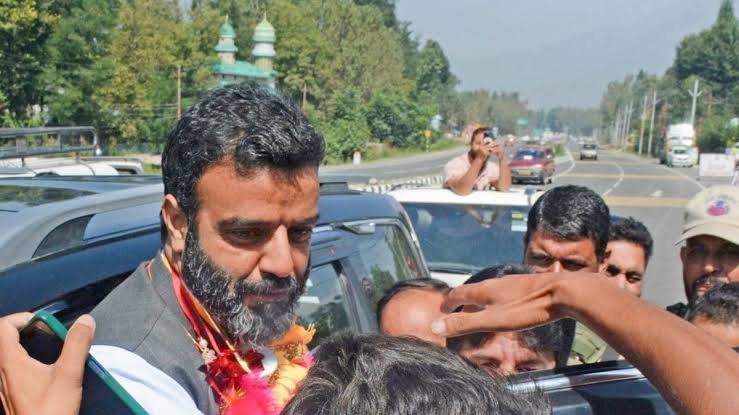
Examiner News Desk | Srinagar:
All eyes are on Budgam today, where Srinagar Lok Sabha MP Aga Syed Ruhullah Mehdi is expected to make a major political announcement during a public gathering at Behisht-e-Zehra (A.S.) Park, organised to mark the death anniversary of his father, Aga Syed Mehdi. The occasion could mark a turning point in Ruhullah’s political career, with his proposed resignation from the National Conference (NC) and the Lok Sabha set to intensify speculation over the future of the Srinagar parliamentary constituency.
The proposed move comes amid an increasingly visible political disagreement between Ruhullah and the NC leadership. What began as differences over specific political and policy issues has developed into a wider debate over the party’s electoral commitments, its approach towards the concerns of the people and the direction of politics in Jammu and Kashmir.
Ruhullah has cited ideological differences and what he describes as the party’s failure to fulfil key electoral promises, including the restoration of Article 370, protection of constitutional rights, resolution of reservation-related concerns and the release of prisoners. His criticism has placed the NC leadership under political pressure to explain its position on commitments made during the 2024 Assembly election campaign.
The gathering at Behisht-e-Zehra Park is expected to provide greater clarity on whether Ruhullah intends to sever his formal association with the party and surrender his parliamentary membership. The political significance of the announcement, however, will extend well beyond his personal decision.
If Ruhullah formally submits his resignation from the Lok Sabha and the Speaker accepts it, the Srinagar parliamentary constituency would fall vacant. Under Section 151A of the Representation of the People Act, 1951, a by-election is generally required to fill a vacancy within six months, subject to specified statutory exceptions.
Such a development would open a new electoral contest in a constituency where Ruhullah secured a substantial mandate in the 2024 Lok Sabha elections. He won 3,56,866 votes, defeating People’s Democratic Party candidate Waheed-ur-Rehman Para, who received 1,68,450 votes. The victory margin stood at 1,88,416 votes.
Ruhullah secured approximately 52.85 per cent of the votes, while Para received around 24.95 per cent. Apni Party candidate Mohammad Ashraf Mir finished third with 65,954 votes, or 9.77 per cent.
These figures provide an important measure of Ruhullah’s electoral standing, but they also raise a significant question: how much of that support was personal, and how much was linked to the National Conference’s organisational network and political identity?
A fresh election would offer the first opportunity to examine that question. If Ruhullah contests as an Independent candidate, he would have to demonstrate that his electoral appeal can survive outside the party structure under whose banner he won the parliamentary seat.
Speculation about Ruhullah floating a new political party or developing an alternative political platform has gained momentum. However, a formal announcement and the details of any proposed organisation would be necessary before its political shape can be assessed.
Launching a political party is one thing; establishing a sustainable political organisation is another. A new platform would require a clear ideological position, an organisational structure, committed workers, leadership beyond a single prominent figure and a programme addressing the concerns of different sections of society.
Ruhullah would also have to explain how his proposed political initiative intends to address issues such as unemployment, reservation policy, political rights, governance, education and the economic challenges confronting Jammu and Kashmir.
The challenge would be particularly significant in a region where political loyalties have traditionally been shaped by established parties, regional identities and local networks. A new organisation would need to build its presence beyond the Srinagar parliamentary constituency and demonstrate that its agenda has relevance across both Kashmir and Jammu.
For the National Conference, Ruhullah’s possible departure would represent a political challenge, particularly because he won the Srinagar seat by a sizeable margin. The party would have to defend its electoral position while responding to questions surrounding the differences with one of its prominent elected representatives.
The NC’s performance in the 2024 Assembly elections provides an important backdrop to the emerging situation. The party won 42 of the 90 elected seats, while its pre-poll ally, the Congress, secured six. The BJP won 29 seats, the PDP three, and the remaining seats went to smaller parties and Independents.
The results demonstrated the NC’s substantial organisational presence, but they also reflected a fragmented opposition landscape. A new political formation led by Ruhullah could potentially alter the equations, although its actual impact would depend on its programme, leadership and ability to mobilise support.
Other political parties, including the PDP, Apni Party and smaller regional formations, would also be watching developments closely. A possible by-election could provide them with an opportunity to reassess their political strategies and seek to consolidate support.
However, it would be premature to assume that the next contest would be limited to a direct NC-Ruhullah confrontation. Candidate selection, alliances, voter participation and the issues dominating the campaign would all shape the electoral landscape.
At the heart of the dispute is a larger question concerning the relationship between electoral promises and political accountability. Ruhullah’s criticism reflects his position that commitments made to voters must remain central to the functioning of a political party even after it assumes power.
The NC leadership, on the other hand, will have its own explanation of the political and administrative constraints facing the elected government. The disagreement therefore goes beyond personalities and touches upon the expectations surrounding the restoration of statehood, constitutional rights and the delivery of political promises.
Ruhullah has also opposed attempts to destabilise the elected government through horse-trading, maintaining that the NC-led government should complete its full five-year term. His position suggests that his differences with the party leadership should not automatically be interpreted as support for efforts to bring down the government.
This distinction is important at a time when political developments in Jammu and Kashmir are closely watched by the public.
Today’s gathering could provide the clearest indication yet of Ruhullah’s political intentions. Whether he proceeds with his proposed resignation, enters the political arena as an Independent or announces plans for a new organisation, the immediate challenge will be to translate his stated differences into a defined political programme.
For the National Conference, the challenge will be to retain its political support and address the questions raised by one of its prominent former representatives. For other parties, the developments may create an opportunity to reassess their positions in Kashmir’s changing political environment.
Ultimately, the significance of the Budgam gathering will not be determined merely by the announcement made from the stage. It will depend on what follows: whether a new political platform emerges, whether it develops an organisational base and whether it can present a credible alternative on the issues that matter to the people.
The coming days may therefore prove consequential for Ruhullah’s political future and the wider political equations in Jammu and Kashmir. The real test will be whether a possible break with the National Conference develops into a broader political initiative or remains an individual political departure.