
By | Syed Salman
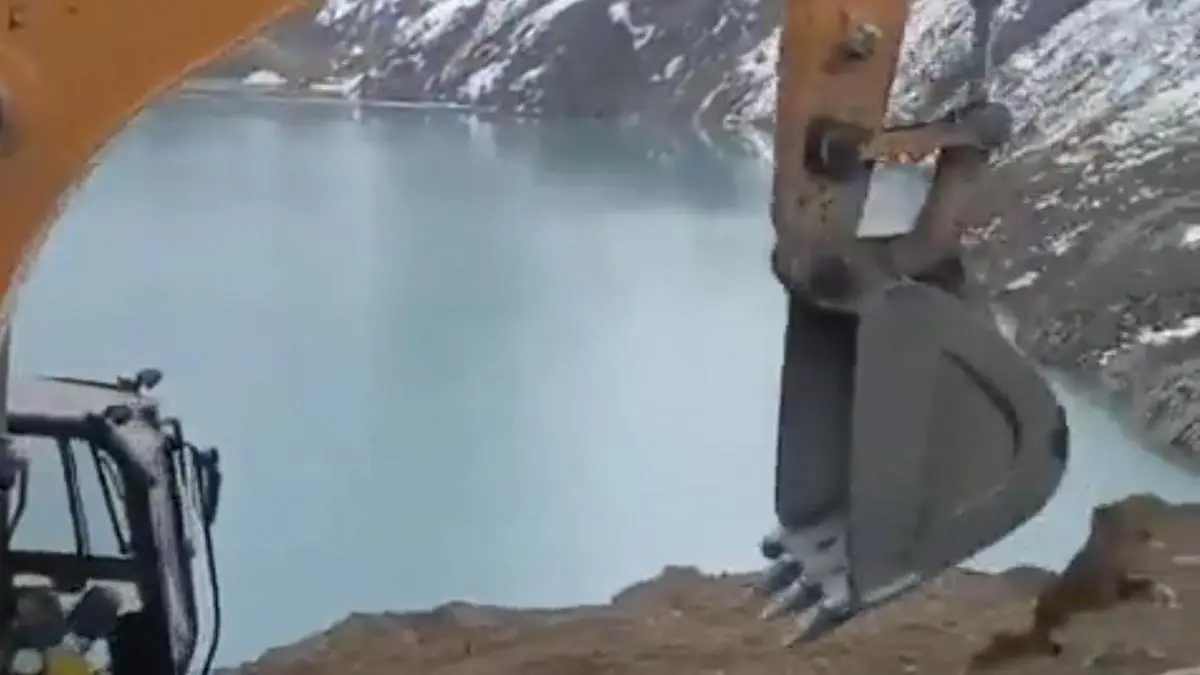
A video showing a heavy excavator cutting and levelling ground near Sheshnag Lake along the Amarnath Yatra route has triggered a major debate in Jammu and Kashmir over the balance between pilgrimage infrastructure and the protection of the region’s fragile Himalayan ecology.
The controversy has brought political leaders, environmental campaigners and religious figures onto a common platform in demanding answers about the nature of the work, the permissions under which it is being carried out and the safeguards adopted to protect the glacial lake and its surrounding landscape.
At the centre of the debate is a fundamental question: can roads and other infrastructure be improved in the high-altitude region without disturbing the natural systems that sustain its lakes, glaciers, slopes and downstream rivers?
The Border Roads Organisation (BRO), which is undertaking the work, has defended its operations, saying the activity forms part of post-Amarnath Yatra maintenance and improvement of the existing track. In its clarification, the organisation said it had started widening the track and stabilising vulnerable stretches to ease congestion and ensure safer passage for pilgrims.
The BRO maintained that claims circulating on social media about new construction were incorrect. It said measures were being taken for safe disposal of excavated material, protection of natural drainage and minimum disturbance to the surrounding terrain.
The explanation, however, has not settled the concerns. Political representatives and environmental voices are seeking details of the project, including its precise location, the extent of excavation, the nature of approvals and whether an independent scientific assessment was undertaken before heavy machinery was deployed in the area.
Situated at an altitude of around 11,800 feet, Sheshnag is a glacier-fed lake in the Pahalgam region and an important stopover along the traditional Amarnath pilgrimage route. Its ecological importance extends beyond its scenic and religious significance.
The lake feeds the Eastern Lidder, one of the two principal tributaries of the Lidder River. The other tributary, the Western Lidder, originates from the Kolahoi Glacier. The streams meet at Pahalgam to form the Lidder River, whose waters support communities, drinking-water supplies and agricultural activity downstream.
This connection makes the protection of the lake and its catchment area a matter of wider public interest. Any intervention that alters natural drainage, increases erosion or affects the movement of sediment could have consequences beyond the immediate construction site.
The terrain around high-altitude glacial lakes can be particularly sensitive. Loose glacial deposits, known as moraine, steep slopes, seasonal snowmelt and changing water flows can make such landscapes vulnerable to disturbance. Excavation and poorly managed disposal of earth and debris may increase erosion, destabilise exposed slopes, obstruct natural drainage channels or carry sediment into nearby streams.
Heavy machinery can also compact or disturb fragile ground and vegetation, while fuel and lubricants present a risk of contamination if not handled properly.
These are recognised environmental risks associated with construction in sensitive mountain terrain. They do not, by themselves, establish that the ongoing work has damaged Sheshnag Lake. Determining the actual impact would require a site inspection, geological assessment, water-quality testing and comparison of conditions before and after the activity.
The concerns assume greater significance in light of the Union Government’s own assessment of glacial lakes in the Himalayan region.
In a written reply to a question in the Rajya Sabha on April 2, 2026, the Ministry of Environment, Forest and Climate Change said the Central Water Commission (CWC) had expanded its monitoring network from 902 glacial lakes and water bodies to 2,843 across the Himalayan river basins. The expanded network includes 76 glacial lakes and 16 other water bodies in Jammu and Kashmir.
The government also informed Parliament that 15 glacial lakes in Jammu and Kashmir had been subjected to risk indexing. Of these, eight were placed in Category 3 and seven in Category 4. Under the CWC’s classification, Category 1 represents the highest risk and Category 4 the lowest.
The risk-indexing process considers factors such as lake size, changes in its area, stability of surrounding slopes, proximity to other glacial lakes and the vulnerability of downstream settlements and infrastructure.
Separately, recent media reports have identified Sheshnag among 14 high-risk glacial lakes in Jammu and Kashmir. The parliamentary reply, however, does not specify Sheshnag’s individual category under the 15-lake assessment. The two figures should therefore not be treated as interchangeable without clarification from the authorities.
The distinction is important. A glacial lake’s vulnerability is assessed through several scientific parameters, and the presence of a lake in a risk inventory does not automatically mean that any particular roadwork has increased its risk of a glacial lake outburst flood (GLOF).
A GLOF occurs when water held in a glacial lake is suddenly released, potentially sending a destructive surge of water, debris and sediment downstream. The likelihood and consequences depend on factors including the stability of the lake’s natural dam, water levels, slope conditions and downstream exposure.
The CWC’s monitoring framework makes it possible to track changes in the water spread of identified lakes. But the impact of a specific construction activity near Sheshnag would need to be established through a separate, site-specific scientific examination.
The controversy has drawn reactions from across the political spectrum, with leaders differing in their emphasis but raising concerns over the need to protect the region’s natural heritage.
Former Chief Minister and Peoples Democratic Party (PDP) president Mehbooba Mufti criticised the government’s response to what she described as unchecked construction in ecologically sensitive areas. Referring to the wider pattern of infrastructure development in Kashmir, she warned that the region could face consequences similar to those witnessed in other Himalayan states.
She also expressed concern that raising questions about construction near Sheshnag could be portrayed as opposition to the Amarnath Yatra, arguing that environmental protection should not be turned into a political or religious controversy.
National Conference MP Mian Altaf Ahmed, while saying he had not personally seen the video, stressed the need to protect Kashmir’s lakes, rivers and forests. He said these natural resources were essential not only for the environment but also for tourism and public health.
CPI(M) legislator and Chairman of the Jammu and Kashmir Legislative Assembly’s Committee on Environment, Muhammad Yousuf Tarigami, called for an immediate halt to any activity that could threaten the lake and its surroundings until the matter was examined by experts.
Tarigami said the terrain around Sheshnag, with its loose moraine and steep slopes, was vulnerable to disturbance. He sought details of the project, the executing agency and the clearances obtained, and called for an inspection by glaciologists and environmental experts.
Apni Party president Altaf Bukhari also sought a clear explanation from the authorities. He said that if the video showing heavy machinery near the lake was genuine, the government owed the public an account of the purpose of the work and the safeguards in place.
Former Srinagar MP Syed Aga Ruhullah criticised the use of heavy machinery near the lake and questioned the approach to infrastructure development in the Himalayan region.
Mirwaiz-e-Kashmir Moulvi Muhammad Umar Farooq described the visuals as disturbing and said improving facilities for pilgrims should not come at the cost of the fragile ecosystem. He called for the immediate protection of the mountains, glaciers and water bodies around the pilgrimage route.
PDP spokesperson Mohit Bhan also questioned the apparent contradiction between the religious significance of Sheshnag and construction activity that could disturb its natural surroundings. He argued that faith and ecological protection were complementary rather than competing concerns.
Environmental campaigners, including Raja Muzaffar Bhat and representatives of the Environmental Policy Group, have sought transparency about how heavy machinery reached the glacial zone, what work was authorised and what environmental safeguards were followed.
The issue took a further political turn on Tuesday when Mehbooba Mufti alleged that police stopped her from proceeding towards Sheshnag. She said the incident had reinforced her concerns about construction activity in the fragile glacial region.
In a post on X, she said questions surrounding the work were growing and called for the Amarnath Cave, the annual pilgrimage and the surrounding mountains to be protected as one ecological unit.
The police action added to the controversy, with the PDP chief seeking greater transparency over the activity near the lake. Police reportedly cited security reasons for stopping her at Chandanwari.
The BRO has maintained that the work is intended to improve the existing Amarnath track, stabilise vulnerable stretches and make the route safer for pilgrims. It has also stated that environmental safeguards, including proper disposal of excavated material and protection of natural drainage, are being followed.
Improving access and safety on a demanding high-altitude pilgrimage route is a legitimate public requirement. The annual Yatra involves thousands of pilgrims, support personnel and service providers, and vulnerable stretches of the route require careful maintenance.
However, the question is not simply whether infrastructure is needed. It is whether the nature, scale and location of the work are scientifically justified and whether the safeguards are adequate for a glacial landscape.
Several questions now require clear answers. What is the exact distance between the excavation site and the lake’s shoreline and drainage channels? How much earth has been cut and where is the excavated material being deposited? Has the work been examined by glaciologists, geologists or other independent experts? What permissions and environmental assessments were obtained, wherever required? Is the water quality being monitored, and has the stability of the surrounding slopes been assessed?
An independent inspection involving the relevant departments, glaciologists, geologists and environmental experts could help establish the facts. Publishing the project details, site maps, approvals, excavation quantities and debris-disposal plan would also help address public concerns.
The authorities could further consider baseline and periodic testing of the lake and nearby streams for turbidity, suspended sediment and possible contamination, along with monitoring of slope movement and drainage patterns.
The Sheshnag controversy is part of a wider challenge facing the Himalayan region, where infrastructure expansion, tourism, pilgrimage and climate change are placing increasing pressure on fragile mountain environments.
The lesson from previous disasters in the Himalayas is not that all construction must stop, but that development in sensitive terrain must be based on sound scientific planning, transparent decision-making and continuous monitoring. Road widening, slope stabilisation and drainage works can themselves be designed in ways that reduce risk, provided the location and engineering methods are appropriate.
For Kashmir, Sheshnag is more than a scenic stop on the Amarnath route. It is part of a connected mountain ecosystem whose waters feed the Lidder basin and whose landscape carries deep religious, cultural and environmental significance.
The immediate need is to establish, through independent technical assessment, whether the work near the lake is consistent with the ecological safeguards claimed by the BRO. If the work is found to pose a risk, corrective measures must follow. If it is scientifically justified and adequately protected, the authorities should make the evidence public.
The debate should not be reduced to development versus environment, or pilgrimage versus conservation. The safety of pilgrims and the protection of the landscape are both public responsibilities. The long-term test of any project near Sheshnag will be whether it makes the route safer without putting the lake, its catchment and the communities downstream at risk.