Agencies | New Delhi:
BRICS member states have reached an agreement on a joint declaration that is expected to condemn unilateral military action without naming any country, four sources familiar with the discussions told Reuters on Saturday.
The agreement comes as the expanded grouping seeks to bridge differences between Iran and the United Arab Emirates (UAE), which have taken opposing positions amid the ongoing conflict in West Asia.
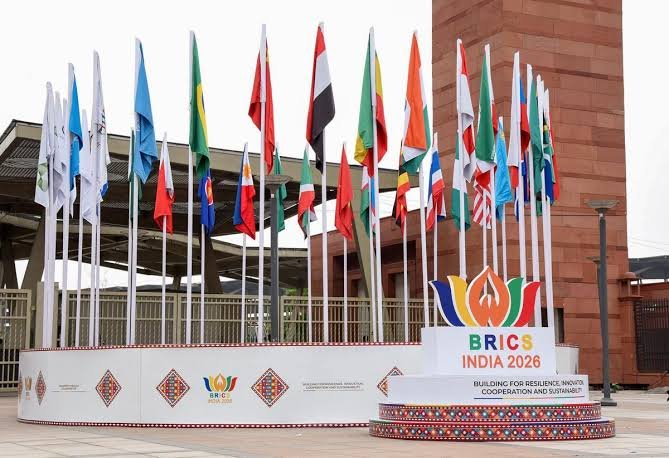
The annual BRICS Summit is being held in New Delhi this weekend, bringing together Brazil, Russia, India, China, South Africa, Egypt, Ethiopia, Indonesia, Iran and the UAE. Leaders are expected to formally approve the joint declaration on Saturday.
The West Asia crisis has emerged as a major diplomatic challenge for BRICS, with disagreements between Iran and the UAE complicating efforts to reach consensus on the summit statement.
The conflict has also severely disrupted shipping through the Strait of Hormuz, a critical route for global oil supplies, while crude prices have risen above $100 a barrel.
The UAE, which has faced Iranian missile attacks since the conflict began, suspended all trade and financial transactions with Iran in August.
The differences had earlier hampered efforts to draft a joint BRICS declaration. Kremlin spokesman Dmitry Peskov said the Iran-UAE dispute had a “negative impact” on the process, while expressing hope that the leaders would eventually agree on language acceptable to all members.
In May, BRICS foreign ministers failed to issue a joint statement following their meeting in New Delhi because of differences between Iran and the UAE. India subsequently issued a chair’s statement acknowledging that member states held “differing views”.
Reaching agreement on a joint declaration would mark a significant diplomatic achievement for India as BRICS chair, as well as for the grouping’s Sherpas involved in negotiating the text.
According to sources cited by Reuters, India has sought to keep the focus on regional stability while ensuring that the West Asia conflict does not overshadow BRICS’ broader economic agenda.
India’s proposed language included condemnation of “unprovoked aggression” without identifying any country, reaffirmation of sovereignty and the principles of the UN Charter, opposition to the use or threat of force, protection of civilians and critical infrastructure, and support for dialogue, diplomacy and freedom of navigation.
Indian officials, along with representatives from Russia, Brazil and Egypt, have held separate consultations with Iranian and UAE officials in an effort to find wording acceptable to both sides.
Iran had sought explicit condemnation of US-Israeli attacks and Western sanctions, while the UAE wanted the declaration to acknowledge Iranian missile and drone attacks on Gulf territory and facilities.
The eventual agreement to avoid naming individual countries appears aimed at allowing BRICS members with sharply differing positions on the conflict to endorse a common statement while preserving the grouping’s broader agenda of economic cooperation, development and multilateral diplomacy.